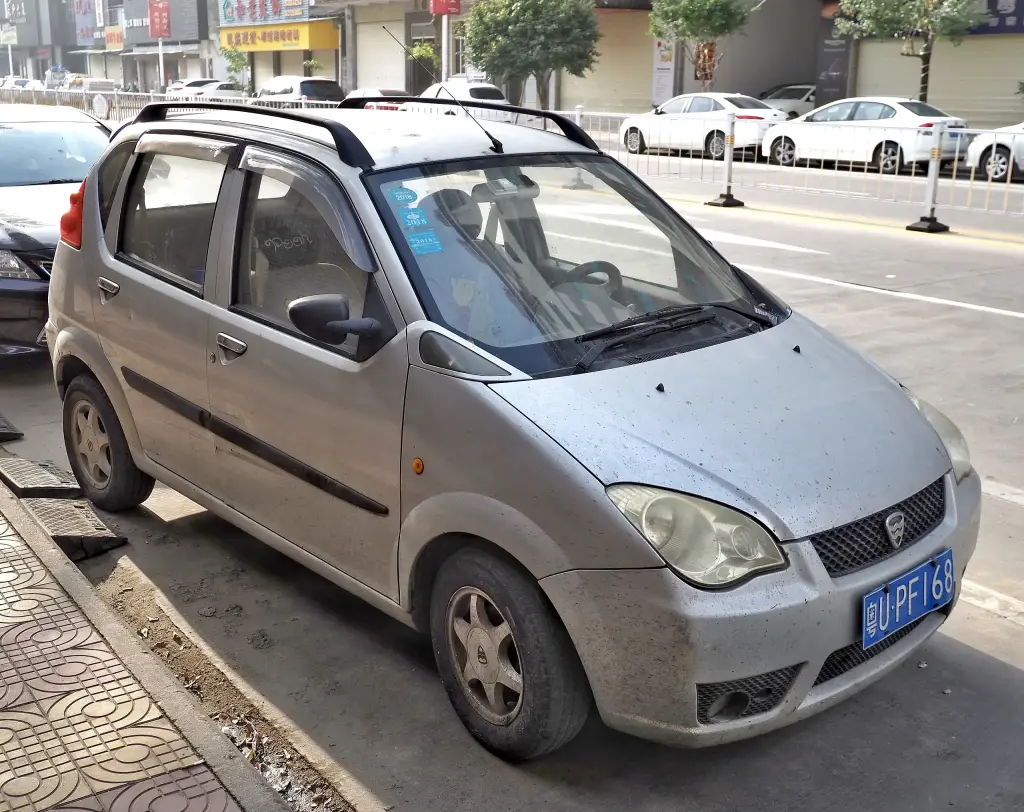
The Hafei Lobo (“treasure on the road” in Chinese) was a small city car presented at the 2002 Beijing Motor Show and built by Hafei Motor in Harbin until 2011. Its body was drawn by Pininfarina and its chassis came from the British company Lotus.
Hafei Lobo at a glance
| Maker | Hafei Motor, Harbin, China |
|---|---|
| Production | 2002–2011 |
| Class | City car |
| Design | Pininfarina, shown at the Beijing Motor Show 2002 |
| Chassis | sourced from Lotus |
| Engine 1.0 | DA465Q-2, 8 valves, 33.5 kW / 45 hp, Euro II |
| Engine 1.1 | DA468Q, 16 valves, 48 kW / 64 hp |
| Drive | front-wheel drive, manual or automatic |
| Names abroad | Hafei Brio (Russia), Micro Trend (Sri Lanka), Naza Sutera (Malaysia), Naza Forza (Thailand) |
| Facelift | 2007 styling update; another for 2010, minor update 2011 |
| Sales in China | 223,817 between 2003 and 2015 |
| Crash test | two stars in C-NCAP |
History of the Hafei Lobo
The Lobo grew out of a design study Pininfarina showed as the Metrocubo concept of 1999; the production body shares clear similarities with it and was unveiled on the Beijing Motor Show stand in 2002. Hafei turned to Lotus for the chassis and helped tune the handling. The car was launched with a target of 100,000 cars a year.
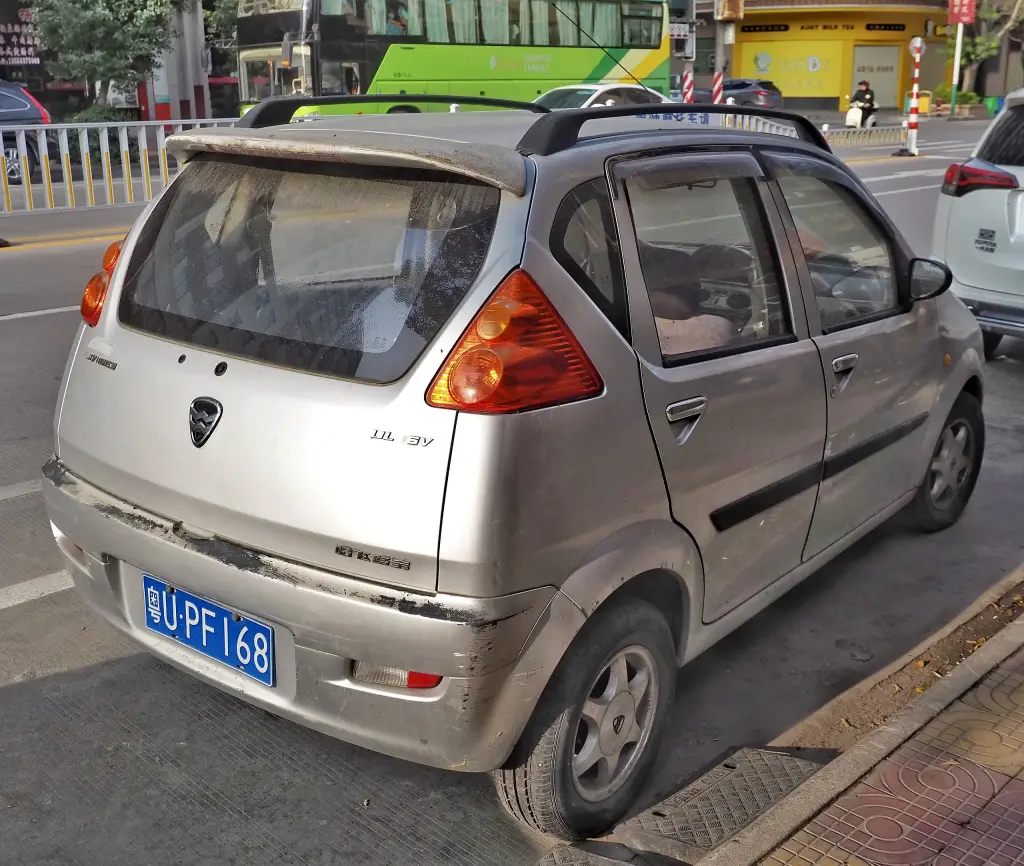
Its most distinctive details are the indicator repeaters mounted in the A-pillars and the tall, triangular tail lights. Inside, the quality of the trim was criticised as unrefined, while the better-equipped versions came with air conditioning, central locking, electric front windows and power steering.
A 2007 model update changed the front and rear ends slightly. A facelift for the 2010 model year brought a new nose that strongly resembled the second-generation Toyota Vitz, and a minor update followed in 2011. Production ended after the 2011 model year, though cars continued to be sold in China; between 2003 and 2015 the model accounted for 223,817 sales there, with the numbers falling sharply after 2010.
The Lobo was exported widely. In Russia it was sold as the Hafei Brio, in Sri Lanka it was built from 2005 with the 1.0-litre engine as the Micro Trend, and in Malaysia Naza assembled it as the Naza Sutera, which was also sold in Thailand as the Naza Forza. In a C-NCAP crash test the car managed only two stars, and at least the South African cars had neither ABS nor airbags.
Design and features
- Pininfarina body: a small five-door hatchback drawn by the Turin studio, with a shape close to the 1999 Metrocubo concept.
- Lotus chassis work: the British company supplied the platform and took part in fine-tuning the handling.
- Small petrol engines: a 45 hp 1.0 and a 64 hp 1.1, both driving the front wheels.
- Many names: Brio, Micro Trend, Naza Sutera and Naza Forza in different markets.
Hafei Lobo versions
- Lobo 1.0 (2002–2011): the base eight-valve engine of 45 hp.
- Lobo 1.1 (2002–2011): sixteen-valve unit of 64 hp, also offered with an automatic gearbox.
- 2007 update: lightly revised front and rear ends.
- 2010 facelift: new front fascia resembling the second-generation Toyota Vitz.
The Lobo was launched in Chile in 2007 together with the Hafei Zhongyi microvan and the Hafei Ruiyi pickup. More cars are in the Hafei collection.
Video: Hafei Brio yellow
Video on YouTube.
Sources
- Hafei Lobo, English Wikipedia: design, engines, export names, facelifts
- Hafei Lobo, German Wikipedia: Beijing show, details, production totals, crash test