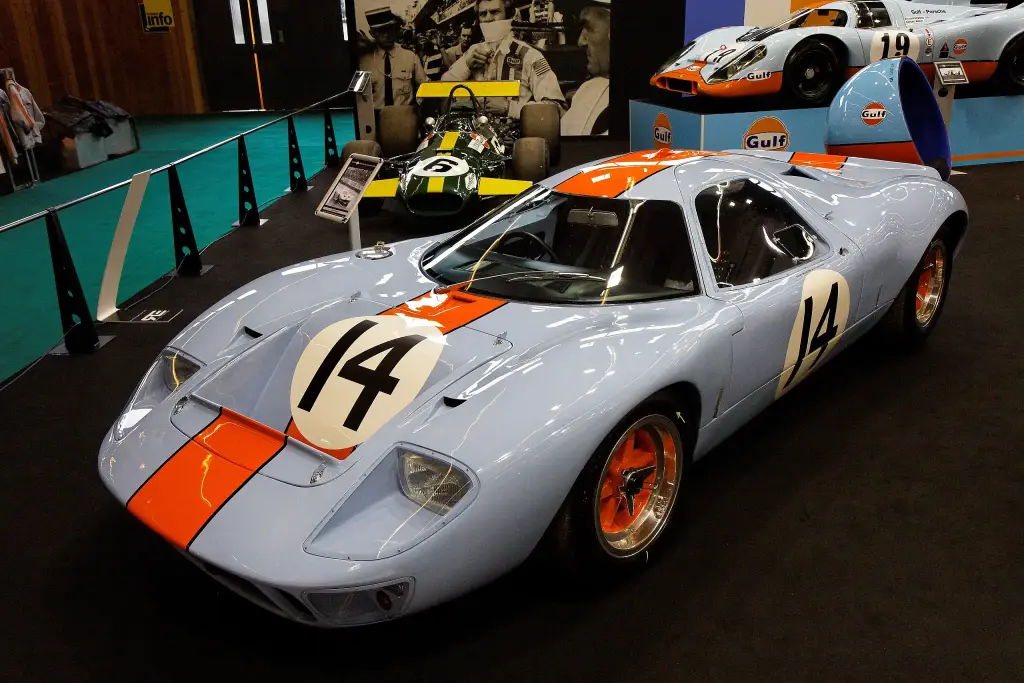

The Gulf Mirages were a family of sports racing cars built by J.W. Automotive Engineering at Slough in England, the first of them a reworked Ford GT40 entered in the powder blue and marigold colours of Gulf Oil. The line ran from the M1 of 1967 to the GR8 that won the 24 Hours of Le Mans in 1975.
Gulf Mirage at a glance
| Builder | J.W. Automotive Engineering (JWAE), Slough, England |
|---|---|
| Also known as | Mirage Lightweight Racing Car |
| First model | Mirage M1, first run 21 March 1967 |
| M1 basis | Ford GT40 Mk I chassis, project by Len Bailey |
| M1 engine | 289 cu in V8 at first, up to 5.7 litres by Le Mans |
| Body | carbon fibre combined with fibreglass, a first in racing |
| Le Mans win | 1975, Mirage GR8 |
| Le Mans 1974–1978 | never outside the top ten: one first, two seconds, a third, fourth, fifth and tenth |
| Team colours | Gulf Oil powder blue and marigold |
| After 1975 | Gulf and John Wyer withdrew; Harley Cluxton III took over the cars |
Based on one source, the English Wikipedia article on the Mirage racing car, which covers the Gulf Mirages built by J.W. Automotive.
History of the Gulf Mirage
Origins: a lighter GT40
The project started in the spring of 1967, after Ford decided to discontinue the GT40 programme. John Wyer bought an earlier project by the English designer Len Bailey, which aimed to improve the aerodynamics, mass and suspension of the GT40 Mk Is. During preliminary tests for the 24 Hours of Le Mans that year, two cars that looked like Ford GT40s appeared in Gulf Oil colours; they were in fact Mirages based on the Ford GT40 Mk I, which Ford had dropped in favour of a newer car. The Mirage M1 made its first run on 21 March 1967, with Le Mans as its first real test. The team had already won the 1,000 kilometres of Spa and carried the winning run on to Sweden, Paris and Kyalami; in the Le Mans preliminary tests the two M1s were quicker than the GT40s but retired from the race itself.
The M1 season
The M1 used a standard Mk I chassis with the front bulkhead squared off and a new, more sleek greenhouse and body. Carbon fibre was used alongside fibreglass body panels, a first in motor racing, and the same technique was carried over to the GT40s JWAE ran in 1968 and 1969. A 289 V8 was fitted at first, but by Le Mans the engine had grown through various capacities up to 5.7 litres. The car was not ready for the first two rounds of the 1967 World Sports Car Championship, so Grady Davis’s own GT40 (chassis P1049) stood in, finishing sixth at the Daytona 24 Hours and dropping out at Sebring. When the Mirage appeared it wore powder blue and marigold instead of the team’s earlier deep metallic blue, and that combination became inseparable from Gulf racing. The highlight of the M1’s short career was victory in the rain-soaked 1967 Spa-Francorchamps 1,000 km for Jacky Ickx and Dick Thompson, together with the Kyalami 9 Hours. At the end of 1967 Group 6 cars of over five litres with fewer than 50 examples built were banned; JWAE argued that the Mirage was a reworked GT40 so that it could run in Group 4 for 1968, but without success. Three M1s were built: M10001 is the only survivor in original form, M10002 was destroyed after Dick Thompson’s accident in practice for the 1967 Nürburgring 1,000 km, and M10003 was turned back into one of the three lightweight Gulf GT40s (P/1074).
GR8 and Le Mans 1975
In 1972 John Wyer took the project up again for the World Sportscar Championship, to replace the Porsche 917, which no longer met the new regulations. After three years of development a Mirage GR8 won the 1975 24 Hours of Le Mans. Following that victory Gulf and John Wyer decided to withdraw from competition, and the structure was taken over by Harley Cluxton III, who raced the Renault V6 turbo GR8 in 1976 and 1977.
The record at Le Mans
From 1974 to 1978 the Mirages never finished outside the top ten at Le Mans, posting a first, two seconds, a third, a fourth, a fifth and a tenth. They were the first cars to wear Gulf Oil’s powder blue and marigold livery, the first to take race wins for Gulf, and the last to win the 24 Hours outright for the company. Along with Rondeau, Mirage is one of only two independently constructed racing car marques to have won Le Mans overall since endurance racing returned after the Second World War in 1949.
Design and features
- GT40 foundation: Len Bailey’s project reworked the Ford GT40 Mk I for less weight and better aerodynamics and suspension.
- Carbon and fibreglass body: the first racing car to combine the two materials in its bodywork.
- Flexible V8 power: from a 289 cu in engine at first to capacities up to 5.7 litres by Le Mans in 1967.
- Gulf livery: powder blue with a marigold stripe, worn for the first time by a Mirage.
- Le Mans record: top-ten finishes every year from 1974 to 1978, including the 1975 victory.
Gulf Mirage versions
- Mirage M1 (1967): the GT40-based original, three chassis built.
- Lightweight Gulf GT40 (P/1074): the car to which the third M1 chassis, M10003, was reverted.
- Mirage GR8: the car that won the 24 Hours of Le Mans in 1975.
- Renault V6 turbo GR8 (1976–1977): run by Harley Cluxton III after Gulf and Wyer withdrew.
Other racing cars of the period are gathered in the Gulf collection.
Video: Le Mans Classic 2014: Mirage Gulf on track
Video on YouTube.
Sources
- Mirage (race car), English Wikipedia: history, M1, Le Mans record