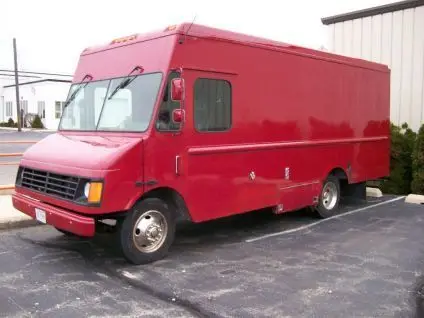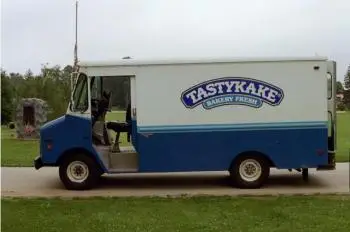
The Grumman-Olson van was the all-aluminium walk-in step van that gave the company its name. From the J.B.E. Olson Corporation of 1946 to the Morgan Olson of today, the same basic idea — a light aluminium body on a commercial chassis — was sold as the Kurb Side, Kurb Van, Kurbmaster, Kubvan and Route Star.
Grumman-Olson Van at a glance
| Maker | Olson / Grumman Olson |
|---|---|
| Under the Grumman Olson name | 1946–2004 |
| Type | aluminium walk-in step van |
| Body | all-aluminium |
| Model names | Kargo King, Kurb Side, Kurb Van, Kurb Van King, Kurbmaster, Kubvan, Route Star, Freight Star |
| Home plant | Sturgis, Michigan, from 1963 |
| Other plants | Loudon, Tennessee (2015), Ringgold, Virginia (2020) |
| Owner from 2003 | JB Poindexter (JBPCO) |
| Company renamed | Morgan Olson, 2004 |
There is no Wikipedia article on a Grumman-Olson van as such; the vans are listed among the products of Morgan Olson in the English Wikipedia article on the company, which is the only source here. Based on one source.
History of the Grumman-Olson Van
The idea and the first company
The aluminium walk-in van began with Walter Heingartner, owner of Kinney Motors Chevrolet in Brooklyn. He saw ten independent laundry companies in Brooklyn alone as a market for a light delivery van, and through his friend Jimmy Olson met Jake Swirbul, one of Grumman’s founders. Grumman Aircraft Engineering was to build the van from 1939, but the Second World War stopped the plan. After the war Olson and three partners formed the J.B.E. Olson Corporation on Coney Island Avenue in Brooklyn, and the first vans followed in 1946.
A long list of van names
Over the following decades the company sold its vans under a changing set of names: the Kargo King from 1946, the Kurb Side, the Kurb Van and Kurb Van King, the Kurbmaster from the 1950s to 1990 with a Junior Kurbmaster beside it, and the small Olsonette of 1955 to the 1960s. Later came the Kubvan of 1983–1985, the Grumman LLV of 1986–1994, the Route Star from 1990 with its Freight Star cutaway version, and today the C250 mail and parcel truck.
Growth, bankruptcy and a new name
The company bought its Sturgis, Michigan plant, still the headquarters, in 1963. In 1984 it won its largest contract, a United States Postal Service order worth over one billion dollars; by early 2016 some 163,000 Grumman LLVs were still in operation. After changes of ownership in the 1990s the market declined and the company went bankrupt in 2001. JB Poindexter, Inc. bought it in 2003 and renamed it Morgan Olson in 2004; since then plants have opened at Loudon, Tennessee in 2015 and Ringgold, Virginia in 2020.
Design and features
- All-aluminium body: the aluminium walk-in van was the company’s founding idea and stayed its signature.
- Walk-in step van: a body entered from the kerb and walked through, built for multi-stop delivery rounds.
- One idea, many names: Kurb Side, Kurb Van, Kurbmaster, Kubvan, Route Star and more were versions of the same concept.
- Still in production: under the Morgan Olson name the company builds walk-in step vans at three plants.
Grumman-Olson Van versions
- Kargo King (from 1946): the first van of the Olson company.
- Kurb Side, Kurb Van, Kurb Van King: the early Kurb family.
- Kurbmaster and Junior Kurbmaster (1950s–1990): the long-running vans of the range.
- Olsonette (1955–1960s): a small class 1 van.
- Kubvan (1983–1985): a short-lived model.
- Route Star and Freight Star (from 1990): the later vans, the Freight Star a cutaway version of the Route Star.
The two best-known models of the range are the Kurbmaster and the P-800. More vehicles are in the Grumman-Olson collection.
Sources
- Morgan Olson, English Wikipedia: company history, products list, plants