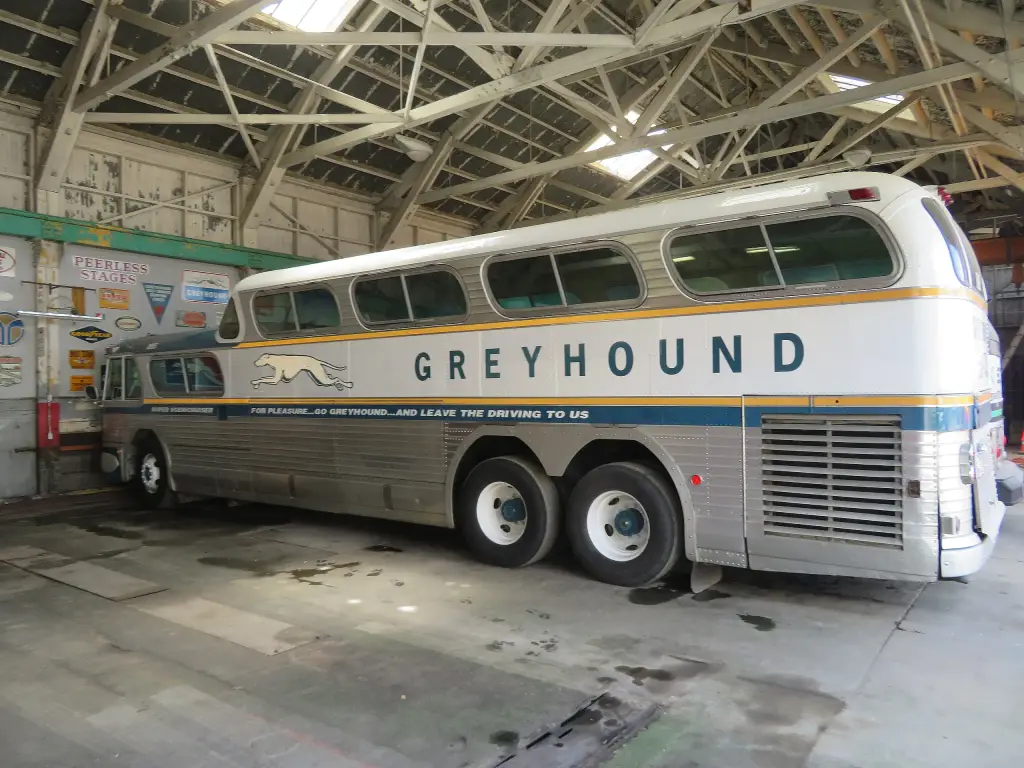
The GMC PD-4501 Scenicruiser was a three-axle monocoque two-level coach that General Motors built for Greyhound Lines. Greyhound used it from July 1954 into the mid-1970s, and 1,001 were made between 1954 and 1956.
GMC Scenicruiser at a glance
| Model | GMC PD-4501 |
|---|---|
| Built for | Greyhound Lines |
| Production | 1954-1956, 1,001 coaches |
| Service | from July 1954 into the mid-1970s |
| Body | three-axle monocoque, two levels |
| Wheels | ten, four on each rear axle |
| Driven axle | the forward of the two rear axles |
| Engines | two Detroit Diesel 4-71, 160 hp each |
| Transmission | three-speed with two-speed clutch, six forward speeds |
| Rebuild | 8V-71 and Spicer four-speed for 979 coaches in 1961-62 |
| Suspension | air ride |
| Named after | scenic and cruiser |
Based on one source, the English Wikipedia article on the PD-4501 Scenicruiser.
History of the GMC Scenicruiser
Seven years of work
The Scenicruiser was the result of seven years of effort by Greyhound and the GM Truck and Coach Division, and the Model PD-4501 became the most distinctive American parlor bus design of the modern era. The first GX-1 prototype followed a design by Raymond Loewy, US patent 2,563,917. It was a true double decker with access from the lower deck and the driver seated on the upper deck, but it was soon decided that a split-level design would be better because the GX-1 was too tall for many Greyhound garages and lacked luggage space for 50 people. The GX-2 had the driver’s area, entrance, ten seats and a restroom on the lower level and 33 seats above, which also left room for a large baggage compartment beneath the second level. Both prototypes were built by Greyhound from 1947 to 1949 with help from GMC.
The production coach
In late 1951 GMC began work on its own prototype, the EXP 331, which was completed in 1954 with features that did not reach production. The Scenicruiser had air-ride suspension and air conditioning, and it was unusual in having ten wheels: each of the two rear axles carried four, but only the forward one was powered. Power came from a pair of GM Diesel 4-71 four-cylinder engines of 160 hp each, connected by a fluid coupling and arranged side by side in a shallow V, because GM had not yet built a V8 version of the Series 71 diesel. Each coach had one three-speed transmission with a manual two-speed clutch, giving six forward speeds. Drivers used to four-speed manuals found the arrangement awkward, and the twin-engine installation proved less than successful: the 979 coaches remaining in 1961-62 were rebuilt with 8V-71 engines and Spicer four-speed manual transmissions by Marmon-Herrington.
Problems and fixes
The Scenicruiser had significant early problems, particularly with the drivetrain and with cracking of the frame structure around the side windows in the rear quarter. Maintenance was difficult thanks to complicated new systems, unproven components, inadequate diagnostic tools and limited mechanic training. One fault was solved in the factory while the 1955 models were being built: the original clutch was electrically operated, so drivers could not engage it smoothly, and the electrical linkage was replaced with a mechanical one. The coach’s popularity with the public later inspired GM’s PD-4107 and PD-4903 Buffalo models, which arrived nearly a decade later with a less obvious second level and were available to all operators rather than only Greyhound.
Design and features
- Split-level body: a lower deck for the driver and ten passengers and an upper deck for 33 more.
- Ten wheels: four on each rear axle, with only the forward rear axle driven.
- Air suspension and air conditioning: a high standard of comfort for 1954.
- Twin engines: two 4-71 diesels coupled together before the 8V-71 rebuild.
- Monocoque construction: a stressed body rather than a separate chassis.
GMC Scenicruiser versions
- GX-1 prototype (1947-1949): the original double-decker with the driver upstairs.
- GX-2 prototype: the split-level layout that reached production.
- EXP 331 (1954): GMC’s own prototype with features dropped from the production coach.
- Production Scenicruiser (1954-1956): 1,001 coaches with twin 4-71 engines.
- Rebuilt coaches (1961-62): 979 buses converted to the 8V-71 and a Spicer four-speed.
The Scenicruiser was the most famous coach of the era that also produced the PD-4104, and its stressed-skin construction was carried into the GMC New Look city bus. More buses are in the GMC collection.
Sources
- PD-4501 Scenicruiser, English Wikipedia: prototypes, production, drivetrain, problems, influence