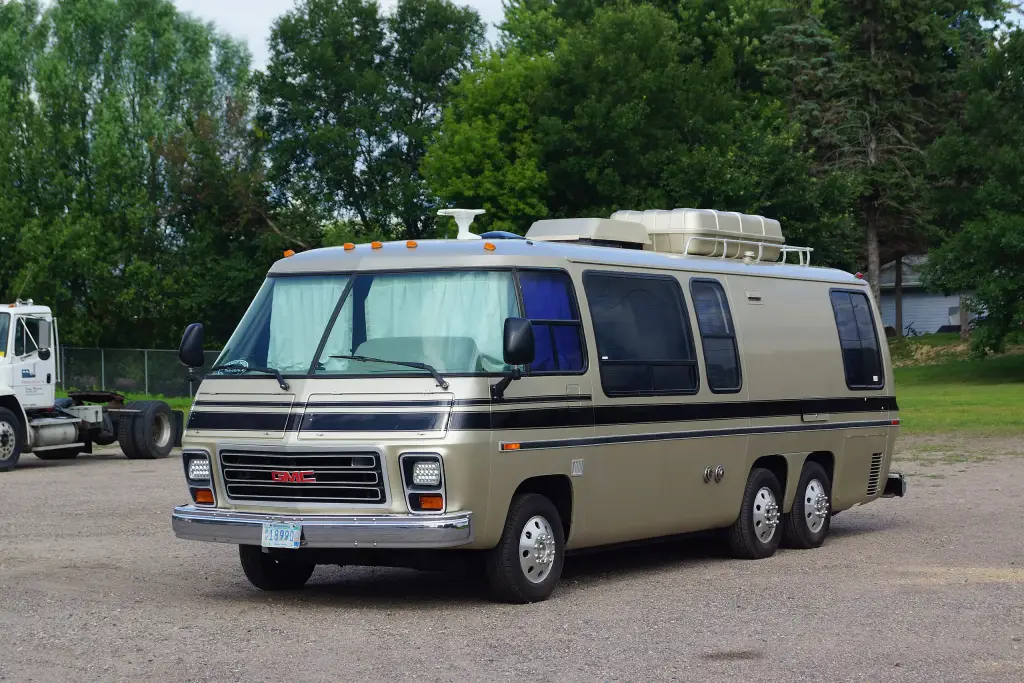
The GMC Motorhome is a recreational vehicle that the GMC Truck & Coach Division of General Motors built for the 1973 to 1978 model years in Pontiac, Michigan. It was the only complete motorhome built by a major car or truck manufacturer, and it was offered in 23 and 26 ft lengths.
GMC Motorhome at a glance
| Production | 1973-1978 model years |
|---|---|
| Built at | Pontiac, Michigan |
| Lengths | 23 ft and 26 ft; about 90 percent were 26 ft |
| Width | 96 in |
| Height | about 9 ft with roof air conditioning |
| Wheelbase | 140 in (23 ft) or 160 in (26 ft) |
| Engine | Oldsmobile 455 cu in V8, 403 cu in from mid-1977 |
| Transmission | Turbo-Hydramatic 425 automatic |
| Drive | front-wheel drive through a transaxle |
| Brakes | front discs, rear drums |
| Gross vehicle weight | 10,500 lb (23 ft) or 12,500 lb (26 ft) |
| Internal name | TVS-4, Travel Vehicle Streamlined |
Based on one source, the English Wikipedia article on the GMC Motorhome.
History of the GMC Motorhome
Origins
Industry rumours that GM was going to build a motorhome had circulated for some time, and on 7 February 1972 the company made it official. Around that time the vehicle was known as the TVS-4, for Travel Vehicle Streamlined. Twelve designers worked with sketches and 1/8-scale clay models, refining the shape until full-size drawings could be made with quarter-inch tape; those guided a full-scale 26-foot clay model, which was polished and covered with a silver-blue film to imitate paint before plaster casts and early fibreglass prototypes were produced.
Chassis and drivetrain
The motorhome used a front-wheel-drive transaxle that GM called the Unitized Power Package, already used in the Oldsmobile Toronado and Cadillac Eldorado, with the Oldsmobile 455 cu in V8 from the Toronado; in mid-1977 the engine was downsized to 403 cu in. Power went through the Turbo-Hydramatic 425 automatic transmission with a wide roller chain connecting the longitudinally mounted engine to the transmission, and then to the front wheels through half-shafts, one of which ran under the front of the engine. Fuel was carried in two 25-US-gallon tanks. Front brakes were discs and all four rear wheels had drums.
The low floor and rear bogies
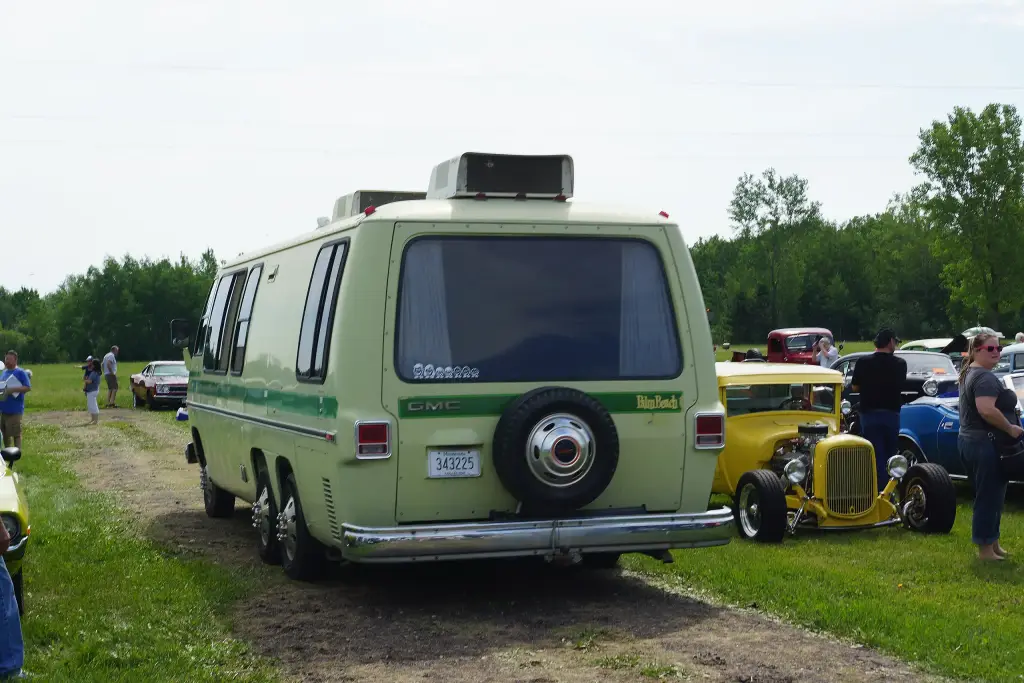
Front-wheel drive removed the driveshaft, rear differential and solid rear axle found on most front-engined motorhomes, so the floor could sit about 14 inches above the road. That was too low for a rear cross axle, so GM designed the rear suspension as a tandem pair of wheels on bogies riding on pins attached to the sides of the low frame. Apart from the wheel wells the rear suspension does not intrude into the living space. The bogies use double-ended reversible sleeve airbags pressurised by an automatic levelling system that keeps the designed ride height and can be controlled manually to level the coach at a campsite. This combination of an existing GM powertrain with a modified rear suspension has been described as an early ancestor of the crossover.
Body and equipment
The body frame was made of welded aluminium extrusions mounted on a steel ladder chassis through body isolators. The floor was marine plywood except at the sloping extremities, which were aluminium plate, and the panels were bonded to the frame with adhesive: fibreglass below the waistline and at the ends, sheet aluminium for the upper sides and roof. The large expanse of windows redefined the RV industry at the time. Equipment often matched the upper models of GM’s car brands, including cruise control, air conditioning, AM/FM/8-track sound and air suspension. Rear lower compartments held Onan generators of 4,000 or 6,000 watts and propane tanks, and there were no front doors for driver or passenger.
Design and features
- Front-wheel drive: a Toronado-derived transaxle with no driveshaft to the rear.
- Low floor: about 14 inches above the road for easier entry.
- Air-sprung tandem rear: bogies with automatic levelling and manual campsite control.
- Integrated body: aluminium frame, fibreglass and aluminium panels bonded in place.
- Bare shells: empty bodies were supplied to other firms for custom conversions, from ambulances to mobile training facilities.
GMC Motorhome versions
- 23-foot Motorhome: the shorter body with a 140-inch wheelbase.
- 26-foot Motorhome: the standard body, about 90 percent of production, 160-inch wheelbase.
- 455 cu in models (1973-1977): the original Oldsmobile V8.
- 403 cu in models (1977-1978): the downsized engine of the final years.
- Custom shells: bodies supplied for mail delivery, people movers and ambulances.
The Motorhome shared its front-wheel-drive idea with the later GMC Acadia, GMC’s first front-wheel-drive passenger vehicle after it. More vehicles are in the GMC collection.
Sources
- GMC Motorhome, English Wikipedia: design, drivetrain, suspension, body, dimensions