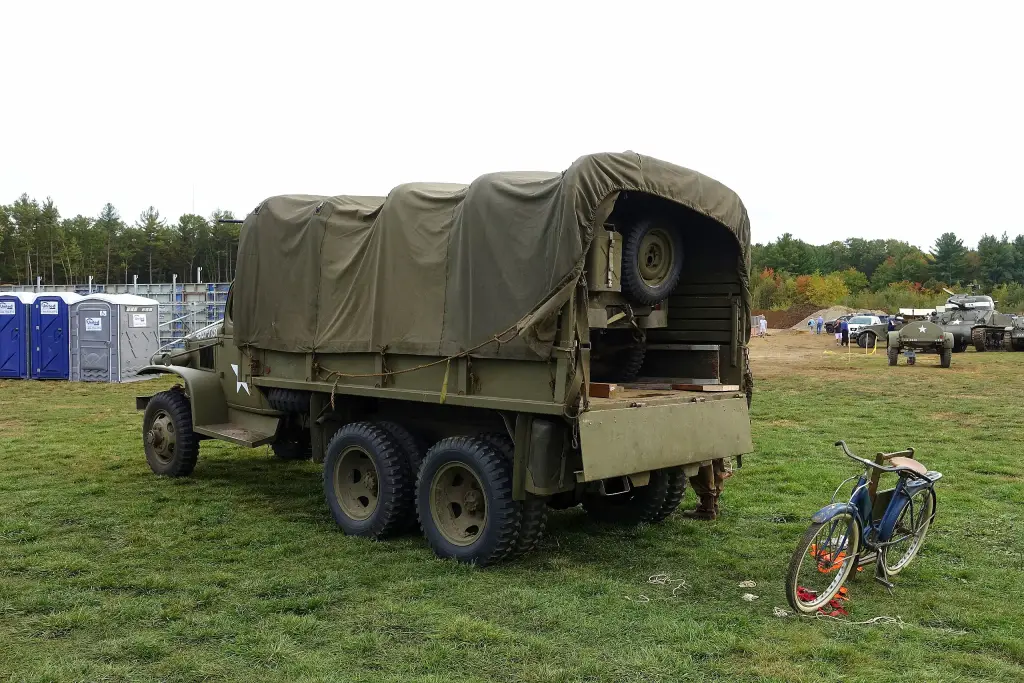
The GMC CCKW, nicknamed Jimmy and known to the US Army as the G-508, was a series of 2.5-ton 6×6 trucks built to a standard design between 1941 and 1945. It was the original Deuce and a Half and formed the backbone of the Red Ball Express that supplied the Allied armies as they pushed east after the Normandy invasion.
GMC CCKW at a glance
| Class | 2.5-ton 6×6 cargo truck |
|---|---|
| Production | 1941-1945 |
| Built by | Yellow Truck and Coach, Pontiac, Michigan; later a Chevrolet plant in St. Louis |
| Engine | GMC 270, 4.4 L overhead-valve straight-six |
| Power | 91.5 or 104 hp at 2,750 rpm |
| Torque | 216 lb-ft at 1,400 rpm |
| Gearbox | Warner T93 five-speed |
| Wheelbase | 145 in (CCKW-352) or 164 in (CCKW-353) |
| Tyres | 7.50-20 |
| Brakes | hydraulic with vacuum assist |
| Army designation | G-508 |
| Built, all variants | about 562,750 according to Ware |
Based on one source, the English Wikipedia article on the GMC CCKW. Production totals differ between the sources quoted in that article.
History of the GMC CCKW
Development
In 1939 and 1940 the US Army Ordnance Corps was developing 2.5-ton 6×6 tactical trucks able to work off-road in any weather. General Motors, already supplying modified commercial trucks to the Army, turned the 1939 ACKWX built for the French Army into the CCKW. The GM design was chosen and went into production at the Yellow Truck and Coach division’s Pontiac, Michigan plant alongside 6×4 CCWs, and later at GM’s Chevrolet plant in St. Louis. The name comes from GMC’s model nomenclature: C for the 1941 design, C for conventional cab, K for all-wheel drive, W for dual rear axles and X for the experimental chassis and non-standard wheelbase used on the first 13,188 units.
Production
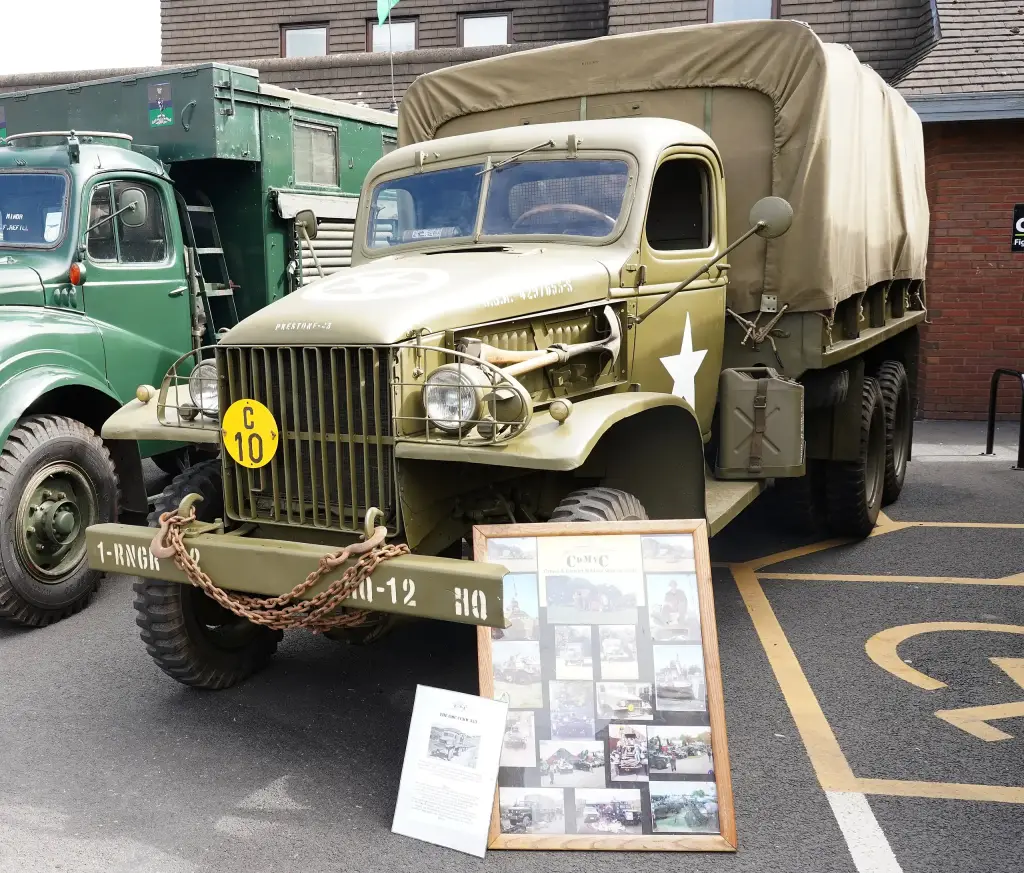
Sources do not agree exactly on how many were built. Ware gives a single figure of 562,750 CCKW trucks across all variants, presumably including the amphibian DUKW. Sunderlin, writing in Army Motors, reports 528,829 2.5-ton 6×6 units produced by GMC excluding the DUKW, against 527,168 accepted by the Army. Jackson’s tabulation of the Army’s 1946 acceptance figures adds up to 524,873 excluding DUKWs and the ACKWX predecessors. Both of those totals still include the cab-over AFKWX-353, leaving some 518,000 to 519,000 actual CCKW-352 and CCKW-353 trucks. GMC serial numbers also indicate about 23,500 of the 6×4 CCW models.
Engine and chassis
The CCKW used the GMC 270, an overhead-valve straight-six of 269.5 cu in with a 3+25/32 in bore and 4 in stroke, rated at 91.5 or 104 hp at 2,750 rpm and 216 lb-ft at 1,400 rpm. The gearbox was a Warner T93 five-speed with a direct fourth gear and an overdrive fifth, and the transfer case had high and low ranges and engaged the front axle. The ladder frame carried three driven beam axles, the front on leaf springs and the rear tandem on leaf springs with locating arms. The short 145-inch wheelbase was used with a short cargo bed as an artillery prime mover for 75 mm and 105 mm howitzers; every other model used the long 164-inch wheelbase. Tyres were 7.50-20 and the brakes were hydraulic with vacuum assist.
Versions and service
Early trucks used a modified commercial AK-series closed cab with a metal roof and doors; by 1944 an open cab with canvas roof and doors was used because it was easier to build and the roof could be removed to lower the shipping height. One cab in four had a machine-gun mounting ring above the co-driver’s seat, a large minority were built with a front-mounted winch, and some open-cab chassis were cut in half behind the cab for air transport and bolted back together on arrival. The CCKW was the basis for the widest range of bodies of any US military vehicle, with the 12 ft cargo version the most common. It remained in US service until the mid-1960s, when the M35 series took over as the standard 2.5-ton 6×6.
Design and features
- Three driven axles: a 6×6 layout with leaf springs front and rear tandem.
- Two wheelbases: 145 in for the CCKW-352 and 164 in for the CCKW-353.
- Winch option: a front-mounted 10,000 lbf winch added 300 lb and 14 inches of length.
- Open or closed cab: the canvas-roofed open cab arrived in 1944 to simplify shipping.
- Wide range of bodies: cargo, prime mover, workshop and many specialised versions.
GMC CCKW versions
- CCKW-352: the short-wheelbase version, used as an artillery prime mover.
- CCKW-353: the long-wheelbase version and the most common model.
- AFKWX-353: the cab-over-engine version built on the same chassis.
- CCW-353: the 6×4, 5-ton on-road variant.
- DUKW: the amphibian built on the same mechanical layout.
- Winch models: trucks fitted with a front-mounted winch.
The CCKW’s post-war successor was the GMC M135. Civilian GMC trucks of the same period include the GMC Blue Chip pickups, and heavier post-war models are in the GMC collection.
Sources
- GMC CCKW 2½-ton 6×6 truck, English Wikipedia: history, production figures, engine, chassis, versions