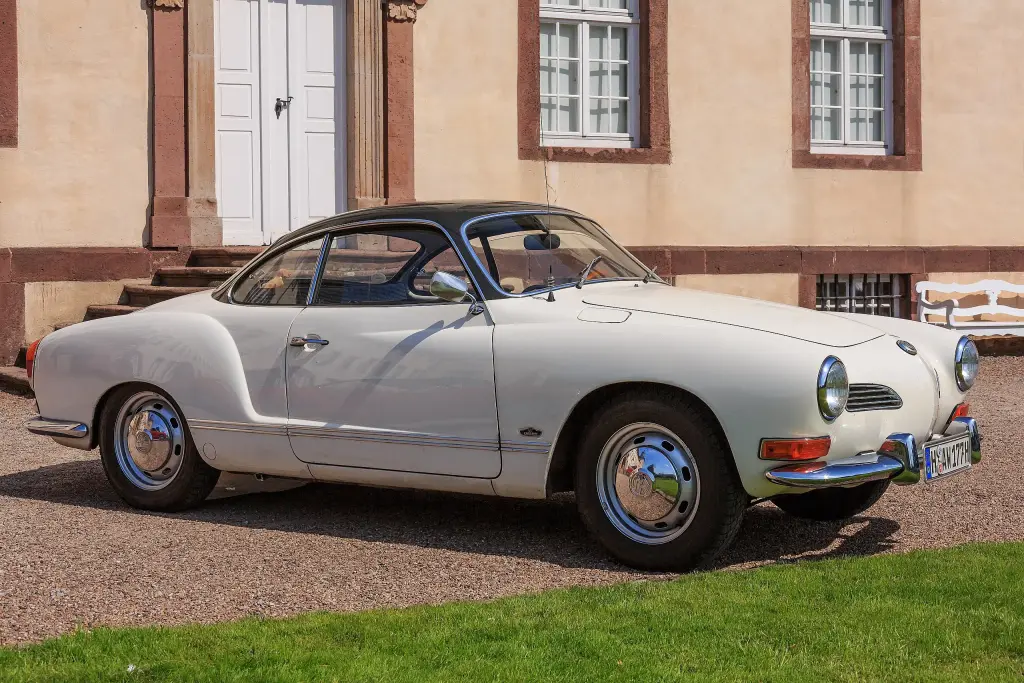
The Volkswagen Karmann Ghia was a Beetle in a tailor-made suit. The floorpan and running gear came from Wolfsburg, the shape from Carrozzeria Ghia in Turin, and the hand-built steel body from Karmann. The result was faster and far more expensive than the Beetle, and its rear seats were famously cramped.
Volkswagen Karmann Ghia at a glance
| Maker | Volkswagen, with bodywork by Karmann |
|---|---|
| Design | Carrozzeria Ghia, Turin |
| Type 14 | 1955–1975 |
| Type 34 | 1962–1969 |
| Brazilian TC | 1972–1975 (Type 145 TC) |
| Bodies | 2+2 coupé (1955–1975), 2+2 convertible (1957–1975) |
| Basis | Beetle (Type 1) or Type 3 floorpan and running gear |
| Type 34 engine | 1500 cc flat-four from the Type 3 |
| Type 34 equipment | optional power-operated steel sunroof |
| Built in Germany | more than 445,000 (Type 34 excluded) |
| Built in Brazil | 41,600 between 1962 and 1975 |
| Final change | rear seat dropped for North America in 1974 |
History of the Volkswagen Karmann Ghia
A Beetle in Turin clothes (1953–1955)
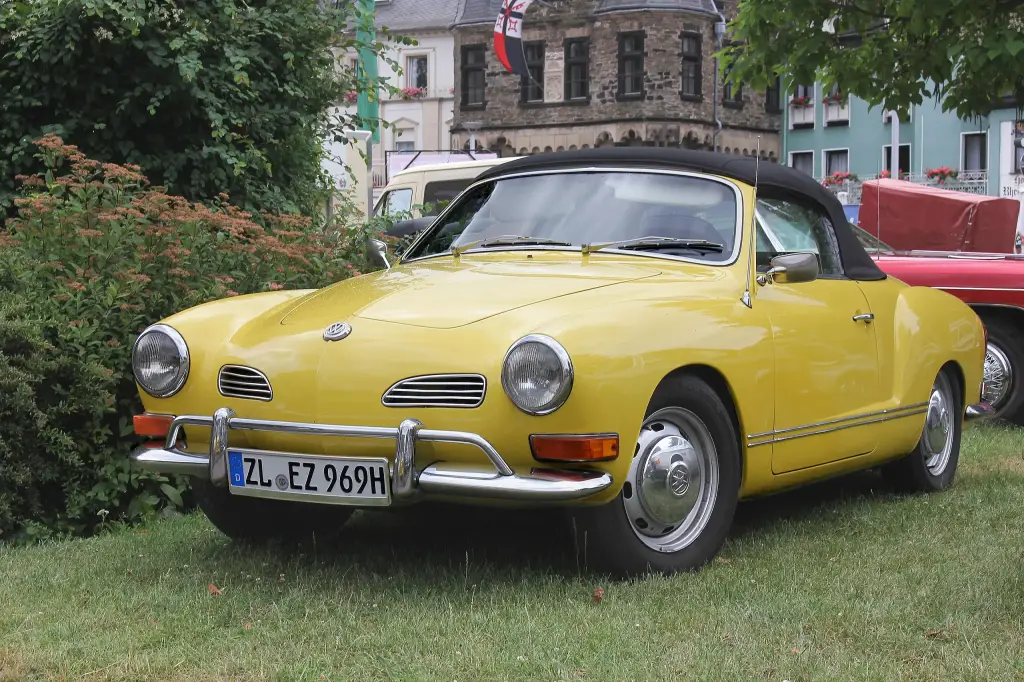
In the early 1950s Volkswagen was selling the Beetle and was at least receptive to adding a halo model. Luigi Segre, who ran Carrozzeria Ghia, wanted to expand the coachbuilder’s international reputation, while Wilhelm Karmann had taken over his family firm and was eager to win more Volkswagen contracts. The two met at motor shows, and after an initial discussion prompted by Karmann, Segre secretly obtained a Beetle: Beetles were hard to come by, and Mario Boano’s son Gian Paolo bought one in Paris and drove it back to Turin. Ghia designed the prototype and built it in five months. Late in 1953 Segre presented the coupé to Karmann in Paris, at the Société France Motors works, and Karmann said: “I’d like to build that!”
The styling combined work by Segre, Mario Boano, Sergio Coggiola and Giovanni Savonuzzi, and at various times each of them took credit for it. It also bore a striking resemblance to Virgil Exner’s Chrysler D’Elegance and K-310 concepts, which Ghia had prototyped. According to Exner’s son, Savonuzzi was the man who scaled down the full-sized D’Elegance and turned it into the Karmann Ghia. A definitive individual attribution was never made.
Type 14 (1955–1975)
The Type 14 went on sale in 1955 as only the second Volkswagen passenger car after the Beetle, six years before the Type 3 saloons and estates. It was faster and more expensive than the Beetle, and very cramped in the back despite its wider, nearly slab-sided postwar body. A convertible joined the range in 1957. In 1961 the Karmann Ghia briefly lost its title as the fastest Volkswagen when the 1500 cc Type 3 arrived, but the Type 14 later received the same 1500 cc engine, in 1967.
Type 34 (1961–1969)
Later in 1961 Volkswagen, Ghia and Karmann presented an all-new Karmann Ghia, the Type 34, on the Type 3 floorpan and with its 1500 cc powertrain. Built from 1962 to 1969, it had more modern, angular and roomier bodywork and a more luxurious interior, which made it substantially more expensive than every other Volkswagen passenger car. It was also one of the world’s first cars offered with a power-operated steel sunroof. The Type 34 became Volkswagen’s range-topper again, costing up to twice the price of a Beetle, while the cheaper Type 14 stayed in production and remained the only one with a convertible.
Failure to offer the Type 34 in the United States, the Karmann Ghia’s most important market, together with high prices elsewhere, limited its sales. After the Type 14 also received the 1500 cc engine in 1967, Type 34 production ended during 1969.
Brazil and the end (1972–1975)
Volkswagen of Brazil wanted an alternative in the same market segment and commissioned Carrozzeria Ghia again, this time for a third Karmann Ghia for South America: the Karmann Ghia TC, or Touring Coupé, made in Brazil from 1972 to 1975. It was a stylish, rakish fastback with good interior space for a 2+2. More than 445,000 Karmann Ghias were built in Germany over the model’s life, not counting the Type 34, and Brazilian production between 1962 and 1975 added 41,600 cars. For its final model year the vestigial rear seat of the Type 14 was dropped for North American cars, which lacked provisions for seat belts; all 1974 Karmann Ghias there were marketed strictly as two-seaters.
Design and features
- Mixing of two companies: Volkswagen mechanicals, Ghia styling and Karmann bodywork in one car.
- Beetle running gear: the Type 14 used the Beetle floorpan; the Type 34 moved to the Type 3 platform.
- Open version: a convertible was offered from 1957, and only on the Type 14.
- Type 34 luxury: a roomier body, a richer interior and an optional power steel sunroof.
- Hand-built bodies: Karmann assembled the steel bodies by hand in comparatively small numbers.
Volkswagen Karmann Ghia versions
- Type 14 coupé (1955–1975): the original 2+2 on the Beetle floorpan.
- Type 14 convertible (1957–1975): the open version, never offered on the Type 34.
- Type 34 (1962–1969): the larger, angular and more expensive model on the Type 3 platform.
- Karmann Ghia TC (1972–1975): the Brazilian fastback designed by Ghia.
The other Ghia-bodied car on this site is the Ghia 450 SS, a Chrysler-powered roadster built in Turin. More cars are in the Ghia collection.
Sources
- Volkswagen Karmann Ghia, English Wikipedia: design history, models, production
- Volkswagen, Italian Wikipedia: place of the Karmann-Ghia in the range