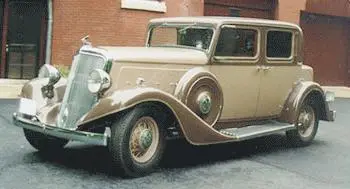
The Franklin Airman belongs to the range of the Franklin Automobile Company, an American maker in Syracuse, New York, that built cars between 1902 and 1934. Franklin was the one company that never gave up air cooling, at a time when almost every other manufacturer had adopted water cooling as cheaper and easier to make.
Franklin Airman at a glance
| Maker | Franklin Automobile Company, Syracuse, New York |
|---|---|
| Cars built | 1902–1934 |
| Cooling | air-cooled throughout |
| Early engine | transverse vertical straight-four, 10 hp (7.5 kW) in 1904 |
| Frame | wood, with an angle-iron frame on the first 1902 cars |
| From 1928 | pressed-steel frame on the heavier cars |
| Body material | aluminium in quantity |
| Styling from 1925 | nickel-plated “hoodfront” dummy radiator by J. Frank DeCausse |
| Engine of 1930 | up to 100 hp (75 kW) |
| Engine of 1932 | air-cooled V12, 398 cu in (6.5 L), 150 hp (110 kW) |
| End | bankruptcy in April 1934 |
The Airman has no article of its own in English Wikipedia; this page is based on the article on the Franklin marque (one source).
History of the Franklin Airman
Franklin built its reputation on two things: air-cooled engines and light weight. The company argued that air cooling was simpler and more reliable than water cooling, and that a light car was the only way to make good performance from the modest power then available. Most Franklins were wood-framed; only the first cars of 1902 used an angle-iron frame, and from 1928 the heavier models took a conventional pressed-steel chassis. Aluminium was used in quantity, so much that Franklin was reckoned to be the largest user of aluminium in the world in its early years.
The 1904 range included a four-seat touring car with a detachable rear tonneau, a transversely mounted vertical straight-four of 10 hp (7.5 kW) at the front, a two-speed planetary transmission and a weight of 1,100 lb (499 kg); it listed at US$1,300. Franklin was a technological leader, offering six cylinders by 1905 and automatic spark advance in 1907. In 1906 L. L. Whitman drove a Franklin from New York City to San Francisco in 15 days 2 hours 15 minutes, a new record. Before antifreeze existed, an air-cooled car had a real advantage in cold weather, and Franklins were popular with doctors and others who needed an all-weather machine. The limit of air cooling was cylinder bore and valve area, which held back power; moving the fan from sucking hot air to blowing cool air in 1921 opened the way to a gradual increase.
Franklins were often odd-looking, though some were handsome with Renault-style hoods. In 1925, at the demand of dealers, the cars were redesigned to look conventional, with a massive nickel-plated dummy radiator that doubled as an air intake and was called a hoodfront; the same year Franklin introduced the boat-tail to car design. A new engine of 1930 ultimately produced 100 hp (75 kW), with one of the highest power-to-weight ratios of the time. In 1932 came an air-cooled V12 of 398 cu in (6.5 L) and 150 hp (110 kW), designed for a light chassis but finished as a 6,000 lb (2,700 kg) car after management overruled the engineers. It sold poorly in the Depression, and the company went bankrupt in April 1934. The name and assets were sold, and air-cooled engines for commercial and aircraft use continued under Aircooled Motors.
Design and features
- Air cooling: no radiator, no water and no antifreeze — the reason Franklin cars were bought for winter use.
- Light construction: wood frames and generous use of aluminium kept the cars light for their size.
- Technical firsts: six cylinders by 1905 and automatic spark advance in 1907.
- Conventional looks from 1925: the hoodfront gave the cars the face customers expected.
Franklin Airman versions
- Early touring cars: the 1904 four-seater with a detachable tonneau, 10 hp and a two-speed planetary gearbox.
- Six-cylinder cars: offered from 1905 onwards.
- Hoodfront models: from 1925, with the nickel dummy radiator and, the same year, the boat-tail body.
- The Twelve: the air-cooled V12 of 1932, 398 cu in and 150 hp.
More cars of the marque, including the Airman, are in the Franklin collection.
Sources
- Franklin (automobile), English Wikipedia: company history, engines, bodies, end of production