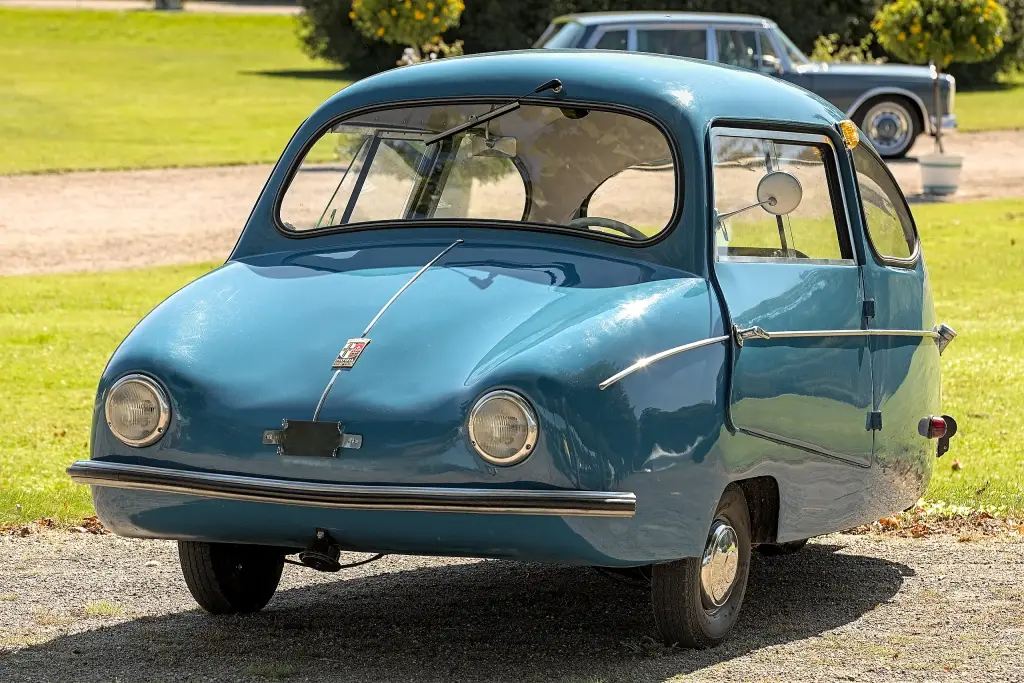

The Fram King Fulda was the Swedish version of the Fuldamobil, a German bubble car of the 1950s and 1960s. The Swedish firm Fram-King built the little three-wheeler under licence from Elektromaschinenbau Fulda between 1956 and 1962, turning out 411 cars.
Fram King Fulda at a glance
| Maker | Fram-King, Sweden, under licence |
|---|---|
| Original design | Fuldamobil, Elektromaschinenbau Fulda, Germany |
| Production in Sweden | 1956–1962 |
| Built in Sweden | 411 |
| Engine | Sachs single-cylinder two-stroke, 191 cc |
| Power | 10 hp |
| Top speed | 80 km/h |
| Seats | two adults and two children |
| Body | three wheels, later four |
| Total Fuldamobil production | about 2,900, 1951–1969 |
Based on three Wikipedia articles on the Fuldamobil: the Swedish and German pages give the Swedish licence production, while most technical detail comes from the English page about the German original.
History of the Fram King Fulda
The German original
The Fuldamobil was designed by Norbert Stevenson, a freelance journalist who had studied mechanical engineering for one term in Berlin. His idea was a very simple three-wheeled car for two people, with two wheels at the front for stability and a small engine at the rear. In the summer of 1949 he found backing from Karl Schmitt, a Bosch wholesaler in the town of Fulda whose company, Elektromaschinenbau Fulda GmbH, repaired emergency power generators. The first prototype made its public debut in the Rosenmontag carnival procession in Fulda in March 1950 and was nicknamed “Flea”. Series production began in February 1951.
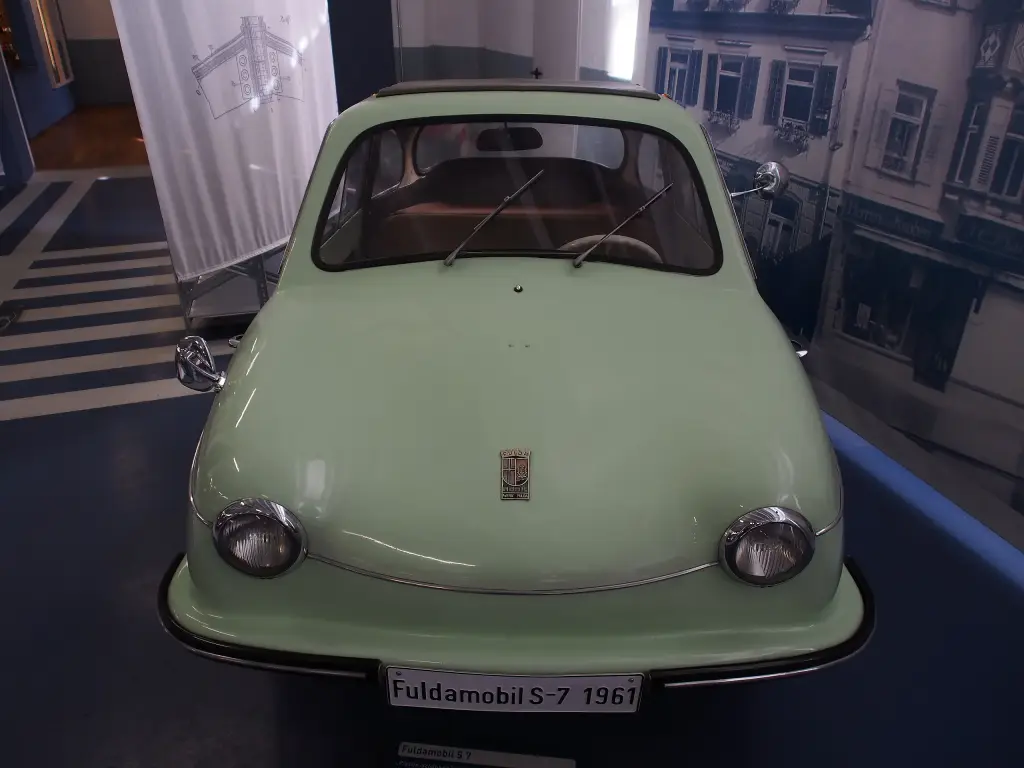

Engineering that came before its time
The front axle of the Fuldamobil used a negative scrub radius, a layout that gives a car a natural straight-line stability on slippery roads and under uneven braking. It is now standard on most front-wheel-drive cars, and the Fuldamobil is credited with being the first car in the world to use it. The chassis was a steel central tube frame with swing axles, the brakes were cable-operated and acted on the front wheels only, and to save cost there were no shock absorbers at all. Bodies changed several times: early cars had plywood panels covered in artificial leather, a squared aluminium-skinned body arrived in 1952 and earned the nickname “Silberfloh”, a heavily rounded version a year later was mockingly called the “Cellokasten”, and from 1957 plastic replaced aluminium.
Fram-King of Sweden
The Fuldamobil was built under licence on four continents, and Sweden was one of the countries that took it up. Fram-King produced 411 cars between 1956 and 1962. The Swedish cars used a Sachs single-cylinder two-stroke engine of 191 cc, which gave 10 hp, and the top speed was quoted at 80 km/h. The little car carried two adults and two children, and the advertising claimed that the seats could be folded into a bed.
The end of the line
Production of the Fuldamobil in Germany ran until 1969, an unusually long life for a microcar, although the cars were never made in large series: only about 260 were built between 1965 and 1969, and the total for the whole period is around 2,900. By then the Swedish licence production had long finished, and the Fram King Fulda had been replaced on Swedish roads by larger, more conventional small cars.
Design and features
- Licence-built in Sweden: 411 cars assembled by Fram-King between 1956 and 1962.
- Sachs two-stroke: a 191 cc single-cylinder engine of 10 hp, good for 80 km/h.
- Room for four: two adults and two children, with seats that advertising said could be made into a bed.
- Advanced front axle: the Fuldamobil layout introduced the negative scrub radius, today used on most cars.
Fram King Fulda versions
- Fram King Fulda (1956–1962): the Swedish licence-built car, 411 examples.
- Fuldamobil Type N: the slab-sided version sold in Germany in 1953–1955.
- Fuldamobil Type S: the rounded version offered alongside the Type N.
- Fuldamobil NWF 200: 701 cars built by Nordwestdeutscher Fahrzeugbau in 1954–1955.
- Other licence versions: the Bambino in the Netherlands, the Nobel in Britain and Chile, the Alta and Attica in Greece and the Bambi in Argentina.
The German original and the rest of the family are described in the Fram-King collection, where other small cars of the period are collected.
Video: King Fram FUlda 1959
Video on YouTube.
Sources
- Fuldamobil, English Wikipedia: design, engineering, bodies, production dates
- Fuldamobil, Swedish Wikipedia: Fram-King-Fulda, Sachs engine, seats, top speed
- Fuldamobil, German Wikipedia: 411 Swedish cars, licence production, totals