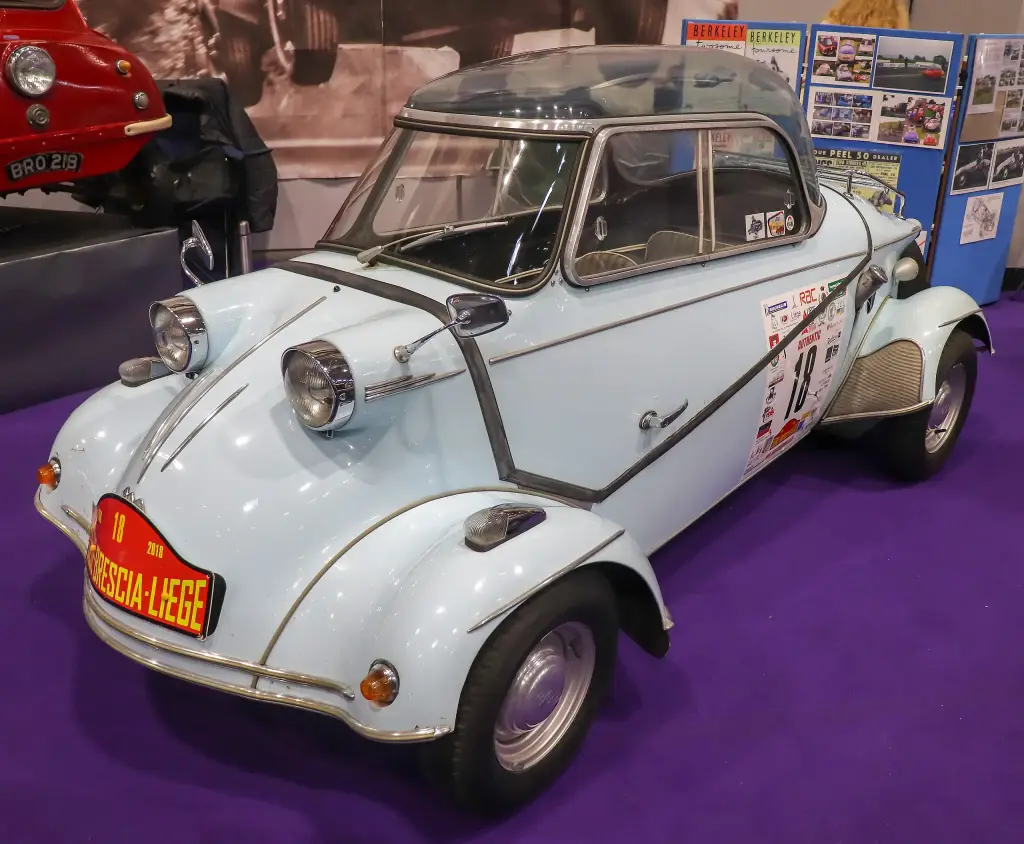

The FMR Tg500 was a small sports car built in Regensburg from 1958 to 1961 by Fahrzeug- und Maschinenbau GmbH, the company that had taken over production of the Messerschmitt Kabinenroller. Where the Kabinenroller was a three-wheeler, the Tg500 had four wheels, a 494 cc two-cylinder two-stroke engine and, for the first time in the family, a reverse gear.
FMR Tg500 at a glance
| Maker | Fahrzeug- und Maschinenbau GmbH (FMR), Regensburg |
|---|---|
| Production | 1958–1961 |
| Based on | Messerschmitt Kabinenroller platform |
| Engine | 494 cc air-cooled two-cylinder two-stroke, Fichtel & Sachs design, built by FMR |
| Layout | transverse engine over the rear wheels, rear-wheel drive |
| Gearbox | H-pattern manual with reverse gear in a transaxle |
| Weight | 350 kg empty, 560 kg fully loaded |
| Top speed | 126 km/h (78 mph) |
| 0–97 km/h | 27.8 seconds |
| Fuel consumption | 6.5 L/100 km |
| Price | DM 3,650 |
based on one source (English Wikipedia).
History of the FMR Tg500
From Messerschmitt to FMR
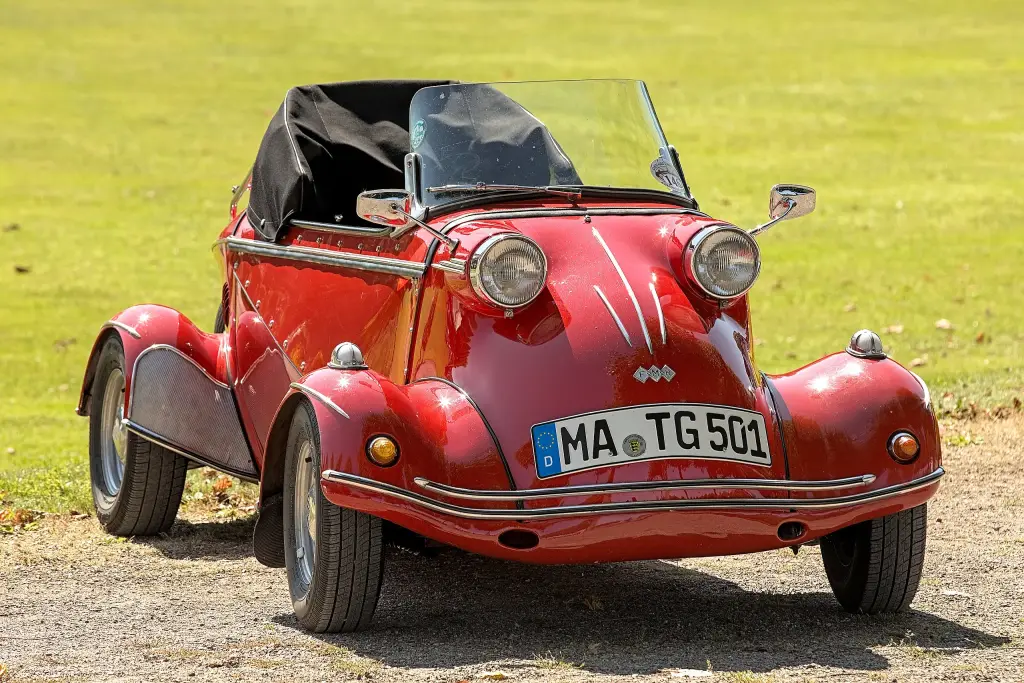

FMR took over production of the KR200 from Messerschmitt in 1956. The three-wheeler still carried the Messerschmitt name and logo, but the new four-wheeled model was badged as an FMR. Its name was a compromise: “Tg” unofficially stood for Tiger, a name that Krupp had already claimed in Germany for one of its trucks, and at the same time Panhard was selling a Dyna Z Tiger. The car was therefore sold as the Tg500 rather than as the FMR Tiger.
Body and seating
The Tg500 kept the narrow body of the Kabinenroller, with driver and passenger sitting one behind the other. Tandem seating let the body taper like an aircraft fuselage within a practical length and kept the frontal area small. It also put the mass of the car on the longitudinal axis; together with the low centre of gravity, low weight and wheels at the extremes of the body, this gave the Tg500 good handling. The centre of gravity sat at the rear seat, so carrying a passenger did not change the way the car behaved. A further, smaller advantage was that no mirrored version was needed for countries that drive on the left.
Entry was through a canopy door hinged on the right side of the car, which included the windscreen, the window frames and the acrylic bubble top — the same bubble as on the KR200. Only the Sports Roadster did without it: there the canopy was fixed and there was no top and no windows at all, just a tonneau cover.
Engine, transmission and chassis
The engine was a 494 cc air-cooled two-cylinder two-stroke designed by Fichtel & Sachs and built by FMR, mounted transversely over the rear wheels. A belt-driven Dynastart starter-generator carried a fan at each end, one for each cylinder. Unlike the KR175 and KR200, the Tg500 had a reverse gear, built into a transaxle unit. The controls followed those of the KR200, with a single starting mode and an H-pattern gearshift that included reverse and needed no auxiliary lever; a tachometer could be ordered in place of the clock.
The front suspension and steering were those of the KR200, apart from 4.40 x 10 tyres all round and a front track widened from 108 cm to 111 cm. At the rear the suspension was fully independent, with universal joints at both ends of each halfshaft, located by lower wishbones and coil springs with concentric shock absorbers. Where the three-wheeled Kabinenrollers used cable-operated mechanical brakes, the Tg500 had hydraulic brakes.
Performance
In standard form the Tg500 reached 97 km/h in 28 seconds and went on to 126 km/h. At a similar price the first series of the Austin-Healey Sprite took 21 seconds to the same speed and reached 132 km/h, so the little FMR was slower than the sports car it was priced against. Its price of DM 3,650 was nevertheless only 46 per cent of the Sprite’s.
Design and features
- Tandem seating: a narrow, aircraft-like body with a low frontal area and the centre of gravity at the rear seat.
- Bubble canopy: the acrylic top of the KR200, entered through a door hinged on the right.
- Four wheels: the first four-wheeled member of the Kabinenroller family, with hydraulic brakes instead of cables.
- Reverse gear: something the three-wheeled KR175 and KR200 did not offer.
- Light weight: 350 kg empty, which helped the modest two-stroke engine.

FMR Tg500 versions
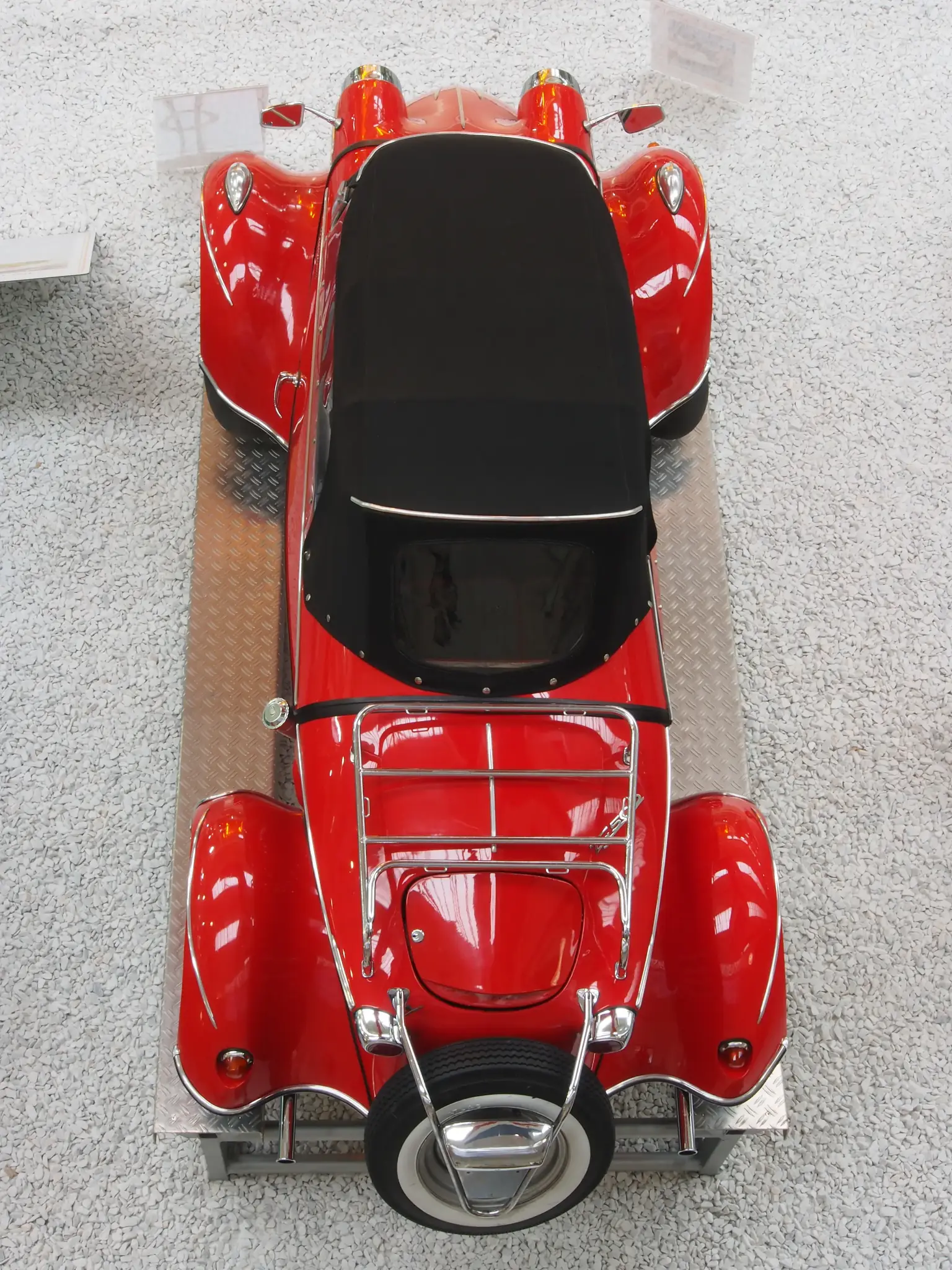
- Tg500 coupé: the standard car with the acrylic bubble canopy and a canopy door.
- Sports Roadster: fixed canopy, no top or windows, only a tonneau cover.
- Kabrio: a folding fabric top in place of the bubble.
The Tg500 grew out of the three-wheeled Kabinenroller, and its story belongs to the small German makers of the 1950s. More cars of the marque are in the FMR collection.
Sources
- FMR Tg500, English Wikipedia: history, body, engine, chassis, performance, data