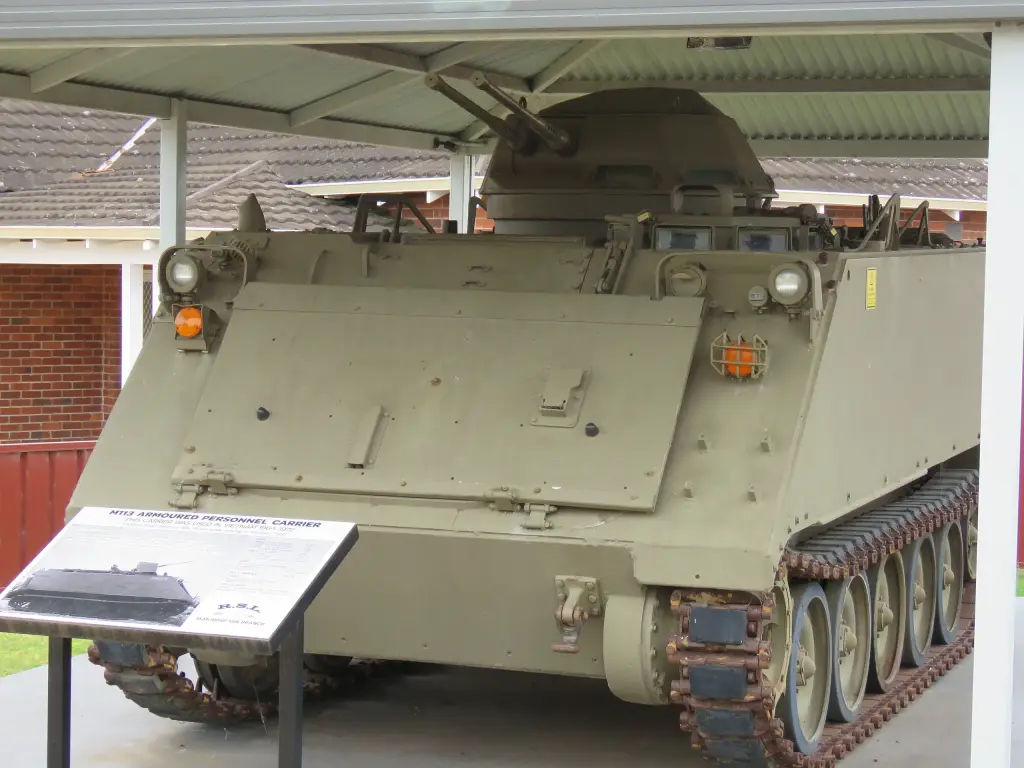

The M113 is a fully tracked armoured personnel carrier developed and produced by the FMC Corporation. Built around an aluminium hull, it was lighter than its predecessors, air transportable and moderately amphibious, and it became one of the most widely used armoured fighting vehicles ever made.
FMC M113 at a glance
| Maker | FMC Corporation, United States |
|---|---|
| In service | from 1960 |
| Production | until 2007 |
| Builder after 1994 | United Defense, then BAE Systems |
| Crew | two: driver and commander |
| Passengers | 11–15 |
| Hull | aluminium armour, first in mass production |
| Main armament | one 12.7 mm M2 Browning machine gun |
| Engine | petrol at first, diesel in the M113A1 from 1964 |
| Air transport | C-130 and C-141 |
| Built | over 80,000 in the whole family |
| Users | more than 50 countries |
based on one source (English Wikipedia).
History of the FMC M113
The M113 was developed by the FMC Corporation, which had already built the earlier M75 and M59 armoured personnel carriers. The M75 was too heavy and too expensive to be useful, because its weight ruled out amphibious use and transport by air. The much cheaper and lighter M59 solved both problems, but it carried too little armour and was unreliable because of its dual-engine powertrain. The Army therefore asked for an “airborne armoured multi-purpose vehicle family” that combined the protection of one with the mobility of the other.
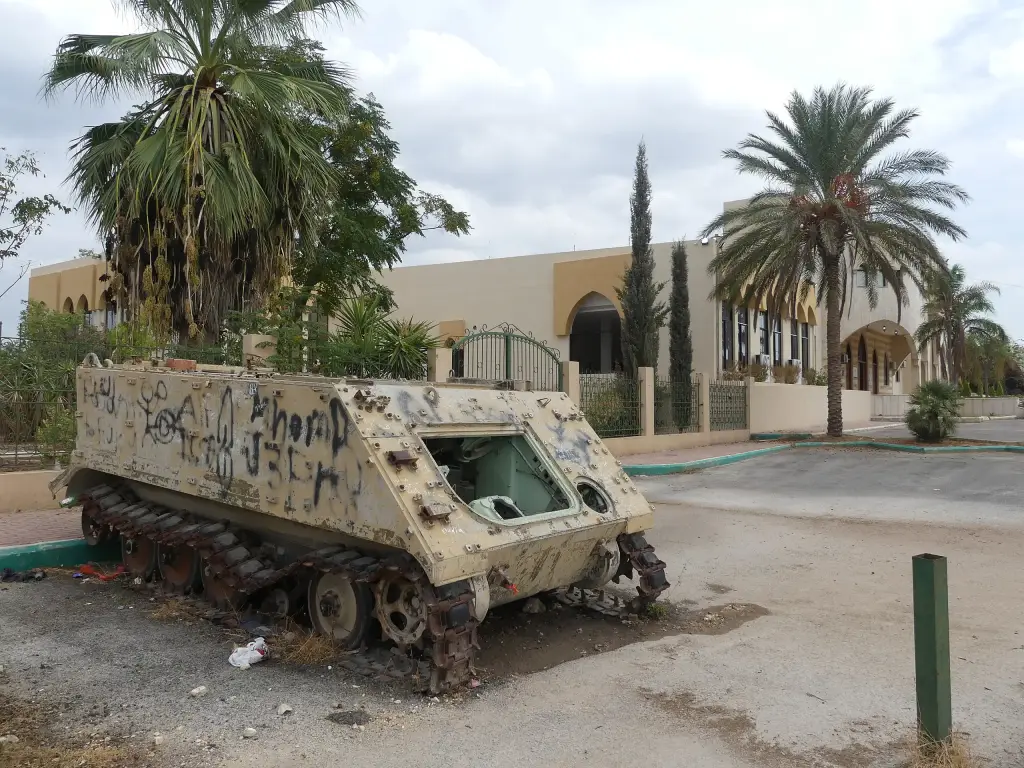

In the late 1950s FMC worked with Kaiser Aluminium on an aluminium armour that could offer the protection of the M75 at the weight of the M59. The company answered with two proposals: two versions of the aluminium T113, one thickly and one thinly armoured, and the largely steel T117. The thicker-armoured T113 weighed less than its steel competitor while offering the same protection, and it was chosen. An improved design, the T113E1, was adopted by the US Army in 1960 as the M113. A diesel prototype, the T113E2, went into production in 1964 as the M113A1 and quickly supplanted the petrol-engined original.
The vehicle was designed to be a survivable and reliable light tracked carrier that could be airlifted and air-dropped by C-130 and C-141 transports. The original concept was narrow: the M113 would carry troops forward under armour, the men would dismount to fight, and the carrier would withdraw to the rear. It entered service with two crew, a driver and a commander, and space for eleven to fifteen passengers, with a single .50-calibre (12.7 mm) M2 Browning machine gun for the commander.
The first batch of 32 M113s reached South Vietnam on 30 March 1962, split between two Army of the Republic of Vietnam mechanised rifle companies with fifteen vehicles each, and the two units were fielded for the first time on 11 June 1962. At the Battle of Ap Bac in January 1963 at least fourteen gunners were killed because of their exposed position, and crews began fitting makeshift shields cut from the hulls of sunken ships; that metal proved penetrable by small-arms fire, so later shields were made from scrapped armoured vehicles. The ARVN 80th Ordnance Unit developed the idea into general-issue gun shields, the predecessor of the armoured cavalry assault vehicle, or ACAV, fitted to ARVN mechanised units in the early 1960s.
South Vietnamese crews used the M113 less as a battle taxi than as what Ralph Zumbro called an amphibious light tank, treating the infantry it carried as extra dismountable soldiers in an oversized tank crew. The M113 became the most widely used armoured vehicle of the US Army in the Vietnam War, where it was also driven through thick jungle to overrun enemy positions. FMC transferred production of the M113 in 1994 to United Defense, its newly formed defence subsidiary, which was acquired by BAE Systems in 2005. Production ended in 2007 after more than 80,000 vehicles of the family had been built for over fifty countries.
Design and features
- Aluminium hull: the first aluminium-hull combat vehicle in mass production, light enough to be airlifted and moderately amphibious.
- Simple layout: a boxy hull with a rear ramp, two crew forward and eleven to fifteen passengers behind.
- Light armament: a single 12.7 mm M2 Browning machine gun on the commander’s hatch.
- Adaptability: the same hull served as an armoured ambulance, mortar carrier, engineer vehicle and command vehicle.
- Long reach: air-droppable from C-130 and C-141 transports, which suited it to fast deployment.
FMC M113 versions
- M113 (1960): the original petrol-engined vehicle adopted as the T113E1.
- M113A1 (1964): diesel-engined version that quickly replaced the petrol model.
- ACAV: armoured cavalry assault vehicle with gun shields developed from ARVN field modifications.
- Support versions: armoured ambulance, mortar carrier, engineer vehicle and command vehicle.
- Later users: thousands served with the Israel Defense Forces, which by 2014 planned to replace many of its 6,000 vehicles with the Namer and, from 2020, the Eitan.
The M113 belongs to the FMC collection, together with the other vehicles built by the Food Machinery Corporation.
Video: M113 A1 (A1 – Diesel) Armored Personnel Carrier, US -FMC made APC
Video on YouTube.
Sources
- M113 armored personnel carrier, English Wikipedia: development, service, variants, production