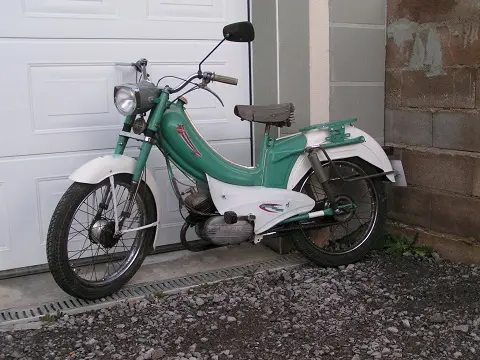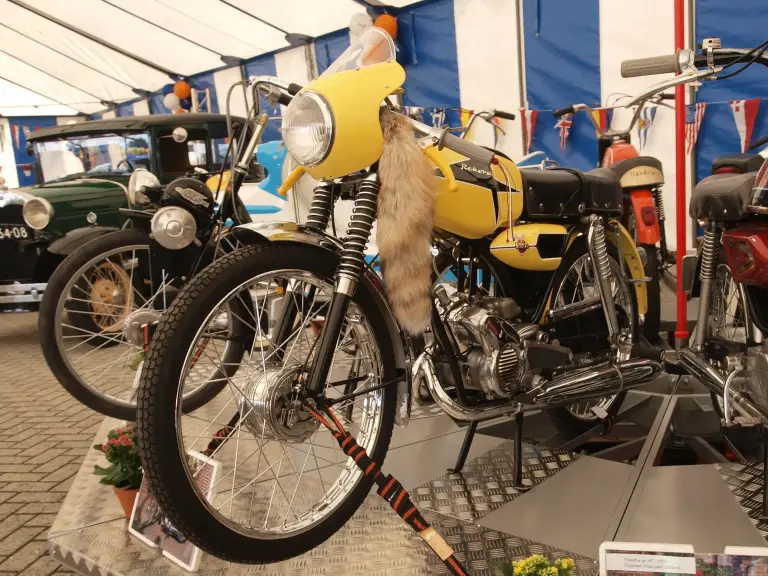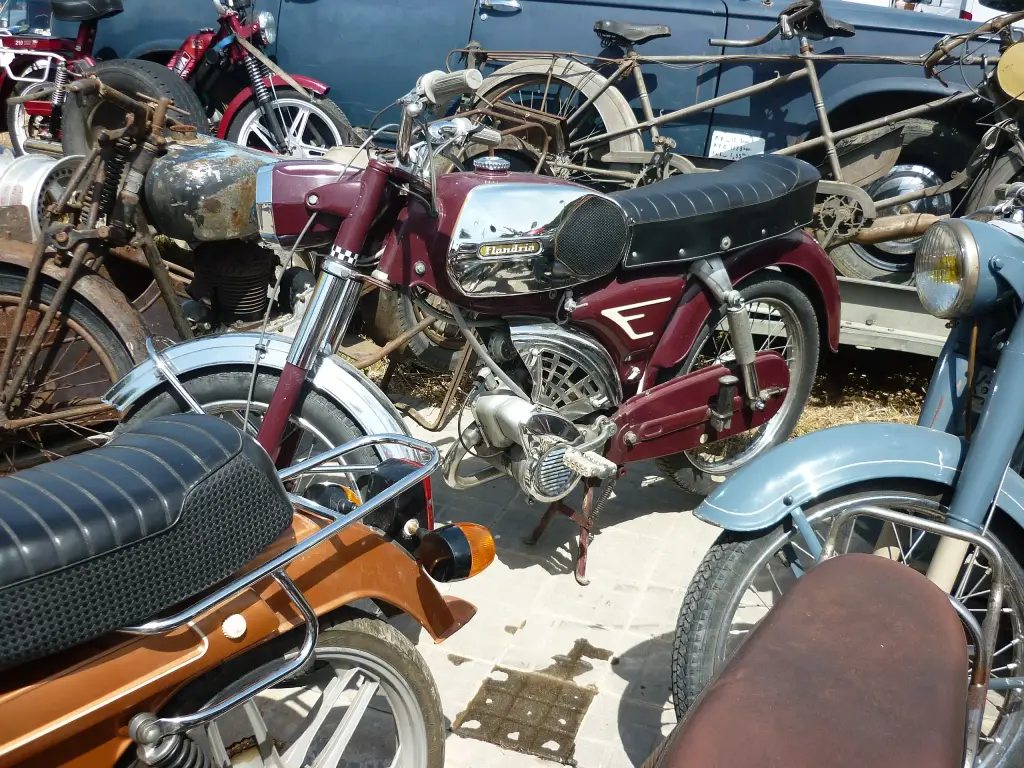
Flandria mopeds were the main product of the Belgian works A. Claeys-Flandria at Zedelgem in West Flanders. The company had been building bicycles since the end of the nineteenth century; after the Second World War it opened a new factory for mopeds, and the first machine, with a 40 cc Rex engine, was built in 1951. Flandria made mopeds until 1981, when production ended.
Flandria moped at a glance
| Maker | A. Claeys-Flandria, Zedelgem, Belgium |
|---|---|
| Type | moped (bromfiets) |
| Production | 1951–1981 |
| First model | 1951, 40 cc Rex engine |
| Own engine | 49 cc two-stroke, from 1952 |
| Two gears and tank frame | from 1953 |
| Range | fast sports mopeds, utility mopeds, ladies’ models |
| Annual output | more than 100,000 mopeds in the mid-1970s |
| Other products | aluminium products, lawn mowers, heating equipment |
| Factories | Belgium, Netherlands (Avaros), France, Morocco, Portugal |
The only source is the Dutch Wikipedia article on the Flandria brand, which deals with the works and its moped production rather than with any single model; the page is based on one source.
History of the Flandria moped
Bicycles before mopeds
The Claeys family’s smithy at De Leeuw, a hamlet of Zedelgem in West Flanders, grew into a works with hundreds of employees. At the beginning of the twentieth century Leon Claeys founded a company for agricultural machinery, while the family firm had sold 150 bicycles by 1910; the brothers Alidor, Jerome, Remi and Aimé Claeys turned the smithy into a bicycle factory, which produced its 250,000th bicycle in 1927. A motorcycle was tried as well: Aimé built four 500 cc JAP-engined prototypes in 1933, but it never went into production.
The first Flandria moped
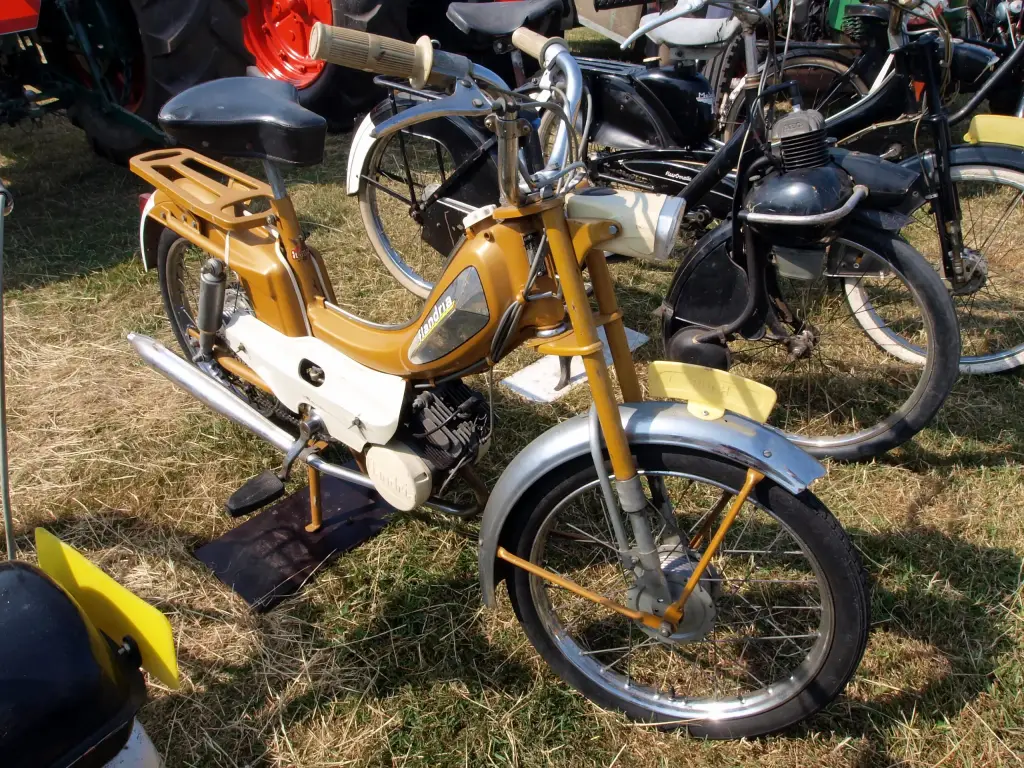
Only after the Second World War did the firm decide to make mopeds, in a factory built for the purpose at Zedelgem. The first Claeys-Flandria machine appeared in 1951 with a 40 cc Rex engine; in 1952 a Flandria engine of 49 cc replaced it, and in 1953 the moped received two gears and a tank frame. The company also built 125 cc and 175 cc light motorcycles with JLO engines from 1953, a 175 cc scooter and a 250 cc motorcycle from 1954, and in 1955 showed a prototype microcar at the Brussels salon that remained a one-off. The mopeds were improved and modernised at the same time.
Mopeds take over
When the brothers divided the company in 1956, Aimé kept the Flandria bicycles under the name A. Claeys-Flandria, while Remi took part of the Zedelgem plant and the Lichtervelde tube works and made mopeds as Superia with Sachs engines. Motorcycle sales fell at the end of the 1950s and Flandria stopped making them, concentrating on mopeds — fast sports mopeds, utility mopeds and ladies’ models. The company also became a cycling sponsor under Pol Claeys, with a team that won major races in the 1960s.
Peak and end
In the mid-1970s Flandria produced more than 100,000 mopeds a year, together with aluminium products, lawn mowers and heating equipment; a Gila-M enduro motorcycle prototype of 1976 was never produced. Mopeds were also assembled outside Belgium, in the Netherlands (Avaros), France, Morocco and Portugal, with Flandria engines built under licence at Figueres in Spain. Most of those countries had separate models of their own, and the French Sportif was made only at Waasten with smaller wheel sizes. Flandria moped production ended in 1981.
Design and features
- Own 49 cc engine: Flandria replaced the bought-in Rex unit with its own two-stroke in 1952.
- Early specification: two gears and a tank frame were part of the moped by 1953.
- Three kinds of machine: sports, utility and ladies’ mopeds were all built.
- Big volumes: more than 100,000 mopeds a year in the mid-1970s.
- International production: factories in four countries outside Belgium and licensed engine building in Spain.
Flandria moped versions
- Early Flandria moped (1951): bicycle frame with a 40 cc Rex engine.
- 1952–1953 moped: Flandria’s own 49 cc engine, then two gears and a tank frame.
- Sports mopeds: the fast models of the 1960s and 1970s.
- Utility and ladies’ mopeds: everyday versions of the same machines.
- Foreign models: separate types from the Dutch, French, Moroccan and Portuguese factories, such as the French Sportif of Waasten.
Individual models of the range are the Flandria Rekord and the Flandria Comet. More vehicles of the marque are in the Flandria collection.
Video: vintage moped Flandria
Video on YouTube.
Sources
- Flandria, Dutch Wikipedia: company history, engines, moped range, output, factories, 1981