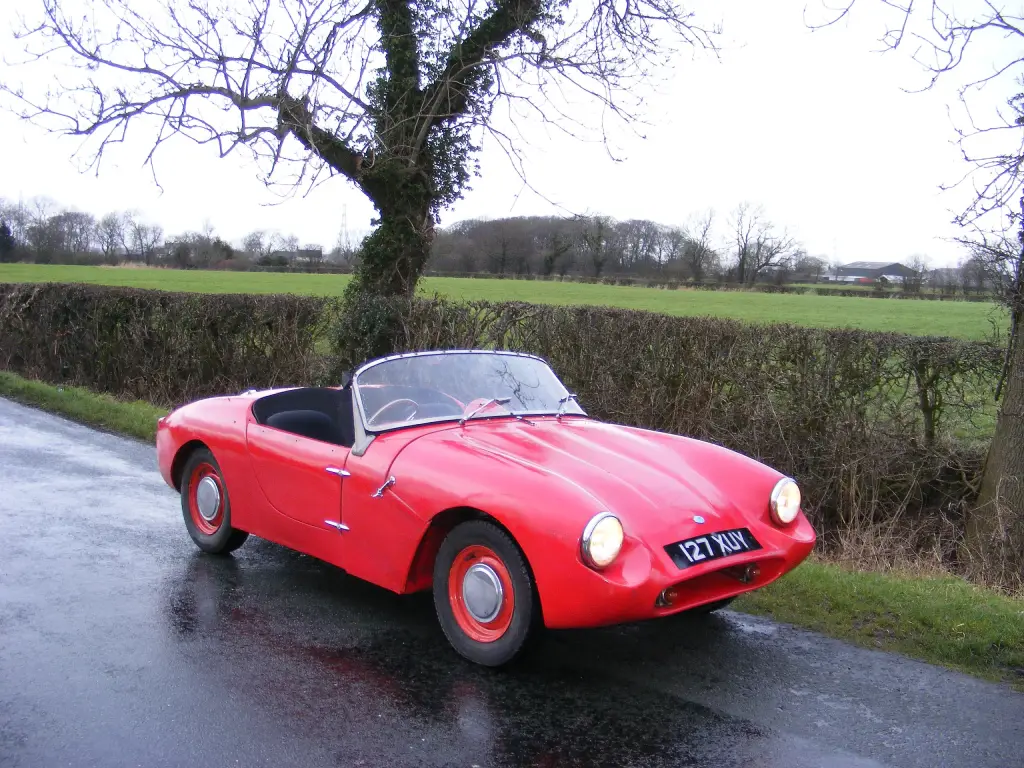

The Fairthorpe Electron was the larger of the two cars with which Fairthorpe Ltd of Buckinghamshire followed its motorcycle-engined Atom: an open two-seater with a glassfibre body and a 1098 cc overhead-cam Coventry Climax engine. The Climax was costly to buy in, so the Electron was expensive and rare; the cheaper Electron Minor that followed in 1957 became the firm’s main product for the next sixteen years.
Fairthorpe Electron at a glance
| Maker | Fairthorpe Ltd, Chalfont St Peter, Buckinghamshire |
|---|---|
| Production | Electron 1956–1965; Electron Minor 1957–1973 |
| Body | open two-seater, glassfibre; hardtop optional |
| Engine, Electron | 1098 cc Coventry Climax overhead-cam four |
| Engine, Electron Minor | 948 cc Standard SC, later the Triumph Spitfire unit |
| Transmission | Standard Ten gearbox and rear axle |
| Suspension | independent front, coil springs |
| Brakes | drums all round; front discs from 1966 on the Minor |
| Price, Electron | £1,050 complete, £734 in kit form |
| Built | about 20–30 Electrons, about 700 Electron Minors |
| Sold as | complete car or kit |
| Peak output | about 20 cars a month |
The Electron is described in a section of the English and German Wikipedia articles on the Fairthorpe marque; the photographs show the Electron Minor, the long-running version of the same family.
History of the Fairthorpe Electron
The Climax-engined Electron (1956)
Fairthorpe had begun in 1954 with the Atom, a tiny two-seater powered by a rear-mounted motorcycle engine. For 1956 the firm built something larger: the Electron, an open two-seat sports car with a glassfibre body over a simple chassis and a 1098 cc overhead-cam Coventry Climax engine at the front. The front suspension was independent on coil springs, and drum brakes were used all round. The German Wikipedia lists Coventry Climax units of 1098 cc (84–93 PS), 1220 cc (85 PS) and even 1960 cc (110 PS), and says the suspension was taken from the Triumph TR2.
The problem was the engine. Buying Coventry Climax units in small numbers was expensive, and the Electron was priced accordingly: £1,050 as a complete car or £734 in kit form, at a time when a small family saloon cost far less. Only around 20–30 are thought to have been made. The English Wikipedia lists the model as running to 1965, with a final version using a Triumph Spitfire engine and a Microplas Mistral body.
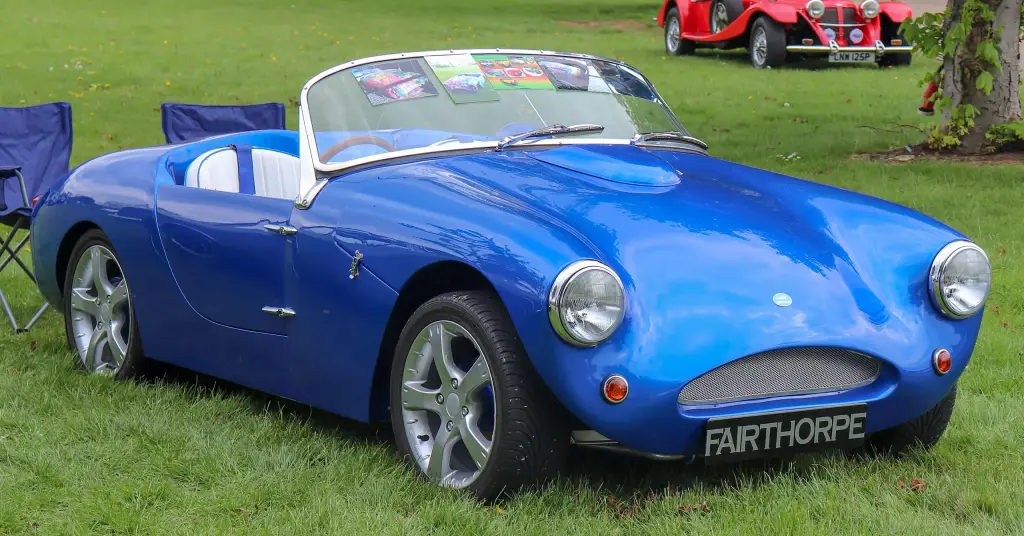

Electron Minor and Electrina (1957–1973)
In 1957 Fairthorpe answered the price problem with the Electron Minor, which used the engine, transmission and rear axle of the Standard Ten — a 948 cc four of 38–45 PS. It was the same kind of car, cheap to build and sold complete or as a kit, and it became the mainstay of production. In 1963 the car received the larger version of the SC engine from the Triumph Spitfire, and in 1966 front disc brakes from the same source. A hardtop was on the options list. Through a series of specification changes the cars ran from Mark I to Mark VI, the last of which used a Triumph GT6 chassis. Production continued until 1973, with about 700 Electron Minors built, and at its peak the works turned out about 20 cars a month.
There was also a closed version. The Electrina was a small two-door 2+2 saloon with Triumph Herald mechanicals, offered in the early 1960s and built in only about six examples.
Design and features
- Glassfibre bodywork: light and easy to mould in small numbers, the basis of every Fairthorpe.
- Coventry Climax power: an overhead-cam racing-derived engine in a road-going kit car.
- Kit or complete: buyers could assemble the car themselves and save several hundred pounds.
- Standard and Triumph parts: the Electron Minor was built from off-the-shelf British components, which kept it cheap to run.
- Long life: the Minor stayed in production, with updates, for sixteen years.
Fairthorpe Electron versions
- Electron (1956–1965): the original Coventry Climax-engined open two-seater.
- Electron Minor (1957–1973): Standard Ten-based version, later with Triumph Spitfire engine and front discs.
- Electrina (early 1960s): closed 2+2 saloon on Triumph Herald mechanicals, about six built.
- Marks I–VI: successive specifications of the Minor, ending with a Triumph GT6 chassis.
The Electron was the larger stablemate of the motorcycle-engined Atom, and the Electron Minor that followed kept the firm alive into the 1970s. More cars from the marque are in the Fairthorpe collection.
Video: Fairthorpe Electron Minor Sports Car
Video on YouTube.
Sources
- Fairthorpe Cars, English Wikipedia: Electron, Electron Minor, Electrina, prices, production
- Fairthorpe, German Wikipedia: engines, power outputs, numbers built