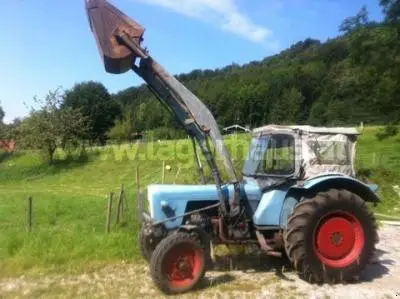
The Fahr D 17 is one of the D-numbered tractors of the Maschinenfabrik Fahr, the agricultural machinery works at Gottmadingen on the Bodensee. The firm was founded in 1870, began building tractors in 1938 and stopped in 1962, so the D 17 belongs to the last generation of machines to carry the Fahr name on the bonnet.
Fahr D 17 at a glance
| Maker | Maschinenfabrik Fahr, Gottmadingen, Baden-Württemberg |
|---|---|
| Company founded | 1870, by Johann Georg Fahr |
| Tractor production | 1938–1962 |
| Engines | mainly Güldner and Deutz |
| Gearboxes | Fahr’s own |
| First tractor | F22 with a 22 PS Deutz engine, 1938 |
| Wartime types | HG25 wood-gas tractor, T22 |
| Europa series | from 1959 with Güldner, e.g. Fahr D 132 |
| Paint | the traditional Fahr red |
| After 1962 | absorbed by KHD; Deutz-Fahr from 1977 |
No Wikipedia article covers the Fahr D 17 itself. This page is based on the German Wikipedia article on the manufacturer, Maschinenfabrik Fahr (one source), and places the model in the history of the Gottmadingen tractor programme.
History of the Fahr D 17
The works at Gottmadingen
The Maschinenfabrik Fahr was an agricultural machinery manufacturer based at Gottmadingen in the district of Konstanz, Baden-Württemberg, close to the Swiss border and the Bodensee. Johann Georg Fahr founded the firm in 1870. In 1892 it opened its first branch works, an iron foundry at Stockach, and in 1903 it became an open trading company when the founder passed the management to his two sons and two sons-in-law. On 24 October 1911 the business was turned into a joint-stock company, but it stayed in family ownership.
Tractors from 1938
Fahr began building tractors in 1938. The engines came mainly from Güldner and Deutz, while the gearboxes were Fahr’s own. The first tractor was the F22, powered by a 22 PS engine from Deutz; the D 17 belongs to the later D-numbered machines of the same programme. Alongside the assembly line the Gottmadingen works had its own design office, hammer mill, forge, machining shop, sheet-metal shop, hardening shop, material testing, final assembly, test track and dispatch, which allowed the firm to develop and finish its tractors in one place.
War and the T22
During the Second World War Fahr produced the HG25, a tractor running on wood gas, and continued the F22. The F22 had to be revised under the Schell plan, and the result was the T22, which differed hardly at all from the F22 in appearance. The post-war years brought a much broader programme: in 1951 Fahr showed the first German self-propelled combine harvester at the DLG exhibition in Hamburg, and series production began a year later.
The 1950s programme
In 1952 the company founded a subsidiary in Buenos Aires, Fahr-Argentina S. R. L. The combine harvester MDL was presented in 1955, and from 1956 Fahr built the Farmobil, a small utility vehicle conceived in the spirit of the Steyr-Puch Haflinger; about 1,000 were made up to 1966. The name Farmobil was deliberately different from the company name so that the idea of the ‘farm mobile’ would catch on. In 1958 Fahr agreed a cooperation with Güldner for tractor production, and a year later the two firms presented the Europa series, whose models were largely identical, such as the Fahr D 132. The D 17 sits in this final phase, when the Gottmadingen works was still building its own red tractors alongside the shared Europa programme.
The end of Fahr tractors
In 1961 KHD acquired 25 per cent of the share capital of Fahr, and in the following year the production of Fahr tractors was stopped. KHD took the majority in 1968 and bought the combine harvester maker Ködel & Böhm a year later; from 1970 machines were built under the Fahr brand in that works, and from 1973 a waste disposal system was added. KHD bought the remaining Fahr shares in 1975, and two years later the firm was fully absorbed into the Klöckner-Humboldt-Deutz group, where it formed Deutz-Fahr together with Deutz’s agricultural division. Tractors were built under that name from 1981, and in 1984 the typical red in which Fahr machinery had been painted gave way to the new light green of Deutz-Fahr. The Gottmadingen plant was run by the Dutch manufacturer Greenland from 1988 and closed in July 2006.
Design and features
- Proven engines: Fahr tractors of the period used engines mainly from Güldner and Deutz.
- Fahr gearboxes: the transmission was the company’s own work, not bought in.
- Fahr red: the works painted its agricultural machinery in a characteristic red until Deutz-Fahr switched to light green in 1984.
- One-site production: design, forging, machining, assembly and testing all took place in Gottmadingen.
- A broad programme: the same firm built combine harvesters, the Farmobil and the tractors of the D series.
Fahr D 17 versions
- F22 (1938): the first Fahr tractor, with a 22 PS Deutz engine and a Fahr gearbox.
- HG25: the wartime wood-gas tractor.
- T22: the F22 revised under the Schell plan, visually almost unchanged.
- D series: the D-numbered tractors of the post-war programme, among them the D 17.
- Europa series (1959): models built jointly with Güldner and largely identical, such as the Fahr D 132.
More machines from the Gottmadingen works are in the Fahr collection.
Video: Fahr D 17 tractor in private hands
Video by the uploader on YouTube.
Sources
- Maschinenfabrik Fahr, German Wikipedia: company history, tractor programme, engines, Europa series