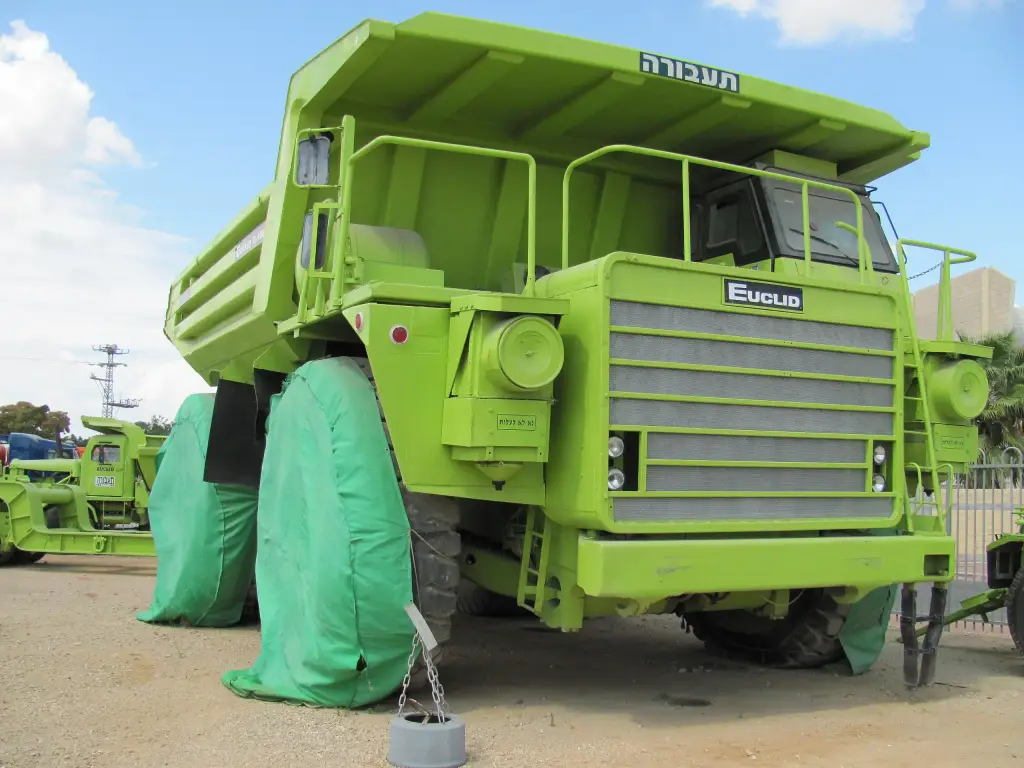

The Euclid R-series was the family of two-axle rigid rear-dump haul trucks with which Euclid Trucks served quarries, open-cast mines and dam sites from the late 1960s onwards. The model numbers ran from the small end of the range up to the R-170, while the biggest machines carried names such as R-190 and R-210. The series survived the company’s sale from General Motors to White, to Daimler-Benz, to Clark and finally into the Volvo and Hitachi groups.
Euclid R-series at a glance
| Maker | Euclid Trucks, Euclid, Ohio; later Guelph, Ontario |
|---|---|
| Type | two-axle rigid rear-dump haul truck |
| Series payload range | 22 to 170 short tons (20 to 154 t) in the Daimler-Benz years |
| Model numbers | R-85 to R-170, R-190, R-210 |
| Engines | Cummins and Detroit Diesel, 228 to 1,600 bhp |
| 1969 | R-X, 110 short tons (99.8 t) |
| 1971 | R-210, 210 short tons (190.5 t) |
| 1979 order | ten B-105 bottom dumps and 31 dumpers R-85 to R-170, US$17 million |
| 1984 | R-210 reissued as a two-axle turbine-electric truck |
| 1986 onwards | sold as Volvo BM, Michigan Euclid and Ranger |
| Owners | General Motors 1954–1968, White 1968–1977, Daimler-Benz 1977–1984, Clark 1984 |
| End of the name | Euclid-Hitachi, Hitachi sole owner by 2000, brand retired 1 January 2004 |
No Wikipedia article covers the R-series on its own, so this page is built from the English, German and French articles on the maker Euclid Trucks; the figures for the individual model numbers come from those accounts, not from a model page.
History of the Euclid R-series
Before the R-series: Euclid’s off-road haulers
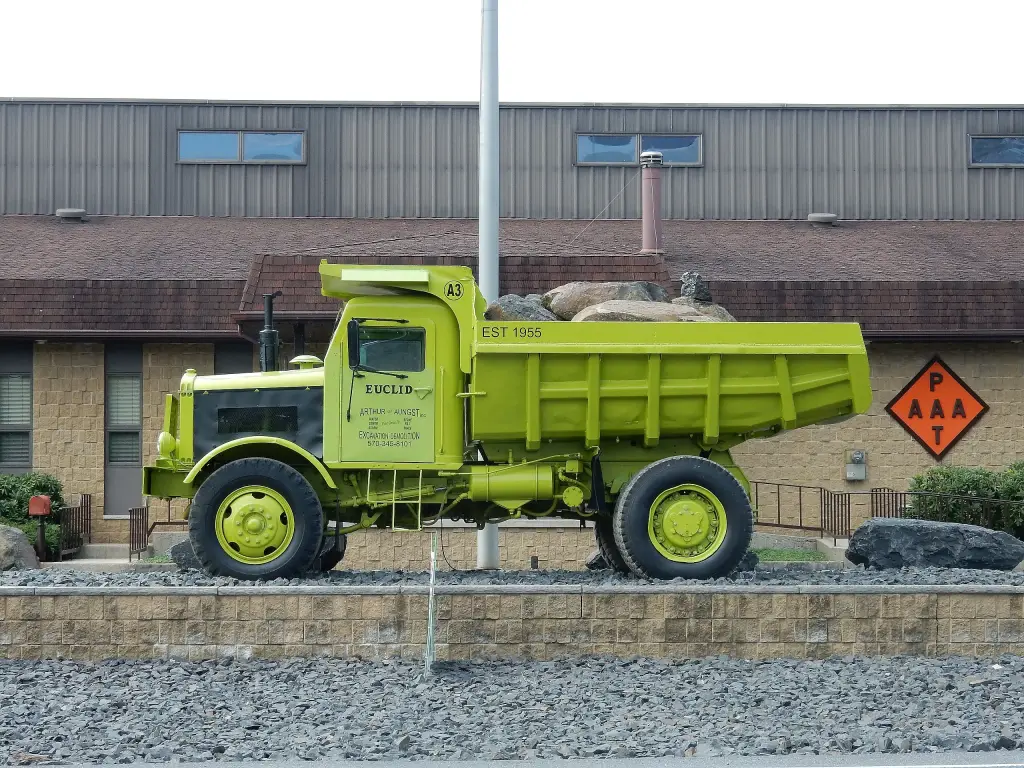
The Euclid Company of Euclid, Ohio, built haulers designed for off-road work from the start, rather than adapting ordinary road trucks as most rivals did. The Euclid Crane and Hoist Co. was formed in 1909 by George A. Armington and his five sons, and in 1926 the family set up Euclid Inc. as the road machinery division aimed at the off-road hauler market. In January 1934 the company produced its first purpose-built off-road dump truck, the Model 1Z, with a 100 horsepower (75 kW) Waukesha petrol engine and 17.5 x 24 tyres that had only just been released by the tyre industry. Euclid machines were finished in a distinctive bright ‘highlite green’ paint scheme. In 1951 the firm built what the English account calls the industry’s first 50-ton three-axle dump truck, with twin Cummins power; the German account records it as the 6×4 off-road dumper 1LLD, whose two 300 bhp Cummins diesels sat side by side at the front and which carried 45 short tons (40.8 t). During the 1950s and 1960s Euclid built two- and three-axle dump trucks with capacities up to 105 tons, and some of the largest three-axle units served as tractors for even bigger end-dump and bottom-dump haulers.

The R-series takes shape
General Motors bought Euclid in 1953, announcing the deal on 30 September 1953 with an official takeover date of 1 January 1954, and ran the business as the Euclid Division. In 1969, by then owned by White Motor Corporation, Euclid introduced the R-X dumper with a payload of 110 short tons (99.8 t), and in 1971 came the R-210 at 210 short tons (190.5 t). White sold Euclid to Daimler-Benz in 1977, and the new owner reorganised the range into three families: the two-axle dumpers of the R-series with payloads from 22 to 170 short tons (20 to 154 t), the B-series bottom-dump trailer units up to 110 short tons (99.8 t) and the SC-series loaders used in coal mining up to 150 short tons (136 t). Power came from Cummins and Detroit Diesel engines rated between 228 and 1,600 bhp. In 1979 Peter Kiewit Sons placed an order worth US$17 million for ten B-105 bottom dumps and a further 31 dumpers ranging from the R-85 to the R-170.
Turbines, wheel motors and the VME years
Daimler-Benz sold the company to Clark Equipment in 1984. That year brought a new generation of trucks and a reissued R-210: a two-axle machine with all-wheel drive and single tyres, driven by an Avco-Lycoming turbine of 1,850 bhp that turned a DC generator feeding an electric motor in each wheel. A second hybrid followed at the end of the 1980s, the R-170, with General Electric wheel motors and a choice of a Cummins V16 diesel or a V12 turbodiesel of 800 bhp. In August 1986 Clark Michigan became part of the VME Americas joint venture with Volvo Construction Equipment, the initials standing for Volvo, Michigan Loader and Euclid; the trucks were sold under the Volvo BM, Michigan Euclid and Ranger labels. The best seller of the period was the R-190 with a 172 t payload, which used the same hybrid drive with a Cummins or a Detroit Diesel V16 of up to 1,800 bhp. In December 1993 VME North America formed a joint venture with Hitachi Construction Machinery, Euclid-Hitachi Heavy Equipment. Hitachi raised its share to 100 per cent by 2000, moved production from Euclid, Ohio, to Guelph, Ontario, and retired the Euclid name on 1 January 2004.
Design and features
- Built for the site, not the road: Euclid designed its haulers from the ground up for off-road earthmoving, unlike makers who converted road trucks.
- Two-axle rigid layout: the R-series kept a simple rigid chassis with two axles, in payload classes from 20 to 154 tonnes.
- Twin engines and turbine-electric drive: Euclid experimented with paired Cummins engines, then with a gas turbine driving a generator and wheel motors.
- Cummins and Detroit Diesel power: the range was sold with American engines from 228 to 1,600 bhp rather than the new owner’s own Mercedes units.
- Highlite green: the bright paint scheme became the visual signature of Euclid equipment.
Euclid R-series versions
- R-X (1969): the first of the big White-era dumpers, 110 short tons (99.8 t).
- R-85 to R-170: the core of the Daimler-Benz range, 31 of them ordered by Peter Kiewit Sons in 1979.
- R-190: the best-selling truck of the VME years, 172 t payload and hybrid drive.
- R-210 (1971): the 210 short ton (190.5 t) flagship of the early range.
- R-210 (1984): all-wheel-drive reissue with single tyres and Avco-Lycoming turbine power.
- R-170 hybrid: General Electric wheel motors with a Cummins V16 or V12 turbodiesel.
More off-road equipment is in the Euclid collection; the later owner Clark Equipment has its own Clark collection, and the VME partner is covered in the Volvo collection.
Video: Stockton Opencast Anthracite Mine PA USA
Video on YouTube.
Sources
- Euclid Trucks, English Wikipedia: company history, the 1951 truck, General Motors years, the split into Terex
- Euclid Trucks, German Wikipedia: R-series payload range, engines, the 1979 order, turbine and hybrid trucks
- Euclid Trucks, French Wikipedia: the three model families, R-210 and the company chronology