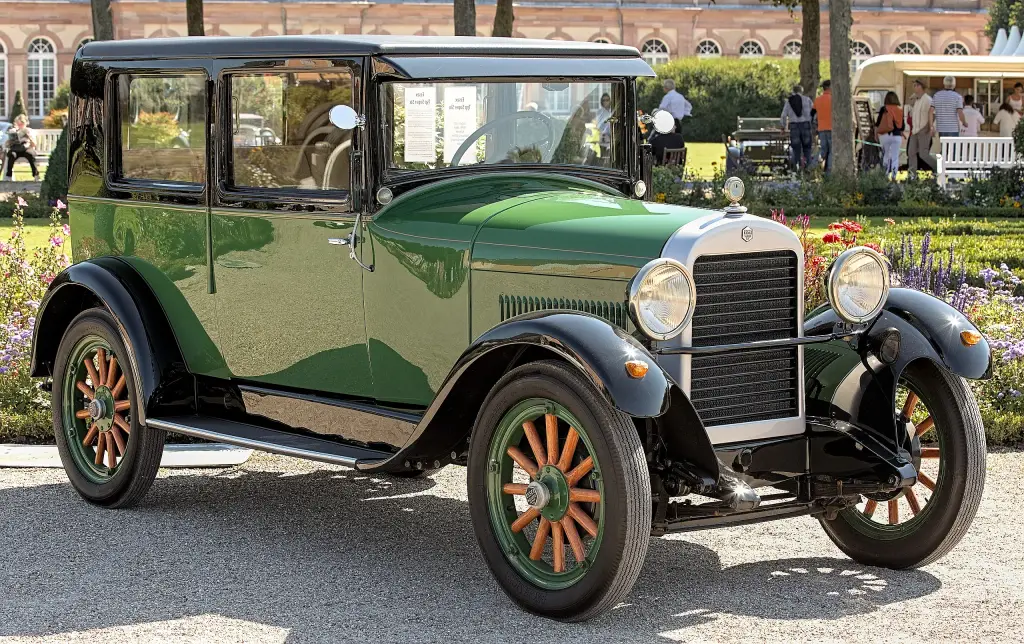

The Essex was a moderately priced American car, first built by the Essex Motor Company and from 1922 by Hudson of Detroit. It is generally credited with starting the move away from open touring cars towards enclosed bodywork, and it did so at a price ordinary families could pay.
Essex at a glance
| Maker | Essex Motor Company, 1918–1922; Hudson Motor Car Company, Detroit, 1922–1933 |
|---|---|
| Introduced | 1918, on sale from 1919 |
| Type | small, moderately priced family car |
| Body styles | touring car; sedan from 1920; coach from 1922 |
| Coach price, 1922 | $1,495, $300 above the touring car |
| 1926 wheelbase | 110.5 in (2,807 mm) |
| 1926 length | 14 ft 6 in (4,420 mm) |
| 1928 | four-wheel mechanical brakes |
| U.S. sales rank, 1929 | third, behind Ford and Chevrolet |
| Models | Essex Coach, Essex Six |
| Final form | Essex-Terraplane, 1932 |
| Sold | more than 1.13 million by 1932 |
The English Wikipedia article on the Essex marque is the only source used here, and it covers the whole brand rather than a single model; the coupe and sedan records are described together.
History of the Essex
A Hudson brand, 1918–1922
The Essex was created as a product of the Essex Motor Company, a wholly owned entity of Hudson. It was conceived as a small car at an affordable price, and it enjoyed immediate popularity after its 1919 introduction. Demand was strong enough that Essex Motors leased the Studebaker factory in Detroit to build the car. In 1919 an Essex completed a 50-hour endurance test in Cincinnati, Ohio, covering 3,037.4 miles (4,888.2 km) at an average speed of 60.75 mph (97.77 km/h); the run was checked and confirmed by the AAA and the United States Post Office. Early Essex cars also took many hill-climb records, and in a special Essex race car Glen Shultz won the 1923 Pikes Peak Hill Climb.
Closing the roof, 1920–1928
Essex began with a line of touring cars, open four-door cars with canvas tops, then the most popular body style in production. An enclosed sedan was added in 1920, and in 1922 Essex released the first closed coach sold at a price close to its open-bodied stablemate: $1,495, some $300 more than the touring car. By 1925 the coach cost less than the touring car. Henry Ford is credited with inventing the affordable car, but it was Essex that made the enclosed car affordable. The bodies were strong, too: Essex advertised “piano hinge doors”, and one press advertisement showed a man fully supported by an open door to prove the point. For 1928 the big news was four-wheel mechanical brakes.
Records and the Terraplane, 1929–1934
By 1929 the Essex was third in American sales, behind Ford and Chevrolet, and sales held up into 1931 before turning down. For 1932 a redesigned Essex appeared as the Essex-Terraplane, a play on the word aeroplane; that year the Essex Motor Company was dissolved and the cars officially became a Hudson product. The instrument panel of the 1932 Hudson and Essex was the first to use warning lights instead of gauges. For 1934 the Essex name was dropped and the car was marketed simply as the Terraplane. More than 1.13 million Essex cars had been sold by the time the name was retired. Essex vehicles were also exported complete or assembled from knock-down kits in Canada, the United Kingdom, Germany, Australia, New Zealand and South Africa.
Design and features
- Affordable closed body: the 1922 coach brought an enclosed car within $300 of an open touring car, and by 1925 it was cheaper.
- Proven durability: a 50-hour, 3,037-mile run in Cincinnati at an average of 60.75 mph was verified by the AAA and the U.S. Post Office.
- Strong doors: the “piano hinge” doors were advertised with a photograph of a man standing on an open one.
- Four-wheel brakes from 1928: mechanical brakes on all four wheels, at a time when many rivals still braked on two.
- Warning lights: the 1932 Hudson and Essex dashboards replaced gauges with the first warning lights.
Essex versions
- Essex touring car (1919–): the open four-door with a canvas top that launched the marque.
- Essex sedan (1920–): the first enclosed body in the range.
- Essex Coach (1922–): the closed coach that undercut the touring car within three years.
- Essex Six: the six-cylinder model listed in the Essex range.
- Essex-Terraplane (1932–1933): the redesigned final Essex, renamed Terraplane for 1934.
More American cars of the period are in the Essex collection.
Video: 1932 Essex-Terraplane coupe
Video on YouTube.
Sources
- Essex (automobile), English Wikipedia: history, prices, records, specifications, models