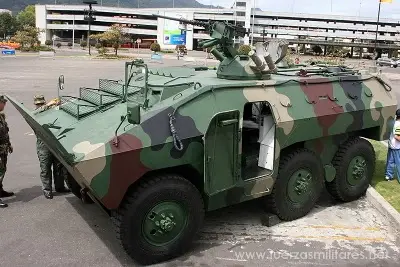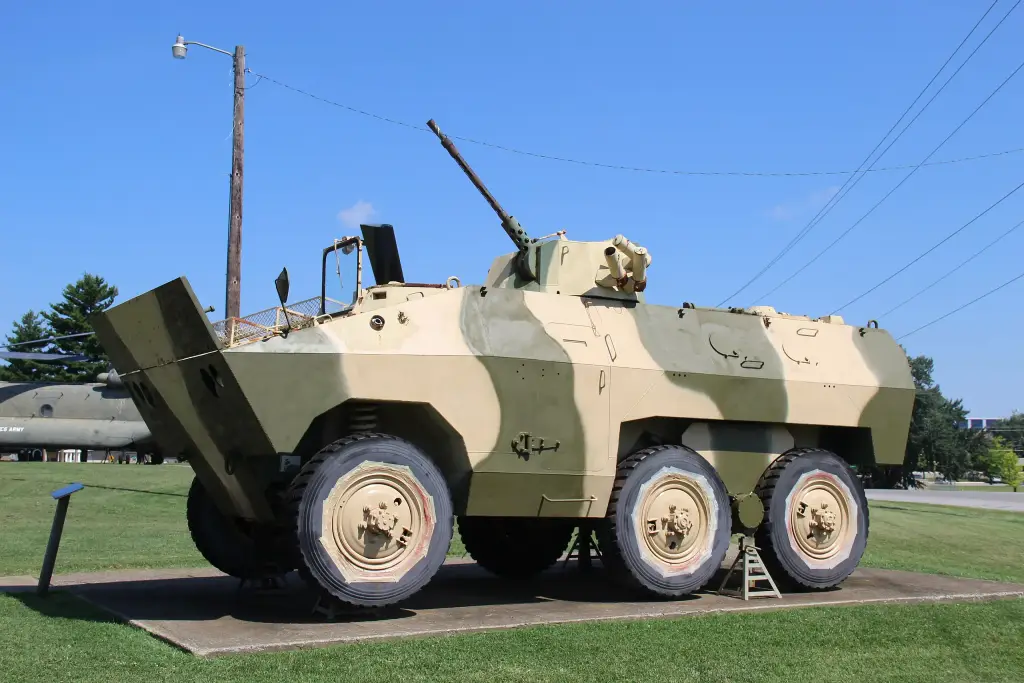
The Engesa EE-11 Urutu is a Brazilian amphibious armoured personnel carrier with 6×6 drive. It was developed from the drivetrain and chassis components of the EE-9 Cascavel armoured car and was built by Engesa from 1974 until the company’s collapse in 1993.
Engesa EE-11 Urutu at a glance
| Maker | Engesa (Engenheiros Especializados S.A.), Brazil |
|---|---|
| Type | amphibious armoured personnel carrier, 6×6 |
| Production | 1974–1993 |
| Based on | EE-9 Cascavel drivetrain and chassis |
| First prototype | 1970 |
| Pre-production trials | Brazilian Marine Corps, late 1973 |
| Brazilian Army order | 217 vehicles |
| Amphibious speed | 8 km/h, twin propellers |
| Main export customers | Libya, Iraq, Chile (37 in 1975) |
| Special variant | Uruvel, with the Cascavel’s 90 mm gun |
| Operators | more than thirty armies and security forces |
The article is based on the English and Portuguese Wikipedia pages on the EE-11 Urutu, with company background from the Engesa articles in the same languages.
History of the Engesa EE-11 Urutu
Development
In the early 1960s Brazil’s defence industry was negligible, limited largely to small arms and the refurbishment of obsolete American equipment. Between 1964 and 1967 the government launched a programme to revive the arms industry, and Brazilian engineering firms such as Engesa began developing weapons for domestic use. In 1967 work started on a wheeled armoured car to replace the M8 Greyhound; it became the EE-9 Cascavel. Engesa’s president, José Luiz Whitaker Ribeiro, also drew up a parallel project, the Carro Transporte de Tropas Anfíbio (CTTA), an amphibious troop carrier on a similar chassis. The first prototype was completed in 1970.
In late 1973 the Brazilian Navy accepted the CTTA for preliminary trials with the Marine Corps. The Marines ordered only six vehicles, but the Brazilian Army was more forthcoming and ordered 217. Mass production began in 1974 in a purpose-built Engesa factory at São José dos Campos, and the first vehicles entered army service in 1975 as the EE-11 Urutu.
Exports and combat use
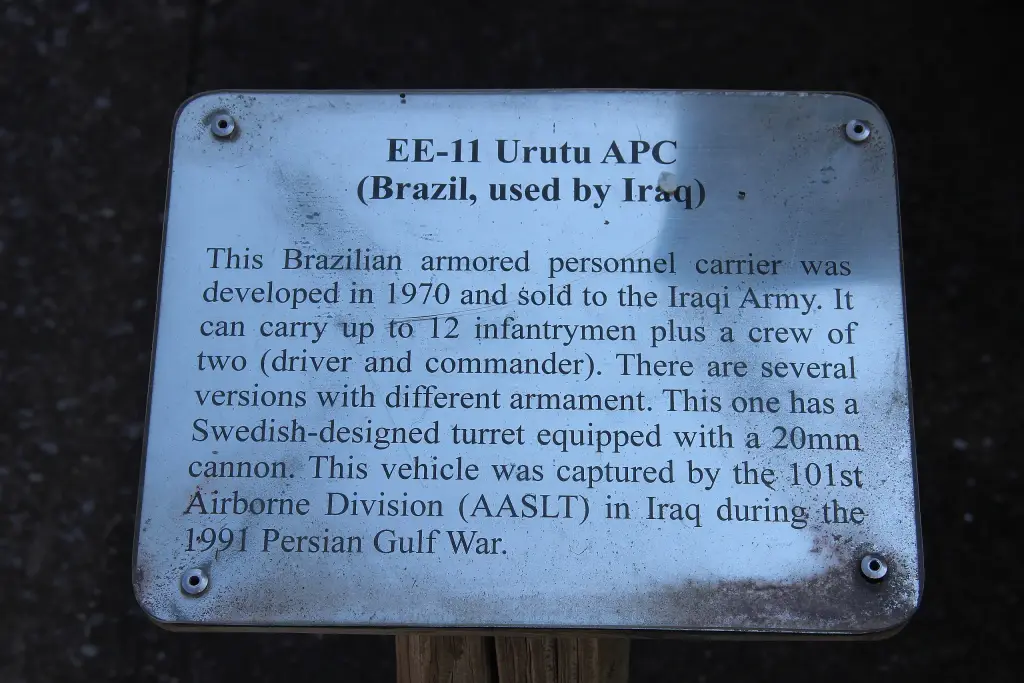
The Urutu benefited from the export success of the Cascavel, as many armies ordered both types to simplify logistics. Chile bought 37 in 1975 to complement its Cascavel fleet, and Libya and Iraq placed large orders; by the late 1980s each may have bought hundreds, some of which were re-exported to other states and regional movements. Iraq used its Urutus during the Iran–Iraq War, which became in effect a proving ground for the vehicle, and Urutus were still appearing in conflicts in the region in the 2010s.
In 1980 the US Army asked for a new wheeled armoured vehicle for a mobile deployment force. Engesa responded with an Urutu carrying a large turret ring and the Cascavel’s 90 mm gun, known as the Uruvel; at least one modified vehicle was delivered for trials, and FMC even bought licences to build both the Urutu and the Cascavel in the United States. The programme was shelved in the late 1980s and the Uruvel was adopted only by Tunisia, which ordered twelve.
End of production
Engesa ran into financial crisis in the early 1990s and suspended all its production lines. By 1993 the firm had declared bankruptcy and production of the Urutu was formally terminated.
Service in Brazil
The Cascavel–Urutu pair formed the basis of Brazil’s new mechanised cavalry for four decades, until the vehicles began to be replaced by the VBTP-MR Guarani from 2014. Urutus served with the Brazilian contingent of the United Nations stabilisation mission in Haiti between 2004 and 2017, where they were used for policing duties, and some Brazilian vehicles were later transferred to public security forces, including the BOPE unit in Rio de Janeiro.
Design and features
- Fully amphibious: the first fully amphibious armoured vehicle developed in Brazil, propelled in water at up to 8 km/h by a pair of propellers.
- Cascavel family: it shared the drivetrain and chassis components of the EE-9 Cascavel, so operators could run both types with one logistics train.
- Wide export base: Urutus were operated by over thirty national armies and security forces, above all in the Middle East.
- Many roles: specialised variants were developed for internal security, vehicle recovery, air defence, cargo transport and medical evacuation.
- Naval version: the Marine Corps vehicles had trim vanes, shrouded propellers, twin rudders and four air intake tubes for open-sea work.
Engesa EE-11 Urutu versions
- EE-11 Urutu APC: the standard amphibious troop carrier.
- Marine Corps version: trim vanes, shrouded propellers, twin rudders and four air intake tubes for operation at sea.
- Uruvel: hybrid with a large turret ring and the Cascavel’s 90 mm gun, offered to the US Army; twelve sold to Tunisia.
- Specialised variants: internal security, recovery, air defence, cargo and medical evacuation versions.
The Urutu shared its chassis and drivetrain with the EE-9 Cascavel and was sold alongside the Engesa EE-15 utility truck as part of a complete package. More vehicles from the maker are in the Engesa collection.
Video: ENGESA URUTU 6X6 APC
Video by Luis Carlos Silva dos Santos on YouTube.
Sources
- EE-11 Urutu, English Wikipedia: development, exports, Uruvel, end of production
- EE-11 Urutu, Portuguese Wikipedia: service in Brazil, Haiti, BOPE
- Engesa, English Wikipedia: company background
- Engesa, Portuguese Wikipedia: company background