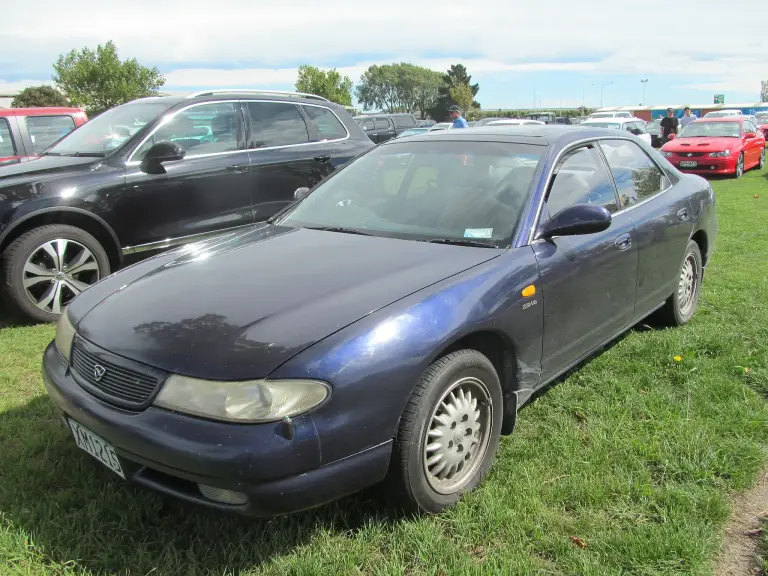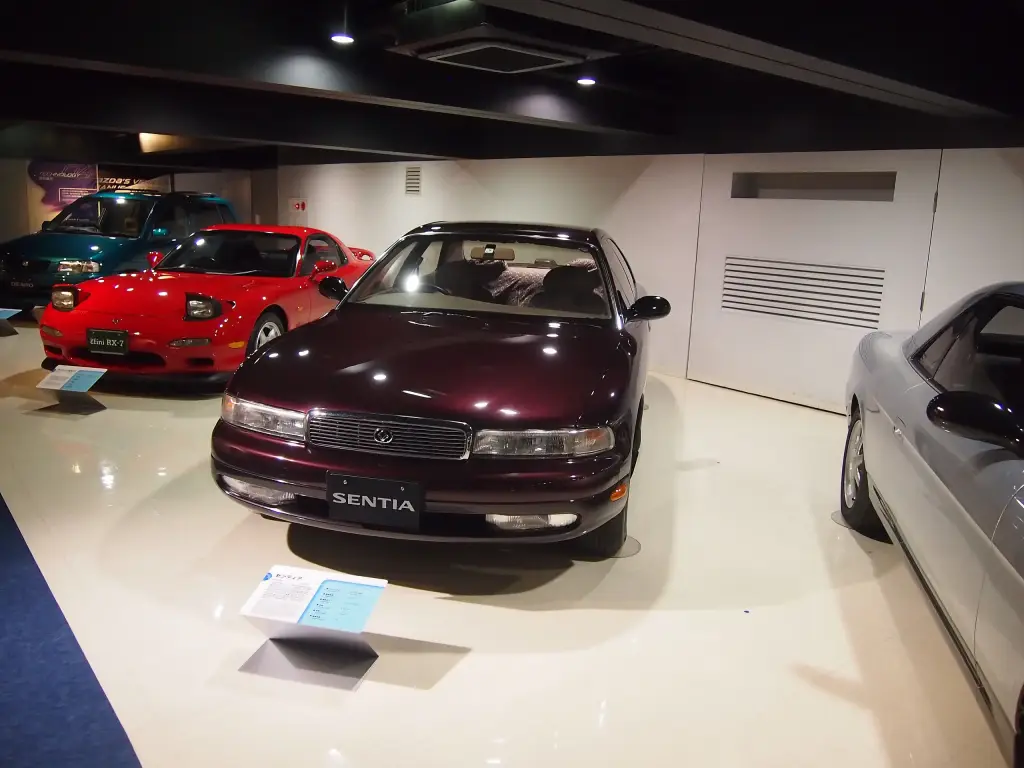
The Efini MS-9 was the largest and most luxurious Mazda sold in Japan in the early 1990s, offered through the company’s short-lived Efini dealer network. It was a more generously equipped version of the Mazda Sentia: items that were optional on the Sentia came as standard on the MS-9.
Efini MS-9 at a glance
| Maker | Efini (Mazda), Japan |
|---|---|
| Production | 1991–1996 |
| Class | flagship luxury sedan |
| Relation | higher-content version of the Mazda Sentia |
| Sold abroad as | Mazda 929 / 929 Serenia |
| Engines | 3.0 L JE-ZE V6, 200 PS; 2.5 L J5-DE V6, 160 PS |
| Layout | front midship: V6 behind the front axle, fuel tank above the rear axle |
| Steering | speed-sensitive four-wheel steering |
| Feature | solar ventilation powered by roof-mounted solar cells |
| Also built as | Kia Enterprise in South Korea |
based on one source (English Wikipedia article on the Mazda Sentia, which covers the Efini MS-9)
History of the Efini MS-9
The Efini channel
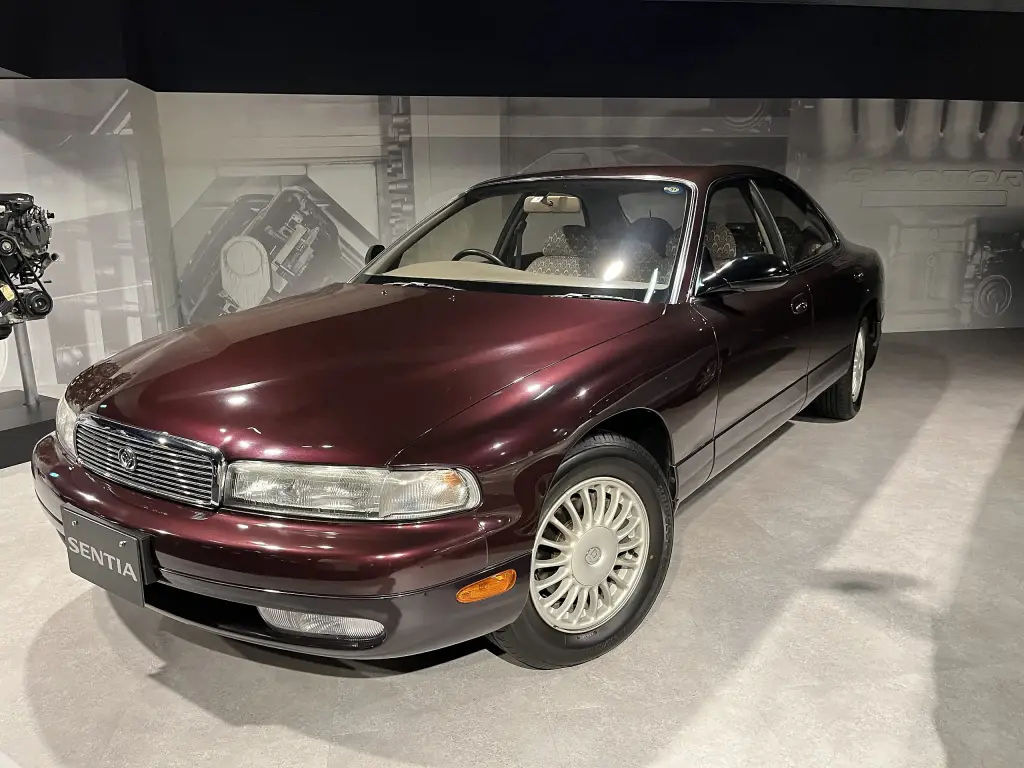
When the Mazda Sentia was introduced in Japan in 1991, it was also sold through Mazda’s short-lived exclusive luxury channel as the Efini MS-9. The two cars were the same design, but the MS-9 was positioned as a higher-content luxury sedan, with equipment that was optional on the Sentia fitted as standard. The Sentia was the largest Mazda of the era and the MS-9 inherited that role, with a 3.0-litre V6 at the top of the range.
Design and engineering
Mazda marketed the car as having a “front midship” layout: the V6 sat behind the front axle, while the fuel tank rested above the rear axle. The installation of the engine behind the front axle used technology Mazda had already developed for its rotary-engined cars, principally the RX-7 and the Cosmo. The body was wide by Japanese standards, which carried a higher annual tax under the country’s dimension regulations, but it also brought the space and presence expected of a flagship.
Chassis technology
This generation of the car debuted Mazda’s speed-sensitive four-wheel steering system. Below about 35 km/h the rear wheels steered in the opposite direction to the front wheels, reducing the turning radius; at higher speeds they steered in the same direction to improve stability. A solar ventilation system was another showcase feature: amorphous solar cells in the sunroof panel powered small fans in the trunk area, cooling the cabin while the car stood parked in the sun. The same idea later appeared on the Eunos 800 and Millenia.
Engines and equipment
Two engines were available, both derived from earlier Mazda V6 designs and unrelated to the aluminium KL series used in Capella-based models. The 3.0-litre JE-ZE received a new variable-length intake manifold that raised its output to 200 PS; the 2.5-litre J5-DE produced 160 PS. Two displacements were offered in Japan so that buyers could choose which annual road tax they were prepared to pay, and the larger engine came with a substantially richer specification. Anti-lock brakes, full electrics, cruise control, four-wheel steering and a solar vent were all part of the package.
Export and end of production
Outside Japan the same generation appeared in 1991 as the Mazda 929, and in Canada as the 929 Serenia. It was also built under licence in South Korea by Kia at the Hwaseong plant until October 2002 and sold there as the Kia Enterprise, using Mazda-sourced engines. Japanese production of this generation ended in 1996, when a new Sentia took over; by then Mazda’s multi-brand strategy was collapsing and the Efini name was on its way out.
Design and features
- Front-midship layout: the V6 sat behind the front axle and the fuel tank above the rear axle.
- Four-wheel steering: speed-sensitive rear steer cut the turning circle and steadied the car at speed.
- Solar ventilation: roof-mounted solar cells drove fans that cooled the parked cabin.
- Flagship equipment: the MS-9 carried as standard items that were optional on the Sentia.
- Two V6 engines: a 3.0-litre unit of 200 PS and a 2.5-litre unit of 160 PS.
Efini MS-9 versions
- MS-9 (1991–1996): the standard flagship with the 3.0-litre V6.
- 2.5-litre cars: the smaller-engined version offered for a lower annual road tax.
- Four-wheel-steer cars: examples fitted with the speed-sensitive rear-steer system.
- Solar-vent cars: cars with the solar-powered ventilation system.
- Export 929: the same car sold outside Japan, including the 929 Serenia in Canada.
- Kia Enterprise: the licensed South Korean version built until 2002.
The MS-9 was the larger stablemate of the Efini MS-8. More cars from the brand are in the Efini collection.
Sources
- Mazda Sentia, English Wikipedia: MS-9 positioning, layout, four-wheel steering, solar vent, engines, export