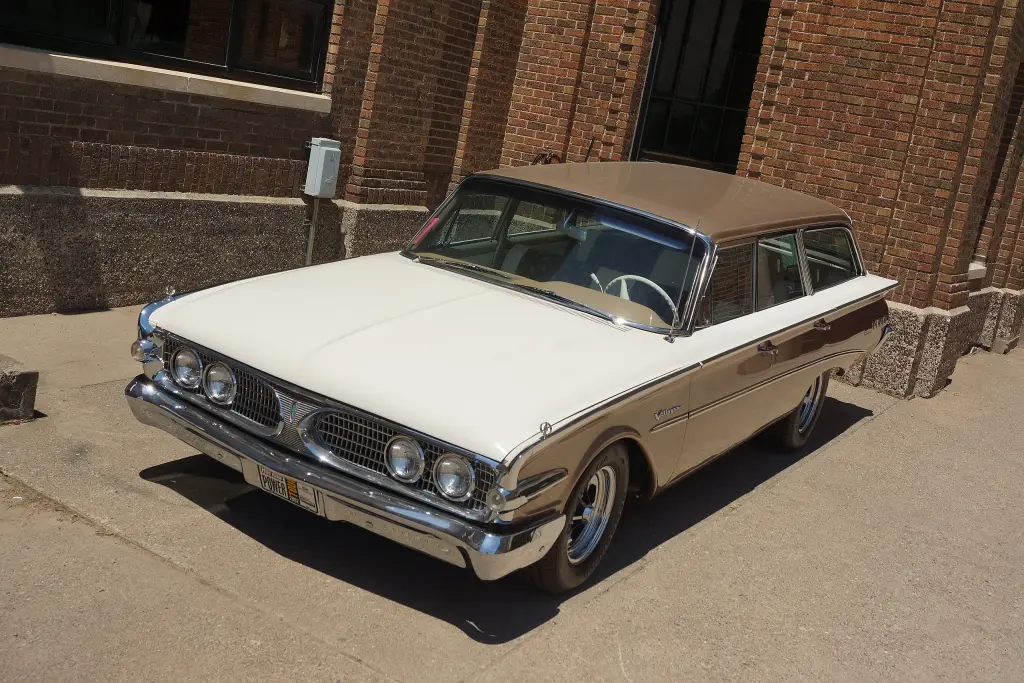
The Edsel Villager is a station wagon that Edsel produced and sold from 1958 to 1960. Built on the narrower Ford wagon body, it was the division’s counterpart to the Ford Country Sedan and, with the Ranger, one of only two nameplates to survive the marque’s whole three-year life.
Edsel Villager at a glance
| Maker | Edsel division of Ford |
|---|---|
| Production | 1958–1960 |
| Body | four-door station wagon, six or nine seats |
| Ford counterpart | Ford Country Sedan |
| Wheelbase | 116 in in 1958–59, 120 in in 1960 |
| 1958–59 engine | 361 cu in (5.9 L) V8 |
| 1960 engines | 223 cu in six, 292 V8 standard, 352 V8 optional |
| Gearbox | three-speed manual; three-speed automatic; Teletouch in 1958 |
| Assembly | Louisville, Mahwah and San Jose |
| Sales | 7,820 in 1959; 275 in 1960 |
Based on one source: the English Wikipedia article on the Edsel Villager.
History of the Edsel Villager
1958
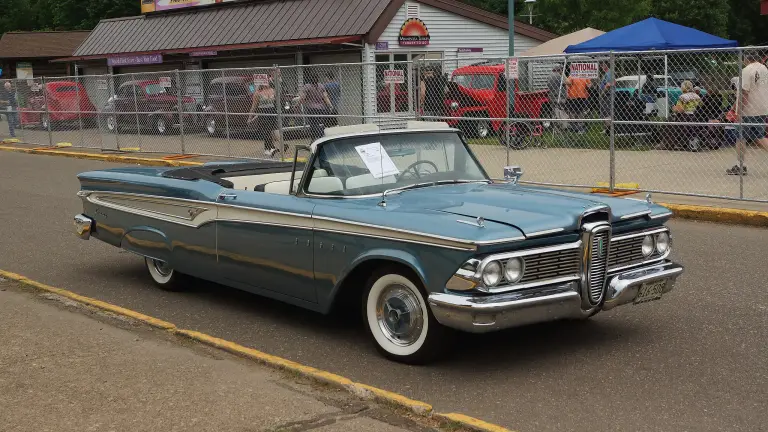
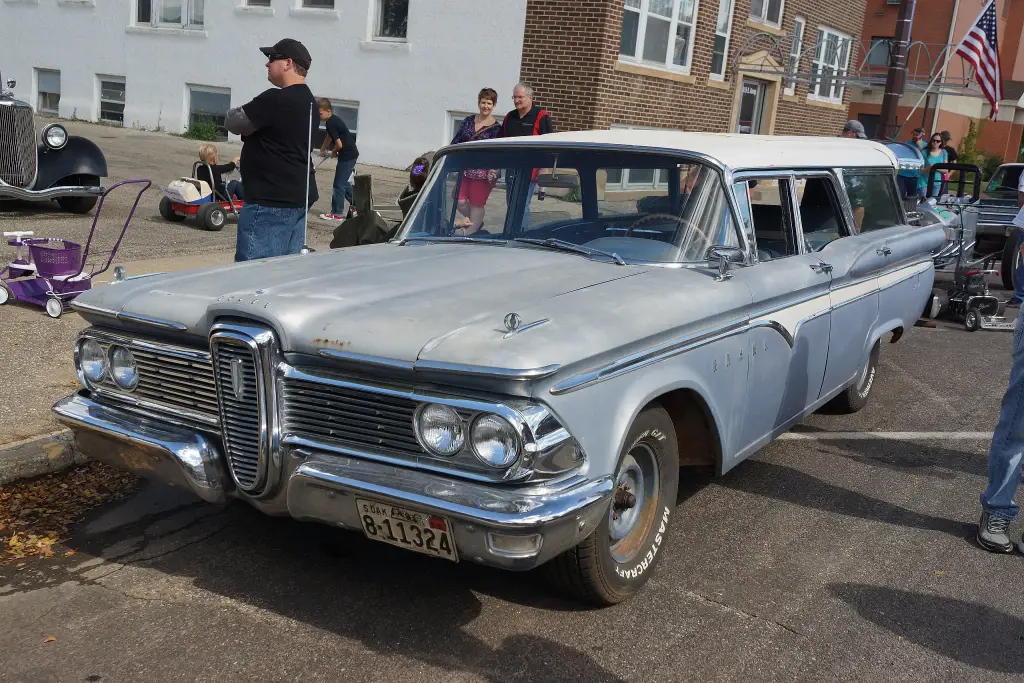
The Villager was the intermediate Edsel wagon, slotted between the two-door Roundup and the premium Bermuda. Ford had originally planned to call it the Caravan. It was sold only with a four-door body, in six- and nine-passenger versions, and it shared its body stampings with the Ford Country Sedan, just as the Ranger was derived from the Fairlane. All Edsel wagons used a 116-inch wheelbase and the Ranger’s interior and exterior appointments, and all had a two-piece tailgate; seat belts were optional. To distinguish the Edsel wagons from the Fords built on the same lines, the Villager received boomerang-shaped taillights instead of the round Ford or delta-shaped Mercury units. As on the Bermuda, their shape made the turn indicators confusing from a distance: the left lamp looked like an arrow pointing right. Every Villager used the 361 cu in V8, the largest engine offered in the Ranger, with a three-speed manual as standard and a three-speed automatic as an option, either with a column selector or with the division-exclusive but trouble-prone Teletouch system in the steering wheel hub. In its first year Edsel sold more Villagers than Roundups and Bermudas combined.
1959
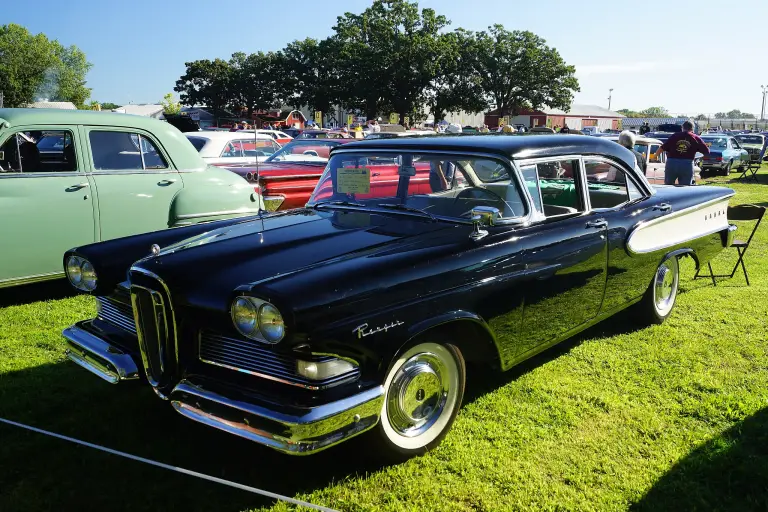
The Roundup and Bermuda were dropped, leaving the Villager as Edsel’s only station wagon. With the Ranger it received a toned-down front: the horse-collar grille stayed but was better integrated into the body along with the headlamps. The boomerang taillights gave way to four round units and two reversing lamps, with vestigial fins. Teletouch was discontinued and every automatic used a column-mounted shifter. Although Edsel sales fell overall in 1959, the 7,820 Villagers sold that year beat the combined sales of all three 1958 wagon lines by nearly 1,500 vehicles.
1960
For its final year Edsel cut the range to the Ranger passenger cars and the Villager wagon. The Villager looked closer to the Ford Country Sedan but had extensive body and interior changes: the horse-collar grille was deleted and replaced by an hourglass design, four vertical oval taillights marked the brand, and the wheelbase grew to 120 inches, an inch more than Ford. The powertrain was all new, the 361 V8 giving way to three engines: a 223 cu in inline six as a delete option, a 292 cu in V8 as standard and a 352 cu in V8 at extra cost, with a three-speed manual on the six and the 292 and a two- or three-speed automatic available throughout. Only 275 Villagers were built, because Edsel was in production for 43 days from mid-October to late November 1959; just 59 nine-passenger cars were made, the rarest Edsel wagon.
After the division closed, Mercury revived the Villager name in 1962 for a Comet wagon and later used it for woodgrained versions of the Montego, Bobcat, Cougar, Zephyr and Lynx. In the early 1990s the Mercury Villager became a stand-alone model, developed with Nissan and sold as the counterpart of the Nissan Quest.
Design and features
- Ford wagon body: shared stampings with the Ford Country Sedan on a 116-inch wheelbase.
- Six or nine seats: both layouts were offered, with a two-piece tailgate.
- Only wagon left: the Villager was Edsel’s sole station wagon in 1959 and 1960.
- New engines for 1960: a 223 six, a 292 V8 and an optional 352 V8 replaced the 361.
Edsel Villager versions
- 1958 Villager: 361 V8, boomerang taillights, optional Teletouch.
- 1959 Villager: the only Edsel wagon, 7,820 sold.
- 1960 Villager: 120-inch wheelbase, new engine range, 275 built.
- 1960 nine-passenger: 59 built, the rarest Edsel station wagon.
The Villager was the middle wagon of the 1958 range, below the Bermuda, and shared its front end with the Ranger; the Corsair was the premium sedan. More cars are in the Edsel collection.
Video: 1958 Edsel Villager Wagon
Video on YouTube.
Sources
- Edsel Villager, English Wikipedia: bodies, engines, changes by year, production