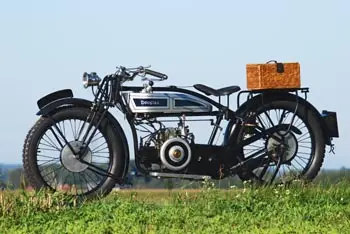
The Douglas EW is a motorcycle of the mid-1920s from Douglas of Kingswood, Bristol, the British firm whose whole reputation rested on horizontally opposed twin-cylinder engines. The machine shown in the video is a 1926 example.
Douglas EW at a glance
| Maker | Douglas, Kingswood, Bristol, England |
|---|---|
| Company founded | 1882, by William and Edwin Douglas |
| Motorcycle production | 1907–1957 |
| Engine layout | horizontally opposed twin, Douglas’s signature design |
| Example shown | 1926 Douglas EW |
| First disc brakes | Douglas, in the 1920s |
| Dirt-track range | DT5 and DT6, late 1920s and early 1930s |
| Company taken over | Bond Aircraft and Engineering, 1935 |
| Last model | 350 cc Dragonfly, 1955 |
| Production ended | 1957 |
There is no Wikipedia page for the EW model; this article is based on the English Wikipedia article on the Douglas company only (one source).
History of the Douglas EW
Douglas grew out of the Douglas Engineering Company, founded in Bristol in 1882 by the brothers William and Edwin Douglas. The firm began with blacksmith work and moved into foundry work, and it was this that brought it into motorcycles: it made castings for Joseph Barter’s Light Motors and took over the manufacturing rights when that company closed in 1907. From 1907 a 350 cc Douglas was on sale, and the horizontally opposed twin became the company’s trademark.
By the 1920s Douglas was an established maker with a Royal Warrant for the supply of motorcycles to the Princes Albert and Henry. The firm built the first disc brakes in that decade, and its RA model of 1923, with disc brakes, was favoured in dirt-track racing — which led Douglas to build specific dirt-track machines, the DT5 and DT6 with 500 cc and 600 cc engines, in the late 1920s and early 1930s.
The EW of 1926 sits in this interwar period, between the company’s early in-line twins and the 1934 Endeavour, the first Douglas with the flat twin mounted across the frame. Times were hard: in 1935 the company was taken over by the Bond Aircraft and Engineering Company, and it continued through the Second World War before a last flowering with the torsion-bar T35 of 1948 and the Dragonfly of 1955.
Design and features
- Flat twin: the horizontally opposed engine layout that Douglas built its reputation on.
- Bristol engineering: designed and built at Kingswood, the company’s works.
- Disc brakes: Douglas pioneered them in the 1920s, a decade before they became common.
- Racing pedigree: the same works built the dirt-track DT models that dominated speedway for about three years.
Douglas EW versions
- EW: the 1920s flat twin shown here.
- RA (1923): the disc-braked model favoured in dirt-track racing.
- DT5 and DT6: purpose-built dirt-track machines of the late 1920s and early 1930s.
- Endeavour (1934): the first Douglas with the flat twin across the frame.
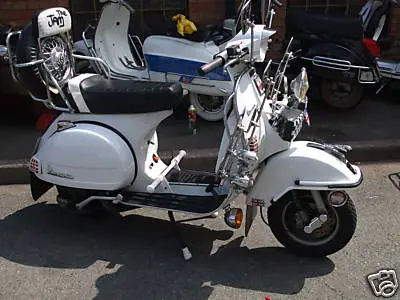
Douglas also imported Vespa scooters after motorcycle production ended: see the Douglas Vespa. More machines are in the Douglas collection.
Video: Trace’s 26 Douglas EW
Video on YouTube.
Sources
- Douglas (motorcycles), English Wikipedia: company history, engines, disc brakes, racing, takeover