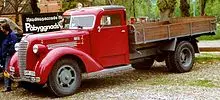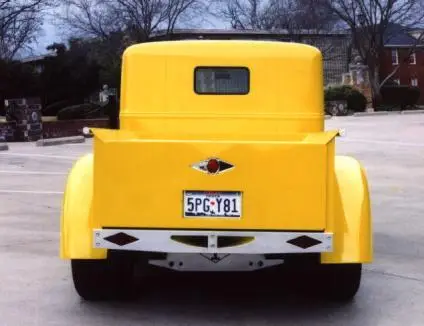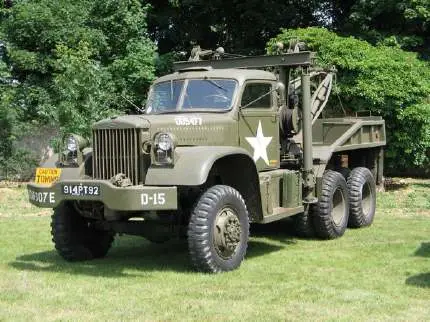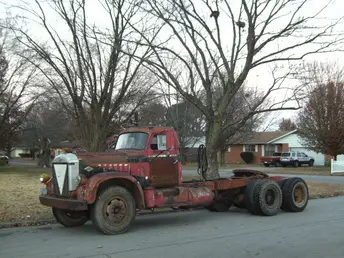
The Diamond T 921 is a heavy commercial truck from the post-war programme of the Diamond T Motor Car Company of Chicago. After civilian production resumed in 1945 the company rebuilt its range quickly: there were five models in 1946 and fourteen in 1947, rated by gross vehicle weight and offered with a wide choice of engines and axles.
Diamond T 921 at a glance
| Maker | Diamond T Motor Car Company, Chicago |
|---|---|
| Founded | 1905 by C. A. Tilt |
| Model | 921 |
| Post-war range | five models in 1946, fourteen in 1947 |
| Ratings from 1947 | chassis of 8,000–36,000 lb (3,600–16,000 kg) GVWR |
| Body styles | conventional, sleeper and cab-over-engine (COE) |
| Engines | Continental, Cummins and Hercules, petrol and diesel |
| Axles | single or tandem rear axles in many wheelbases |
| Model changes | annual changes discontinued; many models unchanged until 1950 |
| Truck cab | all-steel cab of 1933 used until it was replaced in 1951 |
| End of the name | merged with Reo in 1967 as Diamond Reo Trucks, Inc. |
Diamond T has no Wikipedia article on the 921; this page is based on the description of the company’s post-war commercial range in the article on Diamond T (based on one source).
History of the Diamond T 921
Engineering in the 1930s
The Diamond T Motor Car Company was founded in Chicago in 1905 by C. A. Tilt and began with touring cars of up to 70 hp before turning to trucks. The commercial range was modernised in 1928–1929, when a closed cab with doors was introduced, all-wheel hydraulic drum brakes were fitted, six-cylinder Continental and Hercules engines were offered for heavy trucks and a four-cylinder Buda for light ones, and all trucks received geared-differential rear axles. By 1929 chassis load ratings reached 12 tons (10,900 kg) on three axles. In 1933 came an all-steel covered cab with doors and roll-up windows, improved in 1935 with a “streamlined” V-style windscreen; this cab served commercial and military trucks until 1951, and the mechanical side was improved again in 1935 as new models were introduced.
War work
The 1930s brought steady growth: Diamond T sold 6,454 trucks in 1935 and 8,750 in 1936, 4,393 in 1938 and 5,412 in 1939. In 1940 Hercules six-cylinder petrol and diesel engines of up to 118 hp were used and Cummins diesels of up to 200 hp were introduced. In 1942 improved models went into production and then stopped after only 530 units, as the works turned to military production of tactical trucks and half-tracks. Diamond T built the whole G509 series of 4-ton 6×6 trucks and the 980/981 tank transporter, and ranked 47th among United States corporations in the value of its World War II military production contracts.
The post-war range
Commercial production was stopped in 1942; a small number of trucks were built again in 1944 and more in 1945. In 1946, the first full year of peace production, there were five models and in 1947 fourteen. After the war heavy trucks were measured by gross vehicle weight rating, the total weight of chassis, body and payload, and in 1947 Diamond T chassis were rated from 8,000 to 36,000 pounds (3,600 to 16,000 kg) with conventional, sleeper and cab-over-engine bodies. Annual model changes were discontinued and many models continued unchanged until 1950. Petrol and diesel engines came from Continental, Cummins and Hercules, and single or tandem rear axles were available in many wheelbases. The 921 shown in the film belongs to this generation of Diamond T heavy trucks.
Design and features
- Rated by weight: after 1945 Diamond T sold its heavy trucks by gross vehicle weight rating rather than by annual model changes.
- Three engine suppliers: Continental, Cummins and Hercules, in petrol and diesel form.
- Flexible chassis: single or tandem rear axles in many wheelbases, with conventional, sleeper or cab-over-engine bodies.
- Settled design: annual model changes were dropped after the war, so many trucks stayed unchanged until 1950.
- Military pedigree: the same works built the G509 4-ton 6×6 range and the 980/981 tank transporters.
Diamond T 921 versions
- Conventional: the standard bonneted truck with the cab behind the engine.
- Sleeper: a conventional chassis with a sleeper cab for long-distance work.
- Cab-over-engine: a short-wheelbase layout with the cab above the front axle.
- Tandem-axle chassis: heavier ratings with two rear axles for the largest loads.
The lighter end of the same range is described in Diamond T Model 201, the heavy trucks that followed in Diamond T 969 and the 1949 conventional in Diamond T Model 306. More vehicles are in the Diamond T collection.
Video: 1952 Diamond T 921 NSW cruisein out in the Duel like fashion !!
Video on YouTube.
Sources
- Diamond T, English Wikipedia: commercial range, ratings, engines, company history
- 1952 Diamond T 921, YouTube: identification of the truck in the film