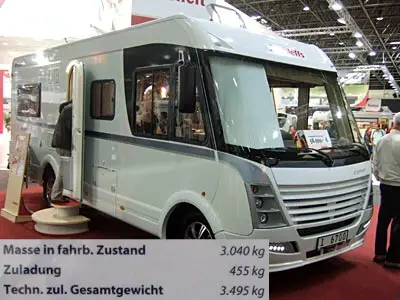
The Dethleffs Esprit is a caravan from Dethleffs GmbH & Co. KG of Isny im Allgäu in the Allgäu, Germany. The company built the first caravan in Germany in 1931, called it the “Wohnauto”, and has remained a caravan and motorhome maker ever since; since 1983 the brand has belonged to the Erwin Hymer Group.
Dethleffs Esprit at a glance
| Maker | Dethleffs GmbH & Co. KG, Isny im Allgäu, Germany |
|---|---|
| Type | touring caravan |
| Company founded | 1832 as Dethleffs KG (whips; ski poles from 1923) |
| First Dethleffs caravan | the “Wohnauto”, designed in 1931, first trip 1932 |
| First customer models | “Tourist”, 1934 |
| First series-produced “Camper” | 1952 |
| Brand name “Camper” protected | 1959 |
| Caravans built in 1976 | about 4,700 a year |
| Ownership | sold in 1971 to Wolfgang Thrun and Jakob Eicker; Hymer group since 1983 |
| Parent company today | Erwin Hymer Group |
| Works | Isny im Allgäu, about 283,000 m² since 2018 |
There is no Wikipedia article on the Esprit itself; this page is based on the German Wikipedia article on the Dethleffs company (one source) and describes the Esprit as part of the caravan range.
History of the Dethleffs Esprit
A whip factory that invented the German caravan
The company was founded in 1832 as Dethleffs KG and made whips; a ski-stick factory was added in 1923. About a hundred years after its foundation, Arist Dethleffs, son of the then owner, wanted to travel on long business trips with his wife, the painter Fridel Dethleffs-Edelmann, and their daughter Ursula. In 1931 he designed a caravan for her, which he called the “Wohnauto” and which was also to serve as a studio; its maiden trip followed in 1932. Caravans were built to order in Isny from 1932, and the first customer models were sold as the “Tourist” in 1934. By 1936 six permanent employees worked only on caravan production.
War, restart and the Camper
During the Second World War caravan building was restricted and the firm made medical sledges, including a caravan series for the Deutsches Afrikakorps in 1941. Immediately after the war, in 1945, the factory served the French as a prisoner-of-war camp. Production resumed in 1948, and in 1952 the first series production of the “Camper” began. Seven years later Dethleffs had the brand name protected; it had become a generic term for caravans and partly for motorhomes. A standard Camper then cost 1,950 marks, the better-equipped export version 2,490 marks. Whip production was given up in 1958 because demand for caravans was so strong.
The caravan series of 1958
By 1958 the range was broad: the Camper with a lifting top, 2.35 or 3.4 m long and 190 kg, for small cars from 1,970 DM; the Tourist with a pop-up roof, 3.6 m and 360 kg, for Volkswagen and DKW, from 4,570 DM; the Globetrotter with a “half” pop-up roof, 4.85 m and 580 kg, for cars from 1,400 cc, from 7,130 DM; the Nomad with a fixed roof, 4.05 m and 490 kg, for cars from 1,100 cc, from 6,290 DM; and the Vagant luxury model, 5.2 m and 830 or 950 kg, for cars from 1,700 cc, from 10,400 to 11,800 DM. In 1966 sixty employees were building Dethleffs caravans in continuous production.
New owners, motorhomes and the Hymer group
In 1971 the company was sold to Wolfgang Thrun and Jakob Eicker of T.E.C.; in 1980 they founded CMC together with Erwin Hymer, bringing Dethleffs, Eriba, Hymer and T.E.C. into one group, and in 1983 Hymer acquired sole rights to CMC. A new works with 12,000 m² of production space was started in 1973, and a year later Dethleffs employed 235 people and was among the ten largest German caravan makers; annual production in 1976 stood at 4,700 caravans. The first series-ready motorhome, on a Mercedes-Benz chassis, was shown in 1977 at 69,900 marks. Cheaper motorhomes followed in 1983 with the Pirat and Globetrotter on Ford Transit and Fiat Ducato chassis from 39,900 marks, later joined by the Mitsubishi L300, VW LT 40 and, in 2004, the Renault Master. Production space grew in 1992 and 2001, and at the 75th anniversary of the Wohnauto the firm had over 850 employees, built 7,150 motorhomes and 5,950 caravans a year and turned over more than 275 million euros. The 80,000th motorhome left Isny in 2011; in 2018 a new hall of 11,000 m² was added for camper vans and urban vehicles, bringing the works to about 283,000 m². Arist Dethleffs died on 14 February 1996 at the age of 88.
Where the Esprit fits
The Esprit is one of the caravan lines sold under the Dethleffs name, the part of the range that continues the firm’s original business: caravans towed behind a car, as opposed to the motorhomes Dethleffs has built since 1977. It follows a long line of Dethleffs caravan series, from the Tourist and Camper of the 1930s to the Globetrotter, Nomad and Vagant of 1958, all built in Isny im Allgäu.
Design and features
- A caravan, not a motorhome: the Esprit belongs to the towed part of the Dethleffs range, the business the firm began with in 1931 and never left.
- Light towing tradition: Dethleffs made its name with caravans light enough for small cars, such as the 1958 Camper at 190 kg and the Nomad at 490 kg.
- Lifting and pop-up roofs: from the 1930s the firm offered caravans with raising tops and pop-up roofs to save height and weight on the road.
- Made in Isny im Allgäu: all Dethleffs caravans and motorhomes have been built at the company’s works in the Allgäu.
- Part of the Erwin Hymer Group: since 1983 the brand has sat alongside Hymer, Eriba and T.E.C. in the group founded with Erwin Hymer.
Dethleffs Esprit versions
- Esprit: the caravan line itself, sold as part of the Dethleffs caravan range.
- Camper (1952 onwards): the first series-produced Dethleffs caravan, with a lifting top and a 1958 price from 1,970 DM.
- Tourist (1934, series from the 1950s): pop-up roof, 3.6 m and 360 kg, intended for Volkswagen and DKW cars.
- Globetrotter (1958): “half” pop-up roof, 4.85 m and 580 kg, for cars from 1,400 cc.
- Nomad (1958): fixed roof, 4.05 m and 490 kg, for cars from 1,100 cc.
- Vagant (1958): the luxury model, 5.2 m and 830 or 950 kg, for cars from 1,700 cc.
More caravans and motorhomes from the same maker are in the Dethleffs collection.
Sources
- Dethleffs, German Wikipedia: company history, caravan series, prices, ownership