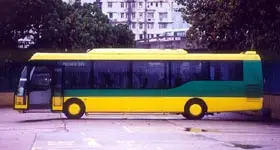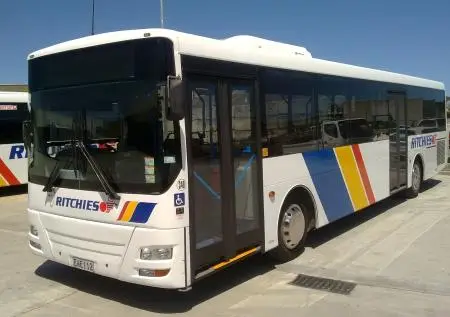
DesignLine was a New Zealand manufacturer of coaches and city buses, best known for the EcoSaver hybrid and the EcoSmart electric bus. Its vehicles were sold in five countries before the company entered bankruptcy in 2013 and its assets were renamed Environmental Performance Vehicles.
Designline buses at a glance
| Founded | 1985, Ashburton, New Zealand |
|---|---|
| First products | tour coaches |
| 1990s | conventional transit buses |
| Late 1990s | hybrid city buses |
| American owners | from 2006, headquarters in Charlotte, North Carolina |
| Bankruptcy | chapter 11, Delaware, 15 August 2013 |
| Assets sold | 28 October 2013 to Wonderland Investment Group |
| Renamed | Environmental Performance Vehicles, January 2014 |
| New Zealand arm | liquidated 2011; Global Bus Ventures (NZ) since 30 May 2016 |
| Bus models | EcoSaver, EcoSmart, EcoCoach, Olymbus |
| Countries in service | five |
DesignLine has no separate Wikipedia pages for its models; the article is based on the company page, which covers the range and its operators. Based on one source.
History of the Designline buses
Coaches from Ashburton
DesignLine was founded in Ashburton, New Zealand, in 1985 as a builder of tour coaches. During the 1990s the company diversified into conventional transit buses, and late in the decade it added hybrid city buses to its range. American interests acquired the business in 2006 and relocated its headquarters to Charlotte, North Carolina.
The EcoSaver hybrid
The EcoSaver was a range-extended electric hybrid bus: a plug-in sodium battery pack backed up by an on-board diesel or compressed natural gas turbine engine. The turbine did not drive the vehicle systems as the battery depleted; instead it produced electricity to recharge the batteries, and the turbines were supplied by Capstone Turbine of Chatsworth, California. The bus was first used in December 1998 in Christchurch, New Zealand, branded as The Shuttle, and had been designed in response to the international tender for ecological buses for the 2000 Sydney Olympics. It plugs in to recharge, captures energy from regenerative braking and needs only simple industrial-grade electrical access; the buses can travel more than 100 miles between charges. Demonstration fleets were deployed worldwide from 1998, and the fourth generation of the North American drive system was in production.
Electric and coach models
The EcoSmart was an all-electric bus powered by sodium batteries and based on the established EcoSaver drivetrain; it was in service in Australia and Abu Dhabi, and the Société de transport de Laval in Quebec was testing one. The EcoCoach was a high-floor, single-door bus powered by compressed natural gas or diesel, built on a lightweight frame intended for long routes with infrequent stops such as intercity services and park-and-ride routes. DesignLine had a contract with New Jersey Transit for 76 EcoCoach buses by May 2013, and the EcoCoach was the first 45-foot CNG coach to complete testing at the Altoona Bus Testing and Research Center.
Bankruptcy and renaming
DesignLine filed for chapter 11 protection in the United States Bankruptcy Court in Delaware on 15 August 2013, employing over 250 people in Charlotte. On 28 October 2013 Wonderland Investment Group bought most of the assets at auction and renamed the company Environmental Performance Vehicles in January 2014. The New Zealand operations had been placed in liquidation in 2011 and were later sold to a Malaysian-controlled joint venture, trading as DesignLine Bus Pacific and renamed Global Bus Ventures (NZ) on 30 May 2016.
Where the buses ran
DesignLine and EPV buses saw revenue service in five countries. In the United States, New Jersey Transit used them on routes 63, 64, 67 and 68 between Toms River, Lakewood, Freehold, Old Bridge and Newark, Jersey City and Hoboken, while RTD in Denver operated two EcoSaver IV vehicles modified for the 16th Street Mall shuttle. In Canada the Société de transport de Laval had one unit. New Zealand operators included NZ Bus, Metrolink, Ritchies, Go Bus and Red Bus, among many others; buses also ran in Adelaide, Mackay and Melbourne in Australia, in Tokyo, and in Newcastle-upon-Tyne, where ten Olymbus buses worked the QuayLink service.
Design and features
- EcoSaver hybrid: a plug-in sodium battery bus with a Capstone turbine that recharges the batteries, giving more than 100 miles between charges.
- EcoSmart electric: an all-electric version built on the EcoSaver drivetrain and tested in Canada, Australia and Abu Dhabi.
- EcoCoach: a high-floor CNG or diesel coach on a lightweight frame, the first 45-foot CNG coach tested at Altoona.
- Simple charging: the EcoSaver needed no proprietary charging infrastructure, only industrial-grade electrical access.
- Regenerative braking: energy recovered under braking helped recharge the batteries.
Designline buses versions
- EcoSaver (from 1998): range-extended electric hybrid bus with sodium batteries and a diesel or CNG turbine.
- EcoSmart: all-electric bus based on the EcoSaver drivetrain.
- EcoCoach: high-floor single-door coach for intercity and park-and-ride work.
- Olymbus: diesel-electric hybrid city bus, ten of which served QuayLink in Newcastle-upon-Tyne.
The hybrid city bus is described in the article on the Designline Olymbus. More buses are in the Designline collection.
Video: Ventura Group: MAN 16.220 Designline [Smart Bus]
Video on YouTube.
Sources
- Environmental Performance Vehicles, English Wikipedia: company history, EcoSaver, EcoSmart, EcoCoach, operators