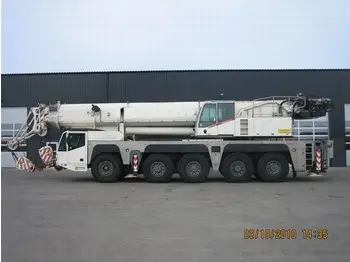
The Demag AC 200 is an all-terrain crane of the AC line built at the Zweibrücken crane works in Germany. Our archive has a video of a Terex-Demag AC 200-1, the name the plant’s cranes carried for a few years after Terex bought the works in 2002. No encyclopaedia article covers the AC 200 itself, so this page tells the story of the works and of the crane line it belongs to.
Demag AC cranes at a glance
| Model | Demag AC 200 (AC 200-1 in our video) |
|---|---|
| Type | all-terrain crane with a telescopic boom |
| Works | Zweibrücken, Germany |
| Works and Demag | part of Demag from 1954 to 2002 |
| Mobile cranes concentrated at Zweibrücken | 1981 |
| Brand after the Terex takeover | Terex-Demag, then Terex, from 2002 |
| Demag name reintroduced | 2016 |
| Owner since 2019 | Tadano Group; models named Tadano since 2021 |
| Range today | multi-axle all-terrain cranes and lattice-boom crawler cranes |
No Wikipedia article covers the Demag AC 200 itself. The facts here come from the history of the Zweibrücken crane works, so the crane’s own technical data — lifting capacity, boom length, production years — is not given: we found no reliable source for it.
History of the Demag AC cranes
Dingler’s workshop
The crane works in Zweibrücken began as a workshop that Christian Dingler opened in 1827 with ten workers, making oil and cutting mills. He added printing presses in 1834, and his toggle press, the Zweibrücker press, sold widely in Europe for years. The business became a joint-stock company in 1897, built its first rail-mounted crane in 1906 and added cranes, double-vibration rollers, asphalt pavers and concrete paving machines to its programme in 1930. In 1935 it was renamed Dinglerwerke AG Zweibrücken. After the Second World War it carried on with cranes and in 1950 introduced its first telescopic mobile crane, rated at 2.5 tonnes.
Demag and the mobile crane works
Demag took a stake in the Dinglerwerke in 1954 and placed the firm in its construction machinery division. The pace picked up: a telescopic mobile crane of 12 tonnes in 1963, the first lattice-boom mobile crane of 45 tonnes in 1965, and lorry crane production at Zweibrücken from 1966. In 1967 the works passed fully to Demag and were focused on mobile cranes; from 1969 the company traded as Demag Baumaschinen GmbH. The 1979 TC 4000 and CC 4000, 800 tonnes each, were followed by the CC 12000 of 1,000 tonnes in 1987. Mannesmann had taken a majority in 1973, and in 1981 it bundled the group’s mobile crane activities in Zweibrücken. A second plant followed at Wallerscheid in 1992; the CC 12600 of 1998 lifted 1,750 tonnes from a 102-metre main boom, with hydrostatic drive and lattice sections of fine-grain steel.
Terex-Demag, Demag again, Tadano
In 2001 the crane business became Demag Mobile Cranes GmbH. Terex bought the Zweibrücken plant from Siemens in 2002 and put it into its cranes division; the cranes were delivered for a while as Terex-Demag, and the name was then shortened to Terex. Our AC 200-1 carries the Terex-Demag lettering, so it belongs to those years. The Bierbach branch, built in 1925, was reopened in 2006 and sold in 2017. Demag returned as a brand in 2016; Tadano bought the company in 2019, and the Demag name was dropped again by the autumn of 2021, when every model was renamed Tadano. In 2023 the works employed around 1,100 people; in 2024 the management cut 249 positions and closed the Wallerscheid site, while the main plant in the Dinglerstraße stayed in operation.
The AC line
The Zweibrücken range is built around multi-axle all-terrain cranes with telescopic booms, alongside lattice-boom crawler cranes assembled from modules on site. The five-axle AC 5.250-2 and its long-boom sister, the AC 5.250L-2 with a 79-metre eight-section main boom and a maximum tip height of 112 metres, show what the AC designation stands for today; the crawler side is represented by the 1,250-tonne CC 78.1250-1. The AC 200-1 in our video is one of the all-terrain machines of this line. Its lifting capacity is not given in our sources, so it is not stated here.
Design and features
- Type: an all-terrain crane with a telescopic boom, the kind of machine the Zweibrücken works builds.
- Carrier: a multi-axle chassis, as on the five-axle AC 5.250-2 of the later range.
- Brand: the Terex-Demag lettering on the crane in our video places it after 2002, when Terex owned the plant.
- Works: built in Zweibrücken, where Demag concentrated its mobile crane activities in 1981.
Demag AC cranes versions
- AC 200-1: the version in our video, sold under the Terex-Demag name.
- AC 5.250-2: a five-axle all-terrain crane of the later Tadano Demag range.
- AC 5.250L-2: its long-boom variant, with a 79-metre eight-section main boom and up to 112 metres tip height.
More German machinery is in our Demag collection; see also the Demag DF 135 C crawler dozer.
Video: Terex-Demag AC 200-1
Video by denisimoos on YouTube.
Sources
- Tadano Demag, English Wikipedia: plant history, Terex-Demag brand, product range
- Tadano Demag, German Wikipedia: dates of the crane models, 1950 telescopic crane, CC 12600