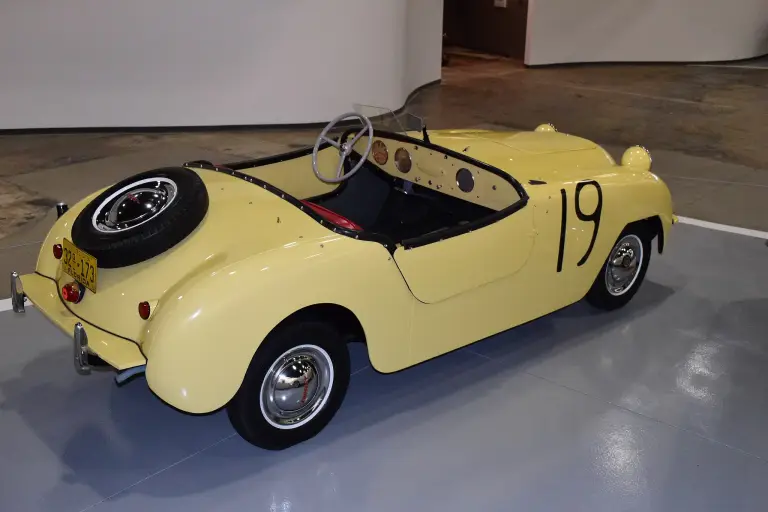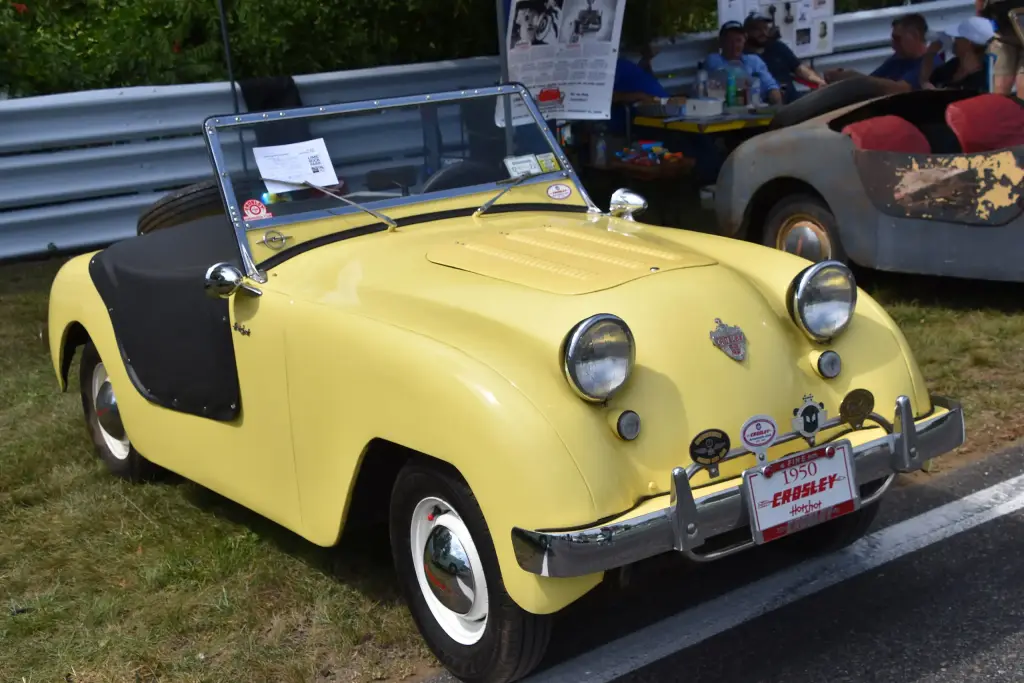
After building only economy cars since 1939, Crosley introduced a little sports car for the 1949 model year, the doorless Hot Shot roadster. It was the first American post-war volume-production sports car, and it was small enough to weigh just 1,095 lb.
Crosley Hot Shot at a glance
| Produced | 1949 to 1952 model years |
|---|---|
| Maker | Crosley Motors, Marion, Indiana |
| Body | doorless two-seat roadster; from 1950 a Super version with hinged doors |
| Engine | CIBA four-cylinder, 44.2 cu in (724 cc), 26.5 hp (20 kW) |
| Brakes | disc brakes on all four wheels |
| Layout | engine behind the front axle, a front mid-engined layout |
| Length | 137 in (3,500 mm) |
| Weight | 1,095 lb (497 kg); 991 lb (450 kg) stripped for racing |
| Price at launch | $849 |
| Top speed | more than 80 mph (130 km/h) |
This page is based on English and Italian Wikipedia, which cover the Hot Shot inside their articles on Crosley, so the details were not cross-checked against a dedicated source.
History of the Crosley Hot Shot
Crosley, the Cincinnati company of Powel Crosley Jr., had sold small, cheap cars since 1939. Its 1949 sports car broke with that pattern. It had a largely new dropped frame and, for the first time, a wheelbase that differed from the usual 80 in of every earlier Crosley, by 5 in extra. The rear suspension combined coil springs with single quarter-elliptic leaf springs that also acted as torque rods.
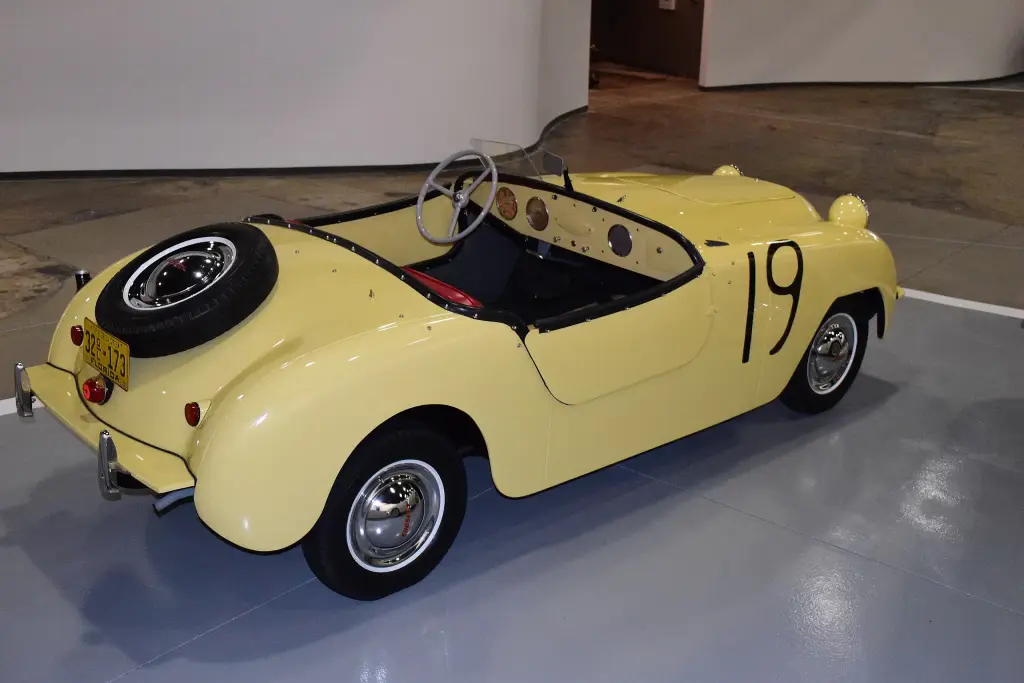
The Hot Shot had no doors and no boot lid. The spare wheel sat on the down-sloping rear deck above the bumper, and the space behind the seats was reached by folding the seat-backs forward. To go racing the weight could be cut from 1,095 lb to 991 lb by leaving off the detachable windscreen and the stowed soft-top and side curtains. Its small CIBA engine, the cast-iron four that replaced the troublesome CoBra unit in 1949, gave 26.5 hp, enough for more than 80 mph.
Sebring, 1950
A Hot Shot won the Sam Collier Memorial Endurance Grand Prix at the 1950 Six Hours of Sebring, averaging 52 mph, and also took the index of performance, an award that weighed speed against engine size. A Siata 300 fitted with Crosley power won the SCCA’s 12-hour race at Vero Beach, and through the 1950s Crosley engines dominated 750 cc sports car racing, winning 10 of 12 SCCA west-coast races.
Super and Super Sports
A Super version was added in 1950, with solid hinged doors, a fold-down top that did not have to be stowed, and red plastic leather upholstery. For 1951 and 1952 the Super Hot Shot was renamed the Super Sports. Crosley’s car sales fell as the Big Three launched larger cars, and the last Crosley left the line on 3 July 1952.
Design and features
- Frame: a new dropped frame, lower than other Crosleys.
- Brakes: disc brakes on all four wheels, a rarity in American cars of the time.
- Stowage: no trunk lid; the spare wheel rides on the rear deck.
Crosley Hot Shot versions
- Hot Shot roadster (1949): doorless, with a removable windscreen and a stowed soft-top.
- Super Hot Shot (1950): solid hinged doors and a fold-down top.
- Super Sports (1951–1952): the Super Hot Shot under a new name.
The little roadster’s maker is covered in Crosley cars: the American microcars of 1939-1952. More from the marque are in our Crosley collection.
Sources
- Crosley Motors, English Wikipedia: Hotshot model, Sebring result, engines
- Crosley, Italian Wikipedia: company history and the Hotshot’s disc brakes