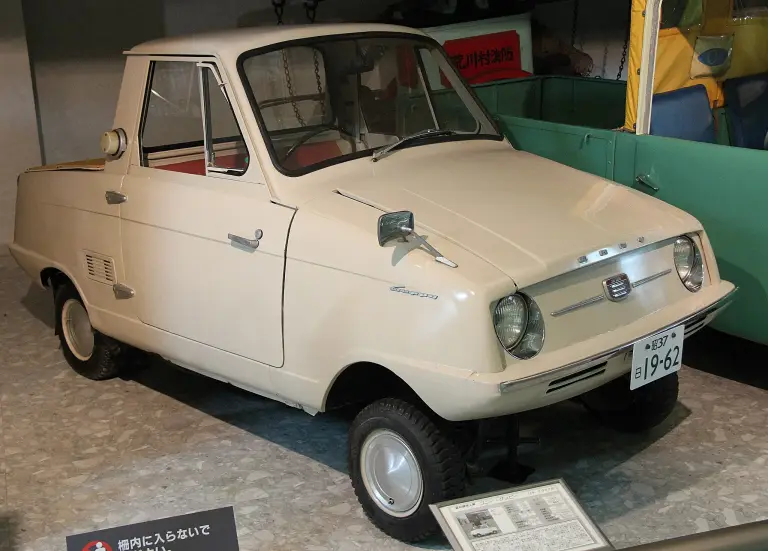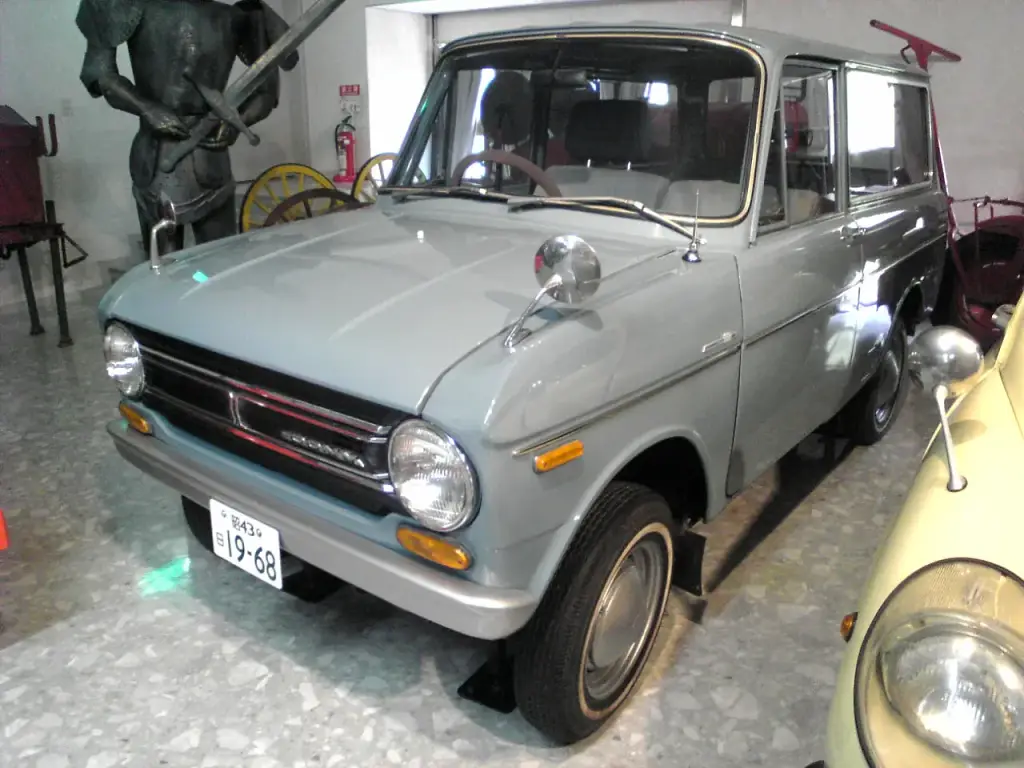
The Cony 360 was a kei car built by the Japanese firm Aichi Kokuki, also offered as a light panel van and a pickup truck. It replaced the older Cony Guppy and the similar Giant 360, and brought a much more modern technical package to Japan’s smallest class of vehicle.
Cony 360 at a glance
| Maker | Aichi Kokuki (Aichi Machine Industry), Japan |
|---|---|
| Class | kei car, panel van and pickup truck |
| Engine | air-cooled 354 cc, 64 × 55 mm bore and stroke |
| Power | about 18 hp, 20 hp after 1967 |
| Layout | rear mid-engine, rear-wheel drive, dry sump |
| Steering | rack and pinion |
| Gearbox | four-speed manual from 1967 |
| Top speed | 74 km/h |
| Bodies | two-door sedan, panel van, pickup |
| Wide truck | shown at the 1964 Tokyo Motor Show |
| Production ended | 1970 |
Based on one source: the English Wikipedia article on the Cony 360.
History of the Cony 360
Replacing the Guppy
The 360 took its name from its 354 cc engine, with a bore and stroke of 64 by 55 mm. It was introduced as a two-door sedan and was also built as a light panel van and a pickup truck, replacing both the unrefined and outdated Cony Guppy and the similar Giant 360. The older air-cooled two-cylinder engine was dropped in favour of a new, lighter air-cooled unit of about 18 hp, and power rose to 20 hp after 1967.
A technical oddity
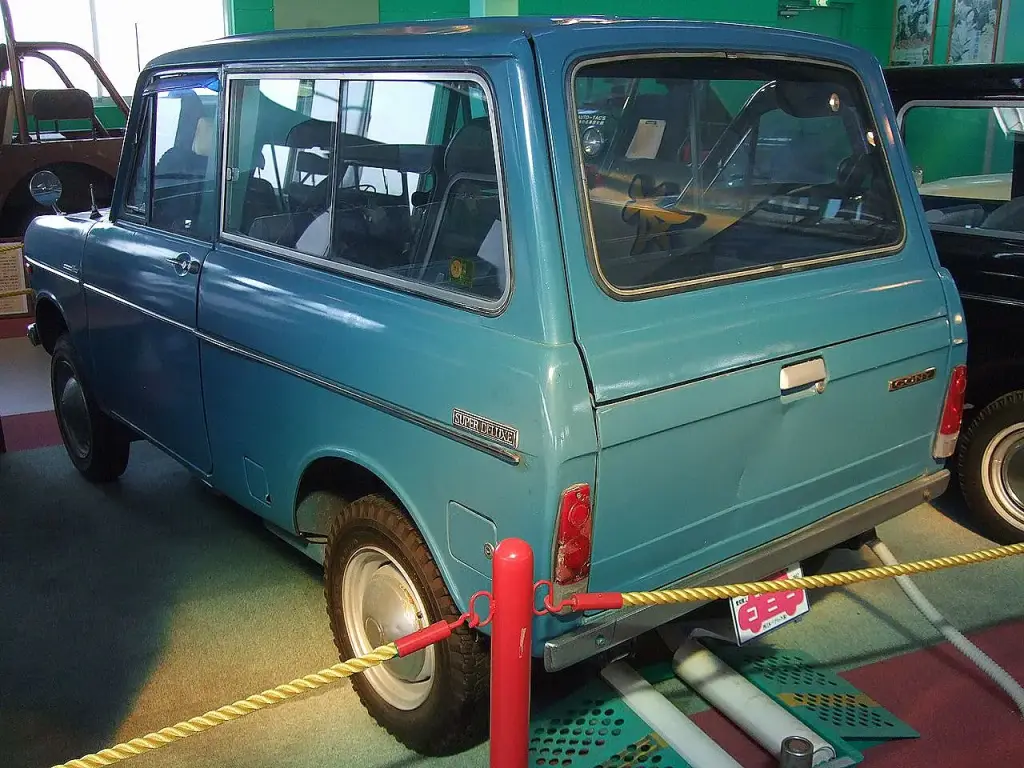
In early-1960s Japan the Cony 360 was a technical oddity. Its compact engine was designed to take up as little space as possible and was mounted behind the seats in a rear mid-engine layout, with a dry sump instead of an ordinary oil pan. The car had rack-and-pinion steering, rare in Japanese cars of the time and mostly found on advanced American and European performance models, and post-1967 cars also had a four-speed manual gearbox, itself unusual among kei cars. Despite these advantages its performance was low even for its class: the top speed was 74 km/h.
The Wide cab-over truck
The Wide truck was unveiled at the 1964 Tokyo Motor Show as a competitor to established cab-over kei trucks such as the Subaru Sambar and Daihatsu Hijet. It was called Wide because of its loading platform, the largest in its class; a panel van version followed in 1966. Some of the cab-over trucks were built in left-hand drive for export markets, mainly North America.
Demise
For a smaller Japanese manufacturer Aichi Kokuki was fairly successful and innovative, but competition in the 360 cc kei segment became fierce. The arrival of newcomers, above all the Honda N360 and T360, ate into Cony’s market share, because the Cony vehicles, although advanced, were inferior in capability and performance to the Honda and Suzulight models. Nissan, which had taken over Prince Motor Company in 1965, was also expanding rapidly. Aichi Kokuki began working with Nissan in 1965 and designed the Nissan A engine that debuted in the 1966 Nissan Sunny. Financial problems and Nissan’s growing share in the company stopped Cony production in 1970; plans to continue the cars under the Nissan badge were dropped, the plant was turned over to larger and more profitable Nissan models such as the Cherry, and the dealer network became the Nissan Cherry Store.
Design and features
- Rear mid-mounted engine: the compact air-cooled unit sat behind the seats to free up cabin space.
- Dry sump: an unusual solution for a kei car, used instead of a conventional oil pan.
- Rack-and-pinion steering: a feature then rare in Japan and mostly associated with sporting cars.
- Four-speed gearbox: fitted from 1967, when most kei cars made do with fewer ratios.
- Wide truck: the 1964 cab-over model had the largest load platform in its class.
Cony 360 versions
- 360 sedan: the original two-door kei car.
- Panel van: a light commercial version of the 360.
- Pickup: a small load-carrying body on the same mechanical package.
- Wide truck (1964): cab-over kei truck with a class-leading platform, built from 1964 and joined by a panel van in 1966.
- Export trucks: left-hand-drive cab-over models for markets including North America.
The 360 replaced the earlier Cony Guppy, and both were products of Aichi Kokuki. More small Japanese cars are in the Cony collection.
Video: Honda Cony 360 Pickup
Video on YouTube.
Sources
- Cony 360, English Wikipedia: engine, layout, truck, production history