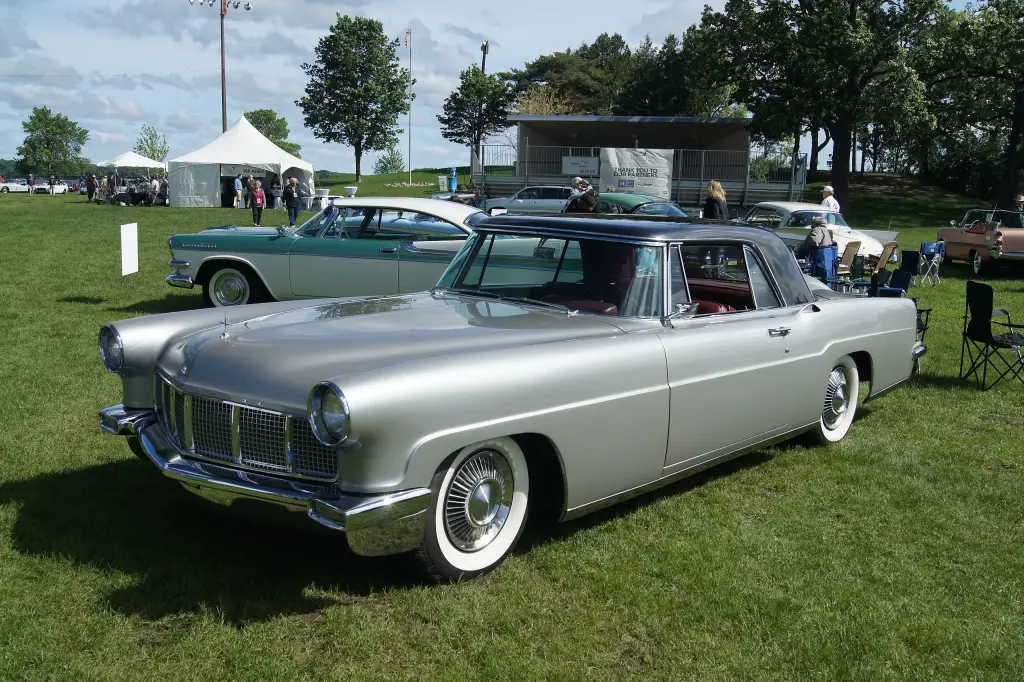

The Continental Mark II is an ultra-luxury coupé sold by the Continental Division of Ford for the 1956 and 1957 model years. It was the first and only product line of that division, developed as the worldwide flagship of Ford Motor Company and priced against the Rolls-Royce Silver Cloud and the Bentley Continental.
Continental Mark II at a glance
| Maker | Continental Division, Ford Motor Company |
|---|---|
| Model years | 1956–1957 |
| Assembly | Allen Park Body and Assembly, Michigan |
| Body | two-door hardtop coupé, hand-assembled |
| Powertrain | Lincoln V8, shared with the standard Lincoln line |
| Layout | rear-wheel drive, body-on-frame |
| Base price | $9,966 at launch, the most expensive American-built car of the time |
| Only option | air conditioning at $595 |
| World debut | Paris Motor Show, October 1955 |
| Design team | William Clay Ford, John Reinhart, Gordon Buehrig, Harley Copp |
| Design height | not to exceed 58 inches |
| Successor | Lincoln Continental Mark III, 1969 |
Based on one source: the English Wikipedia article on the Continental Mark II.
History of the Continental Mark II
A successor to the Continental
Ford had withdrawn the 1939–1948 Lincoln Continental, itself a variant of the 1936 Lincoln-Zephyr, and by the early 1950s interest in a replacement was strong enough for the company to begin work. In 1952 it formed the Special Product Operations team, later the Special Products Division, led by William Clay Ford; the team included John Reinhart as chief stylist, Gordon Buehrig as chief body engineer and Harley Copp as chief engineer. Initial proposals met rejection from senior management, but in 1953 design work was approved and a full-size clay model was signed off in June that year.
Four design objectives
Ford set out the programme in four points: distinctive styling built on clean, classic lines rather than modernistic innovations; technological advances that would add comfort, durability, safety, performance and prestige; an overall height of no more than 58 inches; and maximum interchangeability of chassis parts with Lincoln, including engine, transmission, rear axle and suspension. The Mark II was also meant to revive the memory of the coachbuilt Lincoln Model K of the 1930s. In April 1955 the Continental Division was created as a stand-alone division of Ford to handle the car.
Launch and price
The Mark II made its world debut at the Paris Motor Show in October 1955 and was shown in the United States at Ford headquarters in Dearborn, Michigan. At $9,966 it was the most expensive domestically produced automobile on sale in America; the only extra-cost option was air conditioning at $595. Despite the price, Ford estimated that it lost nearly $1,000 on every car built, a consequence of the largely hand-assembled, low-volume production at the Allen Park plant.
Design details
The car was produced solely as a two-door hardtop coupé and used a body-on-frame chassis with the V8 powertrain taken from the standard Lincoln line. It introduced the integrated “Continental” spare-tyre trunklid, which replaced the bumper-mounted spare tyre and was repeated in variations across later Ford products, and it debuted the rectangular four-point star emblem that Lincoln still uses in modified form.
The end of the division
After the 1957 model year the Mark II was discontinued and the hand-built coupé was replaced by a rebranded Lincoln. The Allen Park facility was then converted into the headquarters of the Edsel brand and survives today as the Ford Pilot Plant, where pre-production vehicles are hand-assembled for testing. Ford revived the Mark chronology in 1969 with the Continental Mark III, which began five successive generations ending with the 1998 Lincoln Mark VIII.
Design and features
- Hand assembly: the coupé was built in small numbers largely by hand, which is why Ford lost money on each one.
- Continental spare-tyre trunklid: the spare wheel was integrated into the bootlid instead of being hung on the bumper.
- Four-point star emblem: the rectangular badge introduced on the Mark II is still used by Lincoln.
- Lincoln mechanicals: engine, transmission, rear axle and suspension were shared with Lincoln to keep the project practical.
- Restrained styling: clean, classic lines rather than the fins and chrome of contemporary American show cars.
Continental Mark II versions
- 1956 Mark II: the launch specification, sold as a single two-door hardtop coupé.
- 1957 Mark II: the second and final model year before the line was discontinued.
- Planned convertible and sedan: a retractable-hardtop convertible and a four-door hardtop were envisaged for the range but never reached production.
The Mark II was the only car of its division, and its name was carried on much later by the Lincoln Continental. More American classics are gathered in the Continental collection.
Video: Making of the 1956 Lincoln Continental Mark II
Video on YouTube.
Sources
- Continental Mark II, English Wikipedia: history, design, price, production