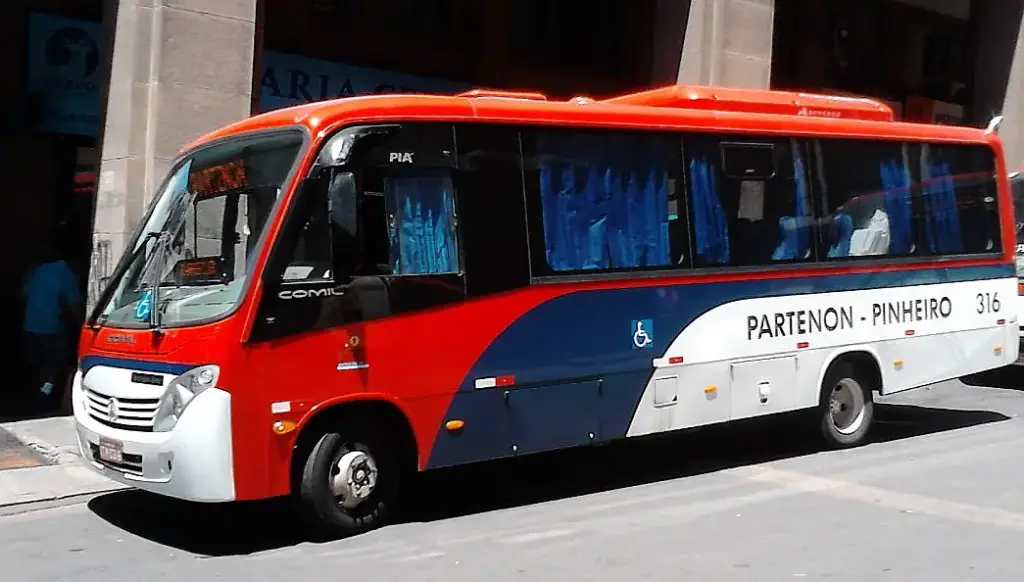
The Comil Piá was the first minibus, or micro-ônibus, built by the Brazilian bodybuilder Comil. Launched in 1999, it was made until 2008 in urban, school, executive and medical versions, and it was restyled in 2002 after three years of steady sales.
Comil Piá at a glance
| Maker | Comil, Erechim, Rio Grande do Sul, Brazil |
|---|---|
| Production | 1999–2008 |
| Type | minibus body |
| Versions | urban, school, executive and road |
| Medical version | Piá Saúde, an ambulance for health services |
| Generations | 1999, restyled in 2002, updated again in 2008 |
| Chassis | among others Mercedes-Benz and Volkswagen |
| Build | curved front with a one-piece windscreen |
| Glazing | optional bonded glass, except at the front |
| Rear lights | taken from the Campione coach |
| Restyle | 2002, after 1,100 units in three years |
| Replaced in the range | by later Comil minis and midis |
The Piá has no article of its own; the page is based on its section in the Portuguese Wikipedia article on Comil, which is the only source used. It is therefore based on one source.
History of the Comil Piá
A first minibus, 1999
The Piá was the first attempt by Comil at the minibus class and joined a range that had until then been made up of coaches and urban buses. It followed the rounded front of the new Svelto, with a one-piece windscreen, large side windows, optional bonded glazing except at the front and rear lights borrowed from the Campione coach. Like every Comil body of the period, it could be mounted on chassis from several makers, including Mercedes-Benz and Volkswagen.
The 2002 restyle
After 1,100 Piás had been built in three years, the minibus was restyled in 2002. The basic smooth, curved lines stayed, but the front gained a car-like headlamp and indicator cluster, the mirrors became more aerodynamic in the manner of the coaches, and the rear door was made in aluminium. New bumpers and rear lights, glass-fibre access steps, a new dashboard with repositioned controls and revised interior trim completed the update. The same year Comil listed fifteen models in its range, with the Piá sitting between the Svelto and Doppio buses and the smaller Bella and Bello minis.
Versions and the end of production
The Piá was sold in an urban form for city and school transport and in a road form for executive travel, charter work and longer routes. A separate Piá Saúde was developed as a mobile medical unit, normally used as an ambulance to carry patients to health centres. A further revision arrived in 2008, after which the model was withdrawn from the catalogues; by then Comil had become one of the largest bus bodybuilders in Brazil, with its main works in Erechim and a factory in Mexico.
Design and features
- Comil’s first minibus: the model that opened the small-vehicle class for the company.
- One-piece windscreen: a rounded, car-like front derived from the Svelto bus.
- Optional bonded glazing: flush glass on the sides, plain glass at the front.
- Several roles: urban, school, executive and long-distance versions from one body.
- Piá Saúde: a medical unit built for ambulance work.
Comil Piá versions
- Urban: city and school transport.
- Road: executive travel, charter and longer intercity routes.
- Piá Saúde: an ambulance and mobile health unit.
- 1999 original: the first generation with the Svelto-style front.
- 2002 restyle: new lights, mirrors, aluminium rear door and dashboard.
- 2008 revision: the final version before the model was dropped.
The Piá shared its range with the larger Comil Condottiere coach, and more vehicles from the same works are in the Comil collection.
Video: New Volkswagen bus chassis Comil Piá, 2013
Video on YouTube.
Sources
- Comil Carrocerias e Ônibus, Portuguese Wikipedia: launch, design, versions, 2002 restyle, production dates