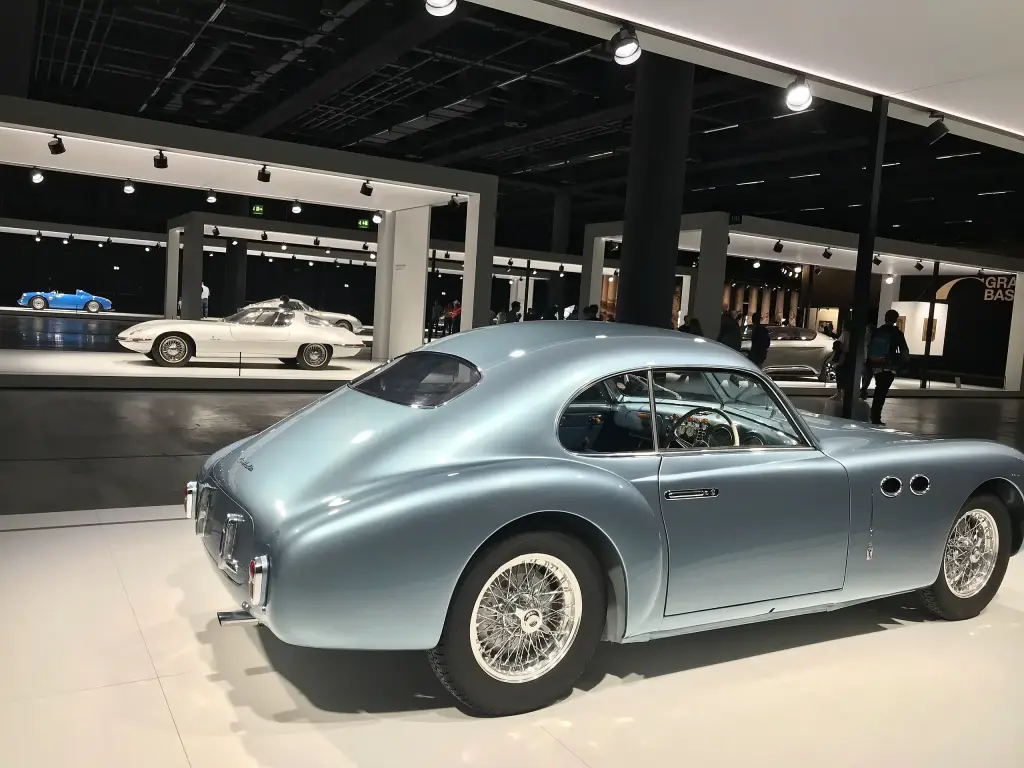

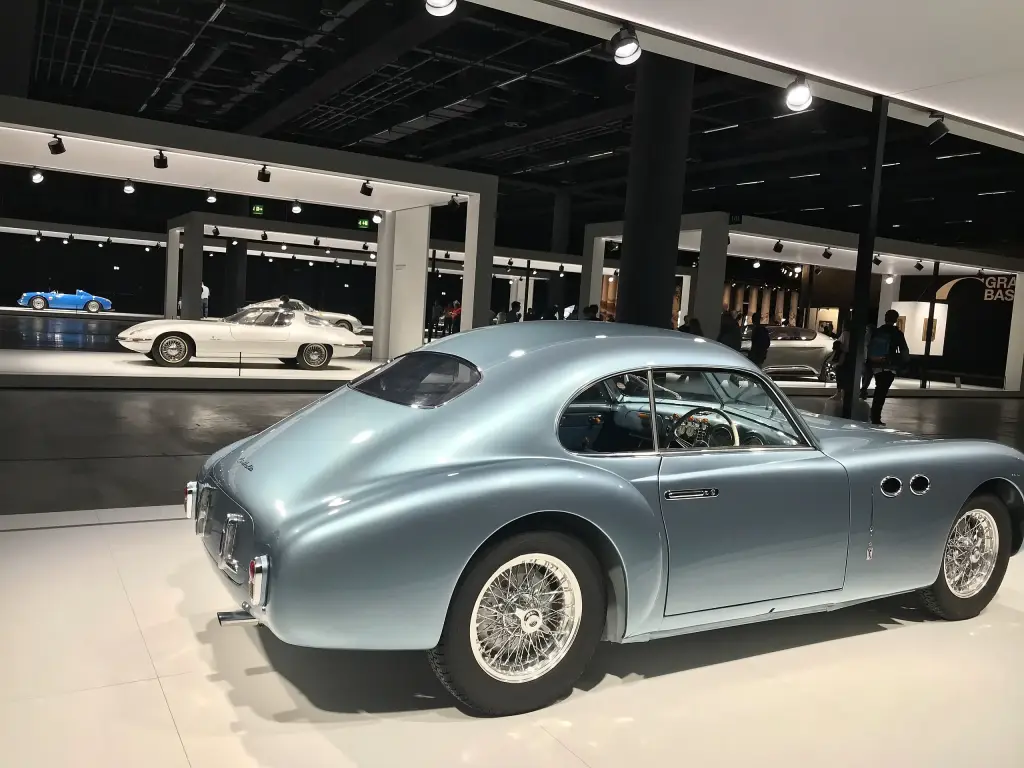
The Cisitalia 202 was a two-seat coupé built in Turin between 1947 and 1952. A small company founded by Piero Dusio put a hand-beaten aluminium body by Pinin Farina on a tubular racing chassis with Fiat-derived mechanics, and produced about 170 cars that changed the way postwar Italian bodywork looked.
Cisitalia 202 at a glance
| Maker | Cisitalia, Turin (Compagnia Industriale Sportiva Italia) |
|---|---|
| Founder | Piero Dusio, 1946 |
| Production | 1947–1952 |
| Body | two-seat coupé, hand-built aluminium, by Pinin Farina |
| Chassis | tubular steel, chrome-molybdenum |
| Engine | 1,089 cc, four cylinders in line, derived from the Fiat 1100 |
| Bore × stroke | 68 × 75 mm |
| Power | 55 hp at 5,500 rpm (Gran Sport) |
| Weight | 780 kg |
| Top speed | 165 km/h |
| Price at launch | 3,900,000 lire |
| Built | about 170 |
History of the Cisitalia 202
The company behind the car

Cisitalia took its name from Compagnia Industriale Sportiva Italia, a business conglomerate founded in Turin in 1946 by the industrialist and sportsman Piero Dusio. The firm started with the D46 monoposto, a small single-seater built around Fiat street-car parts, designed by Dante Giacosa and fitted with a spaceframe chassis that weighed under 400 kg. Drivers including Tazio Nuvolari and Felice Bonetto raced it in the voiturette class, and it won against older and more advanced cars.
That success led Dusio to commission a Grand Prix car from Ferry Porsche, the result being the four-wheel-drive, mid-engined Cisitalia 360. The project was so complex and so expensive that it nearly bankrupted the company, and the money left over had to go into something simpler.
A road car from a racing programme
The 202 grew out of the 202 S MM spider that Nuvolari drove in the 1947 Mille Miglia. Cisitalia’s engineering group, which included Giovanni Savonuzzi, Dante Giacosa and Carlo Abarth, kept the tubular chassis and the four-cylinder engine, and Savonuzzi sketched a coupé body that Pinin Farina executed in hand-beaten aluminium. The car was shown on the eve of the 1947 Italian Grand Prix at the Portello circuit in Milan, then officially at the Paris Motor Show of 23 October 1947 in Sport and Sport Special form, with 50 and 60 hp. The two were soon merged into a single Gran Sport version of 55 hp.
The 202 was not a commercial success: at 3,900,000 lire it cost far more than most Italians could pay for a car, and all of them were made by hand. Most bodies came from Pinin Farina, with examples also built by Stabilimenti Farina and Alfredo Vignale.
Design and the museum
The 202 is a two-box berlinetta whose front, body and fenders form one continuous surface instead of the separate boxes and bolt-on wings that had been normal before the war. The nose carries a simple oval opening closed by 23 convex vertical aluminium slats, with round headlamps set on top of the fenders inside chrome rims. Pinin Farina’s shape was shown at New York’s Museum of Modern Art in 1951 in the exhibition Eight Automobiles, and the car is now part of the MoMA permanent collection.
Competition versions
Giovanni Savonuzzi designed a competition coupé on chassis 101 and 102, built by Stabilimenti Farina; after two coupés a spider version followed, the SMM or Spider Mille Miglia. At the 1947 Mille Miglia Nuvolari led most of the race in one of these cars until heavy rain slowed him, and he finished second overall and first in class. The competition spiders that followed were known as 202 SMM Nuvolaris, recognisable by their large rear fins, twin windscreens and red paint, and about twenty cars close to Nuvolari’s were built.
Design and features
- One flowing surface: hood, body, fenders and headlights were treated as a single shell, without the sharp edges of pre-war coachwork.
- Tubular chassis: a chrome-molybdenum steel spaceframe taken from aircraft practice, lighter and stiffer than the usual ladder frame.
- Fiat-based engine: the 1,089 cc four kept only its cast-iron block from the Fiat 1100; head, crankshaft, rods, pistons and dry-sump lubrication were new.
- Mixed Fiat suspension: independent front suspension with a transverse leaf spring from the Fiat 500 Topolino, a live rear axle on longitudinal springs from the 1100.
- Aerodynamic wheel covers: wire wheels hidden behind hand-worked covers that improved the shape but did the drum brakes no favours.
Cisitalia 202 versions
- 202 Gran Sport (1947–1952): the standard road coupé, 55 hp, 165 km/h.
- 202 SC and 202 C: later coupé and cabriolet versions in the model range.
- 202 SMM Spyder Nuvolari: the competition spider with rear fins and twin windscreens, about twenty built.
- 202 MM Razzo and 202 Streamliner: further experimental and streamlined bodies on the same mechanical basis.
- 202 Cassone and 202 Giacosa: one-off and utility versions listed in the Cisitalia range.
The 202 was the road car that came out of Cisitalia’s racing programme; its story and the rest of the marque are on the Cisitalia collection page.
Video: Vintage: Cisitalia 202
Video on YouTube.
Sources
- Cisitalia, English Wikipedia: company history, 202 design, MoMA, production
- Cisitalia 202, Italian Wikipedia: chassis, engine, dimensions, price, variants