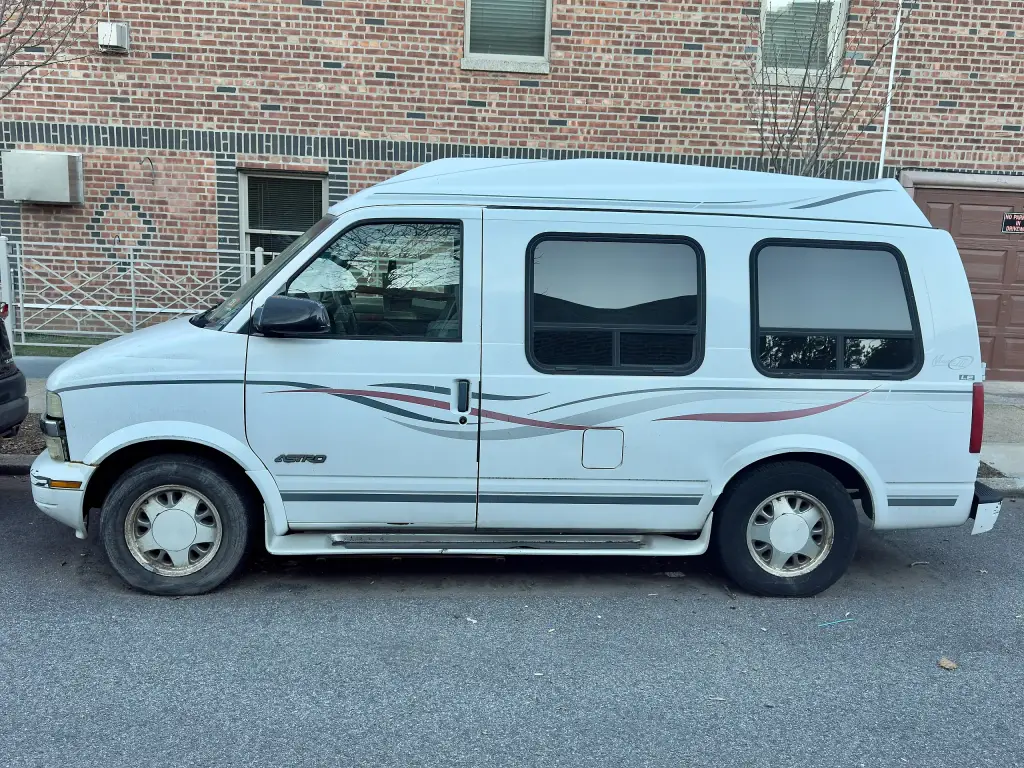
The Chevrolet Astro was a minivan built by Chevrolet from 1985 until 2005 and sold alongside the GMC Safari. Unlike the front-wheel-drive Chrysler minivans it was meant to answer, it used a rear-wheel-drive light-truck chassis, which gave it towing capacity and a long life with commercial buyers.
Chevrolet Astro at a glance
| Production | 1985–2005 |
|---|---|
| Class | Minivan, passenger and cargo versions |
| Layout | Rear-wheel drive; all-wheel drive from 1990 |
| Assembly | Baltimore Assembly, Maryland |
| Engines | 2.5 L four-cylinder to 4.3 L V6 |
| Towing capacity | up to 5,500 lb (2,500 kg) |
| Generations | 1985–1994 and 1995–2005 |
| Combined Astro and Safari output | about 3.2 million |
| Related | GMC Safari; engines and transmissions from the Chevrolet S-10 |
History of the Chevrolet Astro
The Astro and its GMC Safari twin arrived for 1985 as the first minivans from General Motors, intended as an answer to the Chrysler minivans. GM chose a rear-wheel-drive layout instead, sized the vans close to the short-wheelbase Chevrolet G10 van, and adapted light-truck powertrain components from the Chevrolet S-10, which allowed a towing capacity of up to 5,500 lb. The name had been used twice before by GM, on the 1967 Chevrolet Astro 1 concept and on the GMC Astro cab-over tractor from 1969 to 1987.
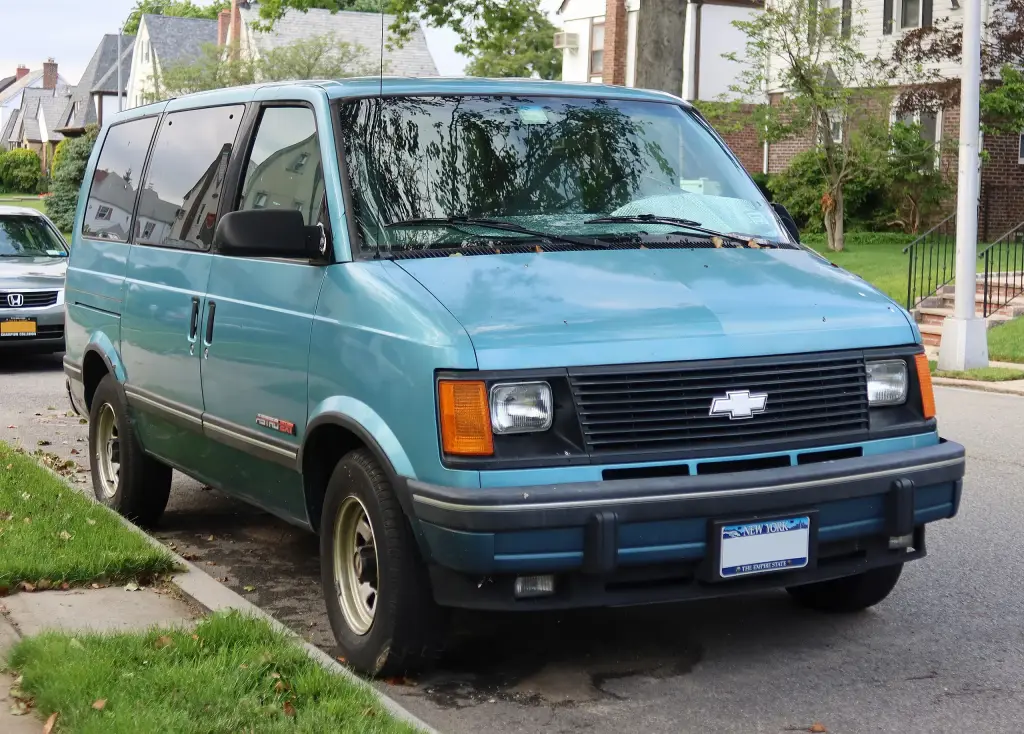
The first generation could seat between two and eight people, and engine choices ran from a 98 hp 2.5-litre four to a 200 hp 4.3-litre V6; the four-cylinder was only offered in short rear-wheel-drive cargo vans and was dropped after 1990. The van used a bolt-on front subframe with suspension parts shared with the B-body station wagons and a leaf-spring rear axle. In 1990 came an all-wheel-drive option, the first on a US-built minivan, along with an analogue dashboard, Hydroboost brakes and, mid-year, an extended body on the same wheelbase. Dutch doors with a flip-up rear window became optional in 1992, and the electronically controlled four-speed 4L60E automatic became the only transmission in 1993.
The second generation arrived for 1995 with a longer nose resembling the new Express vans, and the short body was dropped. A redesigned dashboard with a passenger airbag followed in 1996, and in 2003 the chassis gained suspension components, four-wheel disc brakes and six-lug 16-inch wheels from the half-ton pickups. Production of 32,736 vans in 1998 was followed by falling sales, and the second shift was eliminated. The Astro and Safari were the last model line built at Baltimore Assembly, and about 3.2 million of the two were produced in twenty years.
Design and features
- Rear-wheel drive: unusual for a minivan and the reason for its towing ability and long commercial life.
- All-wheel drive from 1990: the first such option on a US-built minivan.
- Truck mechanicals: engines and transmissions came from the Chevrolet S-10.
- Extended body: a longer version on the same wheelbase, added in 1990.
Chevrolet Astro versions
- Cargo van: the commercial version, available with the four-cylinder only in short form.
- Passenger van: two to eight seats, with the 4.3 V6 as the usual engine.
- All-wheel-drive van (1990 onwards): with a BorgWarner transfer case.
- Second generation (1995–2005): longer nose, no short body, later four-wheel disc brakes.
The Astro shared its engines with the Chevrolet S-10 and was replaced in the range by the Chevrolet Express passenger vans. More cars are in the Chevrolet collection.
Video: 1996 Chevrolet Astro
Video by GreenJeepMac on YouTube.
Sources
- Chevrolet Astro, English Wikipedia: history, generations, engines, production