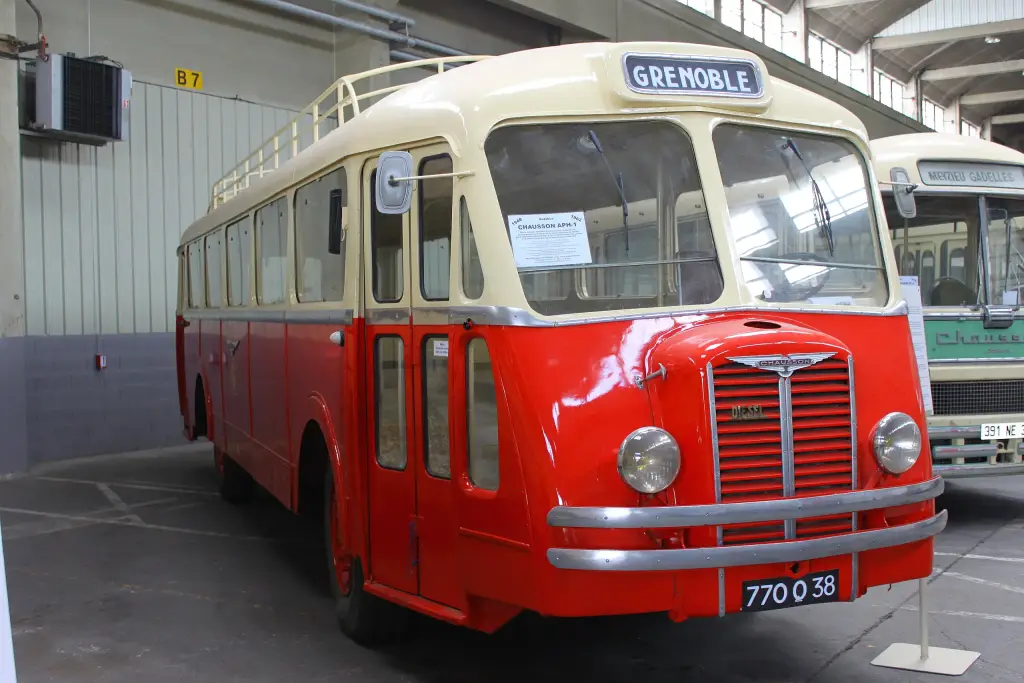

The Chausson AP was a range of coaches, buses and trolleybuses built by the Société des usines Chausson, and from 1959 by Chausson together with Saviem, between 1942 and 1964. Its commercial names followed the engine fitted – AH, APH, ASH, AHH – and its urban derivative, the APU, was bought in large numbers by the Paris transport operator.
Chausson AP at a glance
| Maker | Société des usines Chausson, later Chausson and Saviem |
|---|---|
| Production | 1942–1964, the last examples delivered in early 1965 |
| Body types | coach, city bus and trolleybus |
| Length | 10.0 m on the AP1, 10.47 m with the "nez de cochon" front |
| Seating | 45 seats plus 10 folding seats on the AP2 coach |
| Engine names | AH, APH, ASH and AHH, by engine |
| Engines | Panhard, Hotchkiss, Buda, Somua and Hispano-Suiza petrol or diesel units |
| Urban derivative | APU, 350 built for several networks |
| Paris order | 240 vehicles for the RATP in 1953, delivered in 1954–1955 |
| Main output | 3,000 AP521 coaches and 738 APV buses |
| Assembly | Gennevilliers, with bodies finished at Annonay under Saviem |
| Successor | the Saviem SC 10 |
Based on the French Wikipedia article on the Chausson AP, with company history from the English article on the Société des usines Chausson. No English Wikipedia page exists for the model.
History of the Chausson AP
AP1 and AP2 (1942–1946)

Chausson had supplied radiators and pressed parts since 1907 and had bought Chenard & Walker in 1935. At the start of the German occupation its engineers designed a ten-metre coach, the maximum length allowed in France with a 20 cm tolerance for the bumpers, a chassis of folded sheet steel rather than closed tubes, and the engine overhanging at the front under the driver. The AP1 was presented on 30 July 1942 under the reference KOM with an 80 hp Panhard petrol engine and a gas producer; only 15 were built. Its petrol successor, the APE, kept the AP1 name and was produced in 166 examples in 1945–1946.
The AP2 of 1946 offered a 105 hp Hotchkiss six or an 85 hp Panhard 4HL diesel. The longer Hotchkiss unit forced a rounded front appendage nicknamed the "nez de cochon", the pig’s snout; otherwise the body was unchanged, and the vertical engine sat under a large hump inside the cabin. The nose version measured 10.47 m and carried 45 seats plus 10 folding seats. APE, AH and APH versions came to 63 vehicles built in 1946 as AP2.
AP3 and AP48
From March 1946 the AP3 offered an 80 hp American Buda six or the Panhard diesel at 80 or 100 hp, with a Renondin gearbox and a Chausson front axle; the nose became standard. In March 1947 the names changed to AH47, APH and ABH47. The AP48 replaced it in October 1948, sold as AH, APH and ASH; the ASH had a 150 hp Somua D615H six, a luxury finish with a front fairing and Telma retarder.
AP52 and AP521
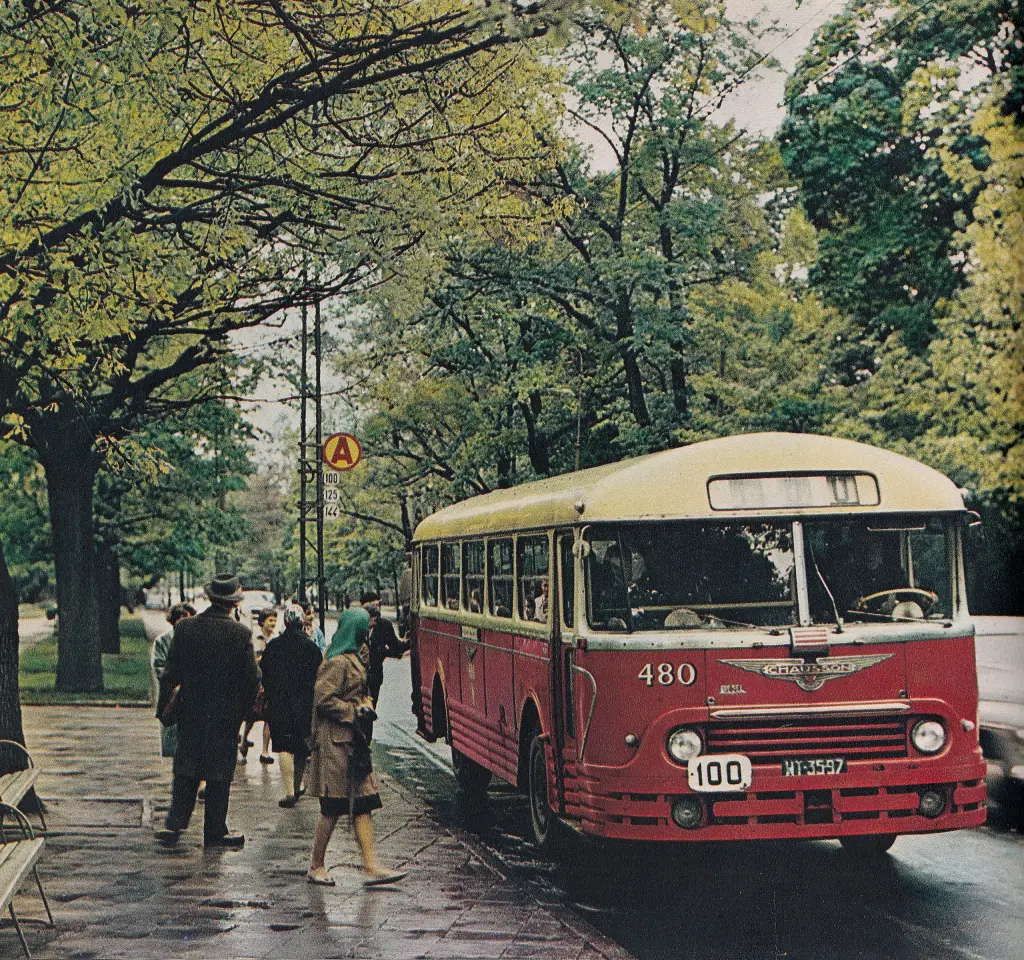
The pig’s snout was widely disliked, and at the Paris Salon in October 1951 Chausson showed the AP52 with a completely new front; production began in March 1952. The engines were the Hotchkiss AH, the Panhard 4HL diesel APH, the Somua D615H ASH and the 125 hp Hispano-Suiza DWXLD AHH. The windscreen was taller and wider but still in two parts, and the flat grille incorporated the headlights. At the end of 1953 the model was renamed AP521 with the same four versions.
The urban APU and APV
Chausson had long supplied the Paris network. In 1953 it won an order for 240 urban vehicles for the RATP after prototypes on the AP52 and AP521, and delivered them in 1954–1955. Derived from the AP521 and powered by the Hispano-Suiza DWXLD, they were laid out for two-man operation with a conductor’s post at the rear door: front and centre doors for alighting, the rear door for boarding. They had a specific rear end and standee windows in the roof. This type was built in 350 examples as the APU, and its improvements led to the APV of the 522 series, with 2.17 m of headroom instead of 1.99 m.
AP522, SC3 and SC4
In February 1956 the AP522 brought technical improvements and, for the bus renamed APV, a roof 18 cm higher, taller side windows and a flat roof. Output reached 3,000 AP521 coaches and 738 APV buses. Renault took over the division on 1 July 1959 and folded it into Saviem: the AP52 was still assembled at Gennevilliers with bodies finished at Annonay, now wearing Chausson and Saviem badges. The new Somua "Fulgur" six of 150 hp gave the SC3 coach and the SC4 bus, built from July 1961 to January 1965 in 90 examples. In 1963 two long-overhang variants appeared, the APHA for Grenoble and Roubaix-Tourcoing and the SC4B for Strasbourg and Rouen. The last buses were replaced by the Saviem SC 10.
Design and features
- Engine-based names: the letters after AP told the buyer which engine was fitted – Hotchkiss, Panhard diesel, Somua or Hispano-Suiza.
- Chassis construction: folded and welded sheet steel instead of closed tubes, with the engine ahead of the driver.
- The pig’s snout: the rounded front added for the longer Hotchkiss engine became the range’s signature until 1951.
- Urban layout: the APU was designed for a conductor at the rear door, with separate doors for boarding and alighting.

Chausson AP versions
- AH: the Hotchkiss petrol version.
- APH: the Panhard 4HL four-cylinder diesel, from the AP2 onwards.
- ASH: the 150 hp Somua D615H six, with the luxury finish on the AP48.
- AHH: the 125 hp Hispano-Suiza DWXLD six of the AP52.
- APU and APV: the urban bus derivatives of the 521 and 522 series.
- SC3 and SC4: the Saviem-badged coach and bus of 1961–1965.
More French buses and coaches are in our Chausson collection.
Video: Bus Chausson APU 53
Video by Gigabus72 on YouTube.
Sources
- Chausson AP, French Wikipedia: models, engines, production numbers
- Société des usines Chausson, English Wikipedia: company history and the RATP orders