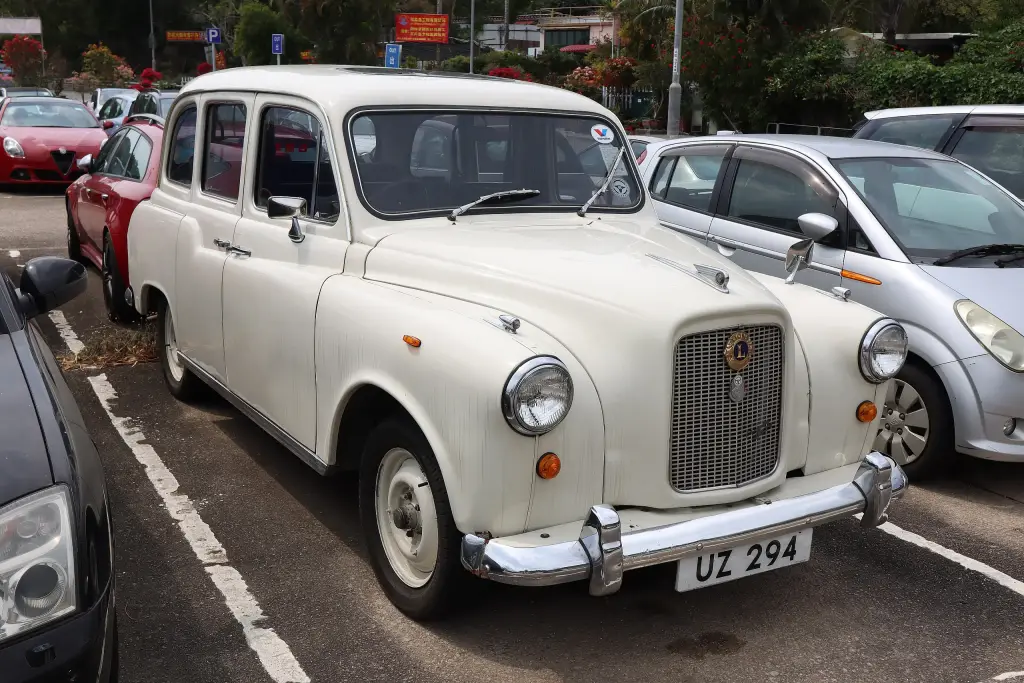

The Carbodies FX4 is the hackney carriage that served London from 1958 until 1997. Austin sold it for the first 24 years, but the body was built and the cab assembled by Carbodies, the Coventry coachbuilder that took over the intellectual rights in 1982 and continued the taxi under its own name.
Carbodies FX4 at a glance
| Maker | Carbodies, Coventry, for Austin |
|---|---|
| Production | 1958–1997 |
| Built | more than 75,000 |
| Engine, 1958 | 2,178 cc BMC diesel |
| Engine, 1971 | 2,520 cc diesel |
| Engine, 1982 | 2,286 cc Land Rover diesel |
| Gearbox | Borg-Warner automatic; manual from 1961 |
| Chassis | separate chassis, independent front suspension |
| Turning circle | 7.6 m (25 ft) |
| Top speed, FX4R | 85 mph (137 km/h) |
| First car | VLW 431, delivered July 1958 |
The FX4 was designed and sold by Austin but built and assembled by Carbodies, which took over the model in 1982; the article covers the cab throughout its life. based on one source.
History of the Carbodies FX4
Designed for London
The FX4 replaced the Austin FX3 of 1948–1958 and was the most widely used taxi in London in its day. It was designed by Austin together with Mann & Overton, the London taxi dealership that commissioned it and paid for half of its cost, and Carbodies, the coachbuilder that built the body and assembled the cab ready for sale. The design team included Albert Moore of Austin’s engineering division, Jack Hellberg of Carbodies and David Southwell of Mann & Overton, with the original design by Austin’s Eric Bailey, engineered for production by Carbodies’ Jake Donaldson. It was the first London taxi to enter production with four doors: earlier cabs had a luggage platform open to the weather on the pavement side in place of a front passenger seat.

Austin years, 1958–1982
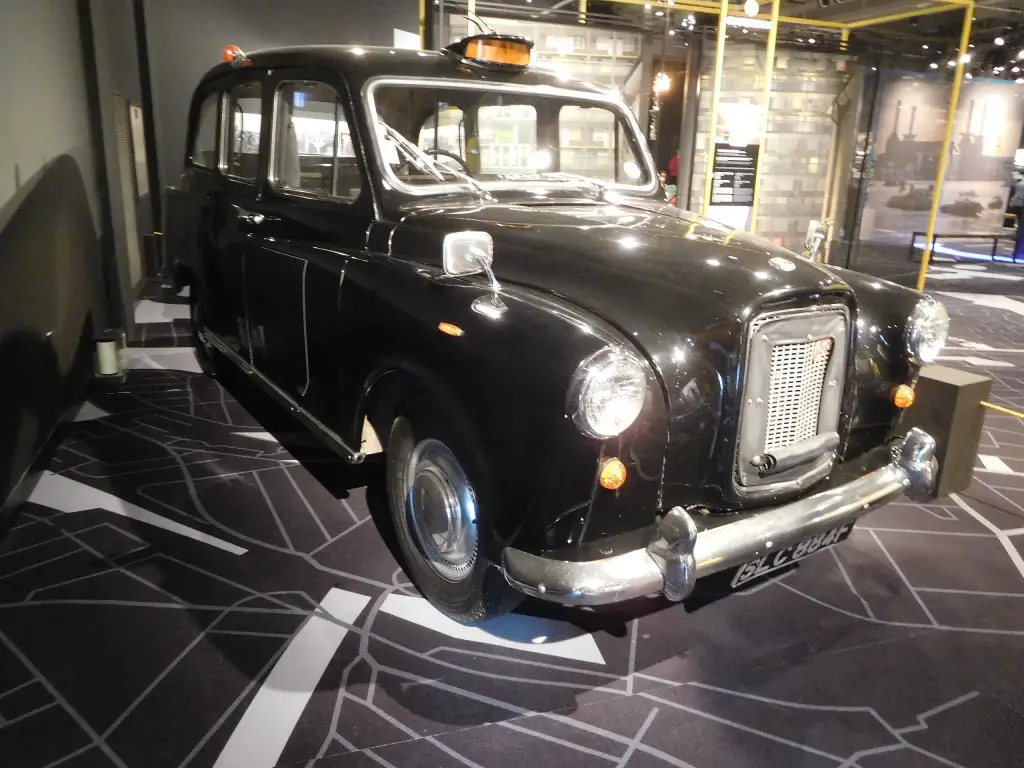
The first FX4, registration VLW 431, was delivered in July 1958 and went on test with York Way Motors; the official launch came later that year at the Commercial Motor Exhibition at Earls Court, where an order for 2,000 cabs worth £24 million was placed at the show. Like the FX3 the FX4 had a separate chassis, but with independent front suspension and dual-circuit hydraulic brakes, and its Ackermann steering let it turn in 7.6 m (25 ft), as London’s narrow roads demanded. The first cars used a 2,178 cc BMC diesel derived from the Austin A70 petrol engine and a Borg-Warner automatic; a manual gearbox from the Austin Gipsy became an option in 1961 and a 2,199 cc petrol engine was offered from 1962, though almost every cab was a diesel. A 1969 revision brought smaller tailfins with lamps from the MkII Austin 1100/1300, front indicators below the headlights, repeater indicators on the wings and the end of the roof-mounted “bunny ears”, while inside came sound deadening, black vinyl seats and a partition with four inches more legroom. In 1971 the 2,178 cc engine gave way to a 2,520 cc diesel that suited the automatic better; the petrol engine was dropped in 1973. When BSA, Carbodies’ owner, faced bankruptcy in 1973, Manganese Bronze Holdings bought the company and carried on, adding burst-proof locks, push-button door handles, safety steering and moulded rubber overriders.
Carbodies takes over, 1982–1997
In 1982 British Leyland lost interest in the cab and Carbodies took over its intellectual property, producing the FX4 under its own name. The old Austin engine was no longer available after the Courthouse Green engine plant closed, so Carbodies chose the 2,286 cc Land Rover diesel, with the similar Land Rover petrol engine as an option, and branded the model FX4R — R for Land Rover engined. It gained power steering, full servo brakes, a top speed of 85 mph (137 km/h) and rear doors that the driver could lock, but performance and reliability were poor and the cab earned a bad reputation. Many proprietors fitted the Perkins/Mazda 2,977 cc diesel instead, which transformed performance but was noisy at idle. To win back sales, Carbodies also built the FX4Q from refurbished old chassis and suspension with new bodywork and original-type 2,520 cc diesels reimported from India, which is why those cabs carry Q registration marks. Carbodies built the FX4 for only two years after taking the rights; London Taxis International continued it from 1984 until 1997, by which time more than 75,000 had been made.
Design and features
- Four doors: the first London taxi in production with a passenger door on the pavement side.
- Tight turning circle: Ackermann steering allowed a U-turn in 7.6 m (25 ft).
- Separate chassis: with independent front suspension and dual-circuit hydraulic brakes.
- Driver-focused cabin: the 1969 revision added sound deadening, vinyl seats and four inches more legroom behind the partition.
- Long-lived shape: its styling carried on in the TX series and the LEVC TX.

Carbodies FX4 versions
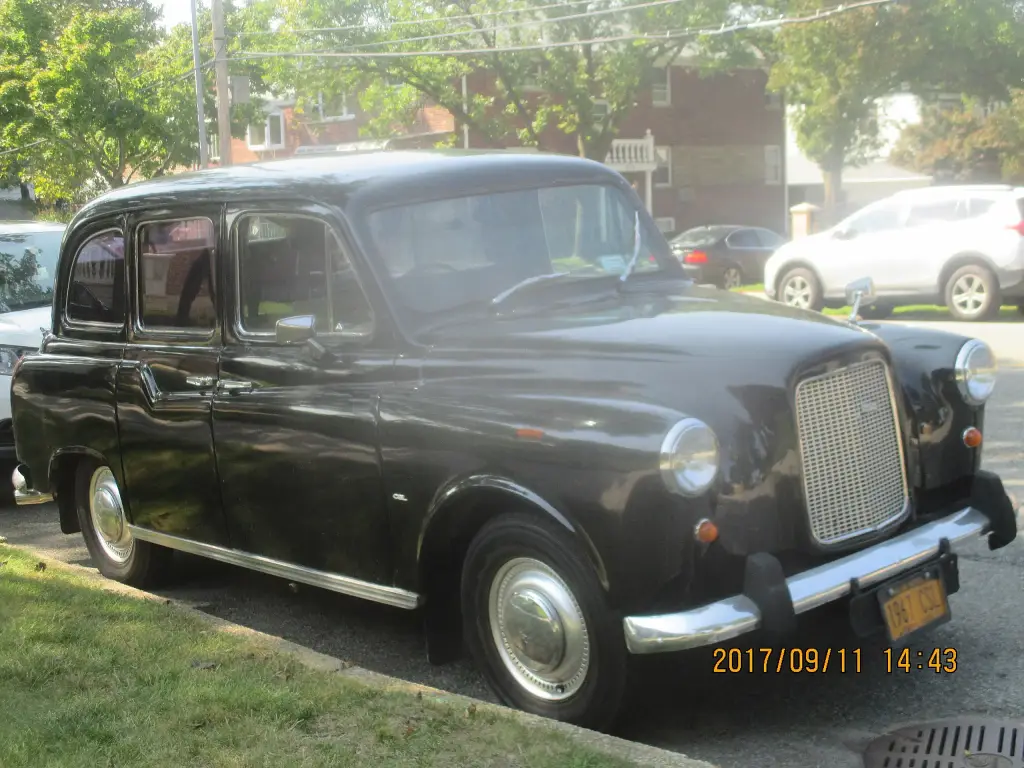
- FX4 (1958–1971): 2,178 cc BMC diesel, Borg-Warner automatic, later a manual option.
- FX4 revised (1969): smaller tailfins, new lamps and a quieter, roomier cabin.
- FX4D (1971–1982): 2,520 cc diesel, petrol dropped in 1973.
- FX4R (1982): 2,286 cc Land Rover diesel, power steering and servo brakes.
- FX4Q: refurbished chassis and new bodywork with a reimported 2,520 cc diesel.
- Perkins conversions: owner-fitted 2,977 cc Perkins/Mazda diesels.
The FX4 followed the Austin FX3 and was continued by London Taxis International until 1997. More London cabs are in the Carbodies collection.
Sources
- Austin FX4, English Wikipedia: design, engines, versions, production