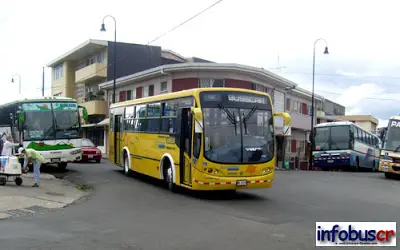
The Busscar Urbanuss was the urban bus body with which the Brazilian coachbuilder Busscar of Joinville, Santa Catarina, carried its city range into the 2000s. Introduced in 1998 and built until 2009, it came as a midi, a standard and an articulated bus on a front-engine layout, and it was the base for the longer-lived Urbanuss Pluss and the Ecoss.
Busscar Urbanuss at a glance
| Maker | Busscar Ônibus SA, Joinville, Santa Catarina, Brazil |
|---|---|
| Class | urban bus body |
| Production | 1998–2009 |
| Generation | third generation of the Urbanus line |
| Engine layout | front engine (“dianteiro”) |
| Body lengths | midi, standard (padron), articulated |
| Floor | low floor |
| Facelift 2005 | glued glass doors |
| Facelift 2006 | wheel arches without rubber trim |
| Facelift 2010 | Urbanuss II |
| Related | Urbanuss Pluss (1999–2012), Urbanuss Ecoss (2006–2012) |
| Brand end | production stopped, bankruptcy in 2012 |
The Urbanuss has no Wikipedia article of its own; this page is based on one source, the history and models sections of the Portuguese Wikipedia article on Busscar.
History of the Busscar Urbanuss
Busscar grew out of a carpentry shop opened on 17 September 1946 in Joinville by the brothers Augusto Bruno Nielson and Eugênio Nielson, of Swedish descent, under the name Nielson & Irmão. A year later the firm was asked to rebuild a bus body, which started it in the trade; in 1949 it built an all-wood jardineira on a Chevrolet Gigante chassis. With Harold Nielson, the elder son of Augusto, joining in 1956, the company turned definitively to bus bodywork and became one of Brazil’s best-known coachbuilders, above all with the Diplomata long-distance model. In 1989, when it launched a new family of vehicles, the company changed its name to Busscar Ônibus SA.
From Nielson Urbanus to Urbanuss
The urban line began in 1987 with the Nielson Urbanus, a front-engine standard (padron) body; after the 1989 renaming it continued as the Busscar Urbanus of 1990–1994, which added an articulated version. A second generation followed in 1994–1999, again with standard and articulated bodies and, from 1996, the midi Urbanus SS. The third generation arrived in 1998 under the name Urbanuss, and this is the body that carried the line into the 2000s.
Third generation
Busscar listed the Urbanuss as a midi, standard and articulated body with a front engine and a low floor, built from 1998 to 2009. Around it the maker developed two close relatives: the Urbanuss Pluss of 1999, offered as a midi, standard and articulated bus but also as a biarticulated, hybrid and even tourism version, and the Urbanuss Ecoss of 2006, an articulated body. The range was kept fresh with a series of facelifts rather than a new model: glued glass doors in 2005, wheel arches without the rubber trim in 2006, a compact series with lower height and the Ecoss II in 2008, the Urbanuss Pluss II in 2009 and the Urbanuss II in 2010.
The end of Busscar
The Urbanuss outlived the company that made it. Busscar went through two financial crises after 2002, the second from 2008, when wages were paid late, production stopped and only a few vehicles were assembled to order by temporary workers; the employees later learned that the company was also in arrears with the FGTS and INSS. On 27 September 2012 the court declared the Grupo Busscar bankrupt. The decision was annulled on 27 November 2013 at the request of the former controllers but confirmed definitively on 5 December 2013. On 21 March 2017 the court approved the sale of the Joinville, Pirabeiraba and Rio Negrinho factories and of the Busscar brand to buyers who were also shareholders of the body builder CAIO Induscar; on 12 June 2017 the new owners took over the plant, created Carbuss and announced the return of production with the Busscar brand, designs and body names.
Design and features
- Front engine: the Urbanuss kept the front-mounted engine layout that Busscar called dianteiro, as on the earlier Urbanus generations.
- Low floor: the third generation moved to a low-floor layout for city service.
- Three body lengths: midi, standard (padron) and articulated versions were catalogued.
- Articulated option: the jointed bus was part of the Urbanuss range, not a separate model.
- Steady facelifts: glued glass doors, cleaner wheel arches, a lower compact series and the 2010 Urbanuss II kept the body current.
Busscar Urbanuss versions
- Nielson Urbanus (1987–1990): the first front-engine standard urban body, before the Busscar name.
- Busscar Urbanus (1990–1994): the same body under the new name, with an articulated version.
- Urbanus (1994–1999): the second generation, joined by the midi Urbanus SS in 1996.
- Urbanuss (1998–2009): the third generation with a low floor, in midi, standard and articulated form.
- Urbanuss Pluss (1999–2012): the wider derivative, also biarticulated, hybrid and tourism.
- Urbanuss Ecoss (2006–2012): the articulated member of the family, revised as the Ecoss II in 2008.
More Brazilian buses are in the Busscar collection.
Video: Busscar UrbanusS 1998 on a Mercedes-Benz OF-1721
Video by Jean Lucas Souza on YouTube.
Sources
- Busscar, Portuguese Wikipedia: history, models, production dates