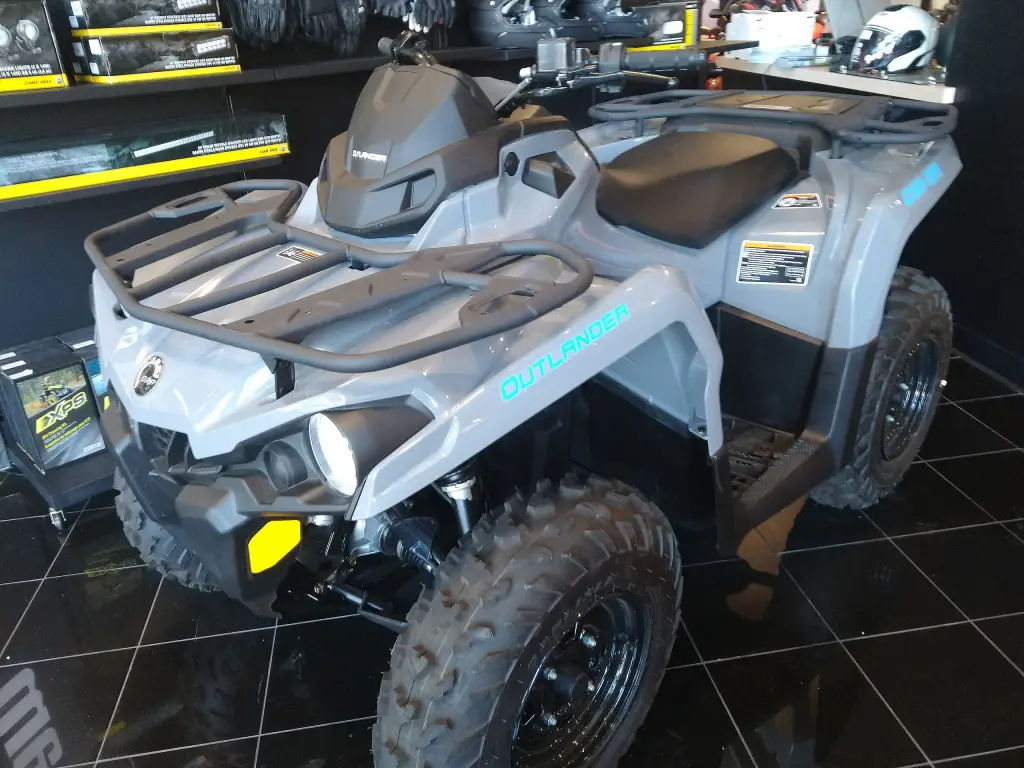

The Can-Am Outlander is the large-capacity all-terrain vehicle of Bombardier Recreational Products, sold under the Can-Am name from 2007. The first Outlander, the 800, appeared in 2006 with an 80-degree V-twin engine and independent suspension on all four wheels.
Can-Am Outlander at a glance
| Maker | Bombardier Recreational Products (BRP), Valcourt, Quebec |
|---|---|
| Brand | Can-Am, ATV line re-branded in 2007 |
| Model | Outlander |
| Launched | 2006 (Outlander 800) |
| Engine | 80-degree Rotax V-twin |
| Front suspension | double A-arms |
| Rear suspension | TTI |
| Assembly | Juarez, Mexico, from 2008 |
| Racing | GNCC Utility Modified title, October 2005 |
| Stablemate | Renegade, the sport ATV of the same line |
| Latest detail in the sources | front differential on the 2022 Outlander MR |
Based on one source, the English Wikipedia article on Can-Am Off-Road.
History of the Can-Am Outlander
Bombardier before the Outlander
The company behind the Outlander began in 1942, when Joseph-Armand Bombardier founded L’Auto-Neige Bombardier Limitée in Valcourt, Quebec. The Can-Am name was created in 1972 as a subsidiary building high-performance motocross and enduro motorcycles. BRP entered the all-terrain vehicle market much later, in February 1998, with a prototype of the Traxter, a utility ATV; a second machine, the DS650, was designed for sport riders and in 2004 won the quad class of the Dakar Rally.
Traxter and the move to big-bore ATVs
The Traxter range grew through the early 2000s. The Traxter XL of 2000 was the first 4×4 all-terrain vehicle with a dumping box-bed, and the Traxter MAX of 2002 was the first manufacturer-approved ATV for two people. In September 2005 BRP introduced the APACHE track kit, the first original-equipment track kit made to fit most major all-terrain vehicles. That same October a BRP team won the GNCC Racing Series championship in the Utility Modified ATV class on an Outlander 800.
The Outlander and the Can-Am relaunch
The Outlander 800 was launched in 2006, a year before BRP re-branded its whole ATV segment as Can-Am in 2007. It used an 80-degree V-twin, double A-arms at the front and TTI suspension at the rear. A year after the re-branding BRP opened a plant in Juarez, Mexico, which took over manufacture and assembly of the Outlander and Renegade line-ups, including the Rotax engines that powered them. The Outlander remained the utility side of the range while the Renegade covered sport riding; a 2022 Outlander MR model is noted in the sources for its front differential.
Where it sits in the range
Can-Am Off-Road grew into a full line of ATVs and side-by-side vehicles aimed at riders of different skill levels and ages, distributed through more than 4,200 dealers and distributors in over 100 countries. Alongside the Outlander and Renegade, the range came to include the Commander and Maverick side-by-sides and the Defender utility line.
Design and features
- Rotax V-twin: the Outlander 800 used an 80-degree V-twin, the layout that also powered the Renegade.
- Independent suspension: double A-arms at the front and TTI at the rear, rather than a solid axle.
- Utility role: the Outlander was the working side of the Can-Am ATV range, with the Renegade as its sport stablemate.
- Front differential: fitted to the 2022 Outlander MR model described in the sources.
- Shared platform: built alongside the Renegade at BRP’s Juarez plant from 2008.
Can-Am Outlander versions
- Outlander 800 (2006): the original big-bore model with the 80-degree V-twin.
- Outlander line: the utility ATV family assembled at Juarez with Rotax engines.
- Outlander MR (2022): a version listed with a front differential.
- Renegade: the sport ATV of the same generation, related but a separate model.
The Outlander belongs to BRP’s collection, where the company’s other machines are gathered.
Sources
- Can-Am Off-Road, English Wikipedia: history, Outlander launch and suspension, Juarez plant, range