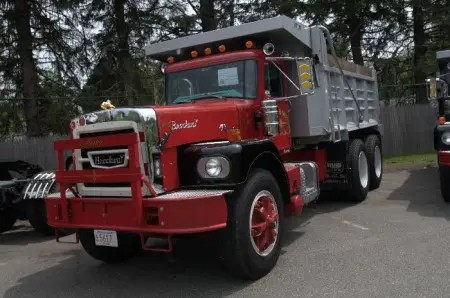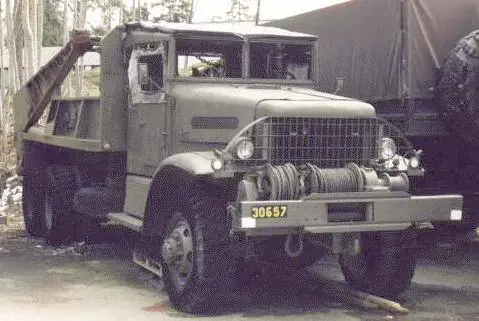
The Brockway B666 was a heavy military truck built by Brockway Motor Company of Cortland, New York, during the Second World War. It appeared in specialised forms such as the B666 Daybrook M-II-A bridge erector and the C666 Quick Way crane, alongside the G547 and G690 6-ton 6×6 bridging trucks.
Brockway B666 at a glance
| Maker | Brockway Motor Company, Cortland, New York |
|---|---|
| Role | heavy military truck, Second World War |
| Base truck | B666 heavy truck |
| Body variant | B666 Daybrook M-II-A bridge erector |
| Crane variant | C666 Quick Way crane |
| Related trucks | G547 and G690 6-ton 6×6 bridging trucks |
| Also built by | Corbitt and White, to the same standard design |
| Engine | Hercules HXD 855 cu in (14 L) inline-six, petrol |
| Power | 202 hp (151 kW) at 2150 rpm |
| Torque | 642 lbf·ft (870 N·m) at 900 rpm |
| Bridge erector size | 370 in long, 100 in wide, 103 in high; about 26,500 lb (13 tons) |
| Crane size | 408 in long, 100 in wide, 136 in high; about 35,275 lb (18 tons) |
There is no separate Wikipedia article on the B666, so this page uses the article on Brockway Motor Company, including its source notes on the bridge erector and crane. It is based on one source.
History of the Brockway B666
Brockway before the war
Brockway Motor Company was a builder of custom heavy-duty trucks in Cortland, New York, from 1912 to 1977. The business grew out of Brockway Carriage Works, founded in 1875 by William Brockway; his son George turned it into a truck manufacturer in 1909 with high-wheelers as the first products. During the First World War the firm built 587 Class B Liberty Trucks for the military, and after the war it offered a range from 1 ton to 5 tons. It began with Continental engines, switched to Wisconsin units in 1925, and in 1928 bought the Indiana Truck Corporation, which it was forced to sell to White Motor Company early in the Great Depression.
The B666 at war
During the Second World War Brockway manufactured the B666 heavy truck. The type was adapted for engineering work as the B666 Daybrook M-II-A bridge erector and as the C666 Quick Way crane. Next to them Brockway built the G547 and G690 6-ton 6×6 bridging trucks, part of a standard design series also produced by Corbitt and White. The G547 Treadway trucks carried a large hoist on the rear for self-unloading, while the G690 chassis were fitted with Quickway cranes, likewise used in bridging operations.
One engine for all
All 6-ton military trucks of the programme, whatever the manufacturer, used the Hercules HXD 855 cu in (14 L) inline-six petrol engine, which developed 202 hp (151 kW) at 2150 rpm and 642 lbf·ft (870 N·m) of torque at 900 rpm. The shared engine and chassis kept spares and servicing common across the trucks of several makers.
After the war Brockway returned to single and dual axle tractors and heavy-duty triaxle dump trucks. Mack Trucks Inc. bought the company in August 1956 and kept it as a division until closing it in June 1977.
Design and features
- Engineering bodies: the B666 served as a bridge erector as well as a heavy lorry, with the Daybrook M-II-A equipment.
- Crane version: the C666 Quick Way turned the same heavy chassis into a revolving crane.
- Standard 6-ton family: the G547 and G690 bridging trucks were a shared design with Corbitt and White.
- Common Hercules power: every 6-ton military truck in the programme used the same 202 hp petrol six.
Brockway B666 versions
- B666 heavy truck: the basic military lorry.
- B666 Daybrook M-II-A: bridge erector, 370 in long and about 13 tons.
- C666 Quick Way: revolving crane, 408 in long and about 18 tons.
- G547 Treadway: 6-ton 6×6 with a rear hoist for self-unloading.
- G690: 6-ton 6×6 chassis with a Quickway crane for bridging work.
The later Brockway heavy truck of the 1970s is described in Brockway 361. Other trucks of the marque are in the Brockway collection.
Video: Brockway b666 bridge erector truck WWII motore e freni in funzione
Video by Ranieri Benvenuti on YouTube.
Sources
- Brockway Motor Company, English Wikipedia: wartime models, dimensions, Hercules engine, company history