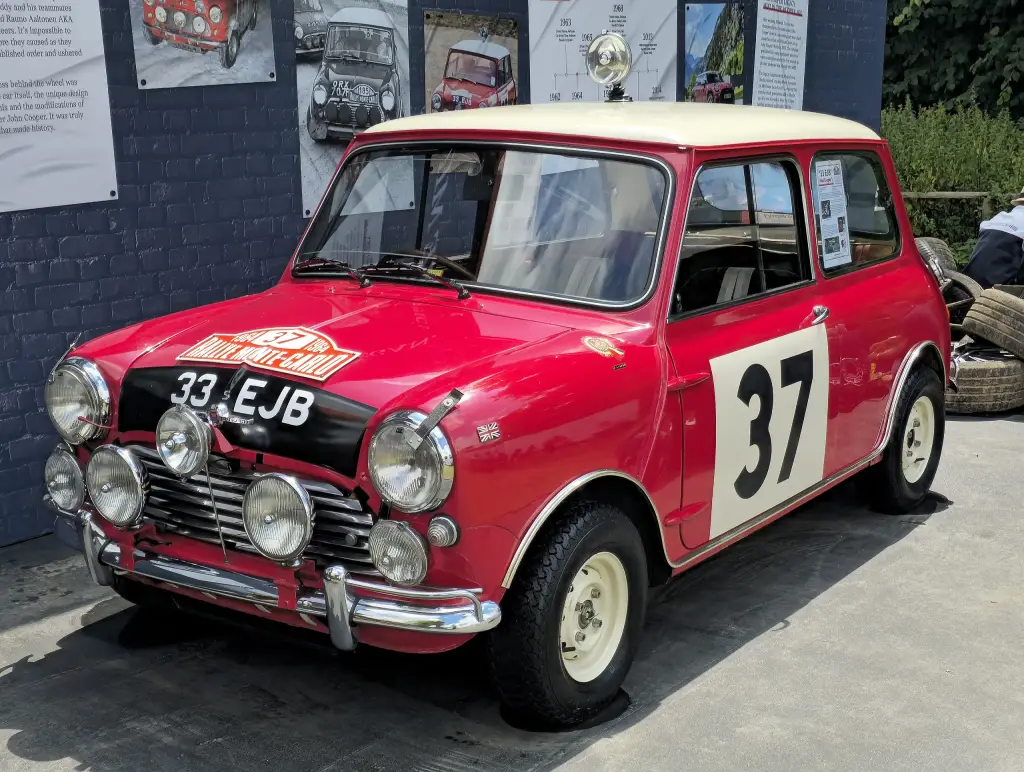

The Mini is the two-door, four-seat small car designed by Sir Alec Issigonis and produced for four decades in a single body shape by the British Motor Corporation and its successors, including British Leyland. About 5.38 million were built between 1959 and 2000, and the car is now known as the Classic Mini to separate it from the BMW-built MINI.
British Leyland Mini at a glance
| Designed by | Sir Alec Issigonis |
|---|---|
| Produced | 1959–2000, one generation |
| Layout | transverse engine, front-wheel drive |
| Body styles | saloon, estate, convertible, pick-up, van, Moke |
| Mark I updates | Mark II, Clubman, Mark III |
| Built | about 5.38 million in all versions |
| Main plants | Longbridge, Birmingham; Cowley |
| Overseas assembly | Australia, Spain, Belgium, Italy, Portugal, South Africa and others |
| Follow-up | Austin Metro, launched 1980 |
| Last car built | Longbridge, October 2000 |
Based on one source, the English Wikipedia article on the Mini.
History of the British Leyland Mini
Why the Mini was built
The Mini came about because of a fuel shortage caused by the 1956 Suez Crisis. Petrol was rationed again in Britain, sales of large cars slumped and the market for German bubble cars boomed, even in a country where imported cars were still rare. Leonard Lord, the head of BMC, is said to have detested these cars so much that he vowed to rid the streets of them with a proper miniature car. He set the rules: the whole car had to fit inside a box of 10 by 4 by 4 feet, the passenger compartment had to take up six of those ten feet, and the engine, for reasons of cost, had to be an existing unit.
Issigonis and the Orange Box
Alec Issigonis, who had been working for Alvis, was recruited back to BMC in 1955. His smallest project, XC9003, had the lowest priority until Lord laid down his requirements in October 1956; then work on the larger car stopped and the small one took over. With a team that included John Sheppard, Jack Daniels, Chris Kingham and Charles Griffin, Issigonis had a running prototype by July 1957, nicknamed the Orange Box for its colour. Lord approved it for production on 19 July, and XC9003 became project ADO15.
The layout that changed small cars
The ADO15 used a conventional BMC A-Series four-cylinder water-cooled engine, but mounted it transversely, with a four-speed transmission running in the engine sump, and drove the front wheels. The primary gears on the end of the crankshaft gave the car the transmission whine for which the Mini became famous. The layout let 80 per cent of the floorpan be used for passengers and luggage, and it influenced a generation of makers: the Honda N360 of 1967, the Nissan Cherry of 1970 and the Fiat 127 of 1971 all followed the same recipe.
From BMC to British Leyland
The Mini was first sold under the Austin and Morris names, as the Austin Seven and the Morris Mini-Minor. The Austin Seven was renamed Austin Mini in 1962, and Mini became a marque in its own right in 1969, the year British Leyland took over BMC. The Mark I had three major updates in Britain – the Mark II, the Clubman and the Mark III – and the range grew to include an estate, a pick-up, a van and the jeep-like Moke. The Cooper and Cooper S were successful in racing and rallying, winning the Monte Carlo Rally in 1964, 1965 and 1967.
Design and features
- Transverse engine and front-wheel drive: the space-saving layout that 80 per cent of the floorpan was given over to people and luggage.
- Single body shape for four decades: the same two-door shell was built through successive Marks and Clubman versions.
- Many body styles: saloon, estate, convertible, pick-up, van and the open Moke.
- Rally pedigree: the Cooper and Cooper S won the Monte Carlo Rally three times in the 1960s.
British Leyland Mini versions
- Saloon: the standard two-door car, sold first as the Austin Seven and Morris Mini-Minor.
- Estate, pick-up and van: commercial and load-carrying versions of the same shell.
- Mini Moke: a jeep-like open buggy.
- Cooper and Cooper S: the performance versions, successful in racing and rallying.
- Clubman: one of the three major UK updates of the Mark I range.
More cars built by the company are in the British Leyland collection.
Sources
- Mini, English Wikipedia: design, layout, production, variants