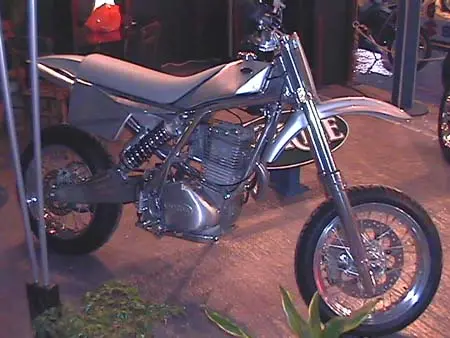
The Borile B500CR is a hand-built café racer from the small Italian firm of Umberto Borile, shown at the EICMA show in Milan in 1999 and delivered to customers from the spring of 2002. The English Wikipedia describes it as “a modern day interpretation of how a BSA Gold Star would look if it were produced today”. It is the best-known model of a company that has built retro-styled motorcycles in small numbers since the late 1980s.
Borile B500 at a glance
| Company | Umberto Borile & Co s.r.l., known until 2010 as Borile Motociclette |
|---|---|
| Base | Spoleto; earlier Vò Euganeo, province of Padua |
| First motorcycle | Piuma 500 off-roader, 1987 |
| B500CR shown | EICMA, Milan, 1999; definitive version 2001 |
| Deliveries | from spring 2002 |
| Engine | single-cylinder, 40 CV in the B500CR |
| Frame | chromium-molybdenum steel |
| Bodywork | aluminium, made and finished by hand |
| Supermotard sister | 500SM, 56 CV |
| Later models | 651 Scrambler, B450 Scrambler, B500 Ricki, B300CR |
| B500 Ricki | special built in 20 examples |
| Present base | Spoleto, after the 2017–2018 restart |
The Italian Wikipedia article on the company is the main source; the English article on Borile is much shorter and supplies the description of the B500CR and its place in the retro wave. No free photographs of the model were found on Wikimedia Commons, so the previous cover image is kept.
History of the Borile B500
From the Piuma to the B54T
The story begins in 1987 with the Piuma 500, a single-cylinder four-stroke off-road motorcycle with a chromium-molybdenum perimeter frame. At 101 kg it was, and remained, a record for its class. Ten years later, at the Milan motorcycle show in 1997, Borile presented the B54T: a classic machine in the style of English motorcycles of the 1960s, with a GM speedway engine, a separate gearbox built by Borile himself, a black Cr-Mo frame and a polished aluminium tank.
The B500CR
The B500CR appeared at EICMA in Milan in 1999 as a café racer made completely by hand: an all-aluminium motorcycle with details machined from solid light alloy and then polished. The definitive version was shown at the Milan show in 2001, and deliveries began in the spring of 2002. Its single-cylinder engine produced 40 CV. The model is the point where the company’s vintage style and its engineering ambitions met most clearly, and the English Wikipedia places such machines at the centre of the retro wave of the first decade of the 21st century.
The range grows
Borile followed the café racer with a supermotard, the 500SM, which used the same engine but was tuned from the CR’s 40 CV to 56 CV. It was finished in a single satin aluminium colour, used an unusual arrangement of subframe and monoshock and showed two chromed intake trumpets on its left side; like the CR it was made entirely by hand. In the same year the firm took the bikes to the Paris and Birmingham shows. In 2004, at the Munich show, came the 651 Scrambler with a Suzuki LS 650 engine — a long-stroke unit chosen for its torque at low revs. Its hand-beaten and polished aluminium tank and aluminium mudguards recalled a Matchless and the BSA crossers of the 1960s.
Later models and the company
In 2006 Umberto Borile built the first prototype of the Multiuso, an aluminium runabout weighing 79.5 kg; it reached the market in 125 and 230 cc versions in 2010, the year the Bassi family joined the company and it took the name Umberto Borile & Co s.r.l. At EICMA in 2011 Borile showed the B450 Scrambler, with a new engine using an air-cooled Ducati cylinder head, and at the same time the B500 Ricki, an all-aluminium special made by hand in only 20 examples. The B300CR of 2015 was presented as the smaller sister of the B500CR. For some years production took place at a site in the province of Milan, while the Vò base kept research and development and the “special” models such as the B500 Ricki. After a period in which little was heard of the firm, the marque was reported to be restarting with new partners from Verona; in 2018, after an agreement with Administra, a Veronese automotive company, production resumed with a wider range. The registered office and production later moved to Spoleto.
Design and features
- Hand-formed aluminium: bodywork in aluminium, with parts machined from solid light alloy and polished.
- Cr-Mo frame: chromium-molybdenum steel, the material used from the Piuma onwards.
- Café racer style: a deliberate modern reading of the BSA Gold Star.
- Retro-modern: vintage looks with the engineering of a 2000s small-series maker.
- Limited production: the early Boriles were hand-built in small numbers.
Borile B500 versions
- B500CR (1999, delivered from 2002): the café racer, 40 CV.
- 500SM: supermotard on the same engine, 56 CV, satin aluminium finish.
- 651 Scrambler (2004): Suzuki LS 650 engine, aluminium tank and mudguards.
- B450 Scrambler (2011): new engine with an air-cooled Ducati cylinder head.
- B500 Ricki (2011): all-aluminium special, 20 examples.
- B300CR (2015): the smaller sister of the B500CR.
The Borile B500 belongs to the Italian tradition of small hand-building workshops; other Italian marques in the collection include Aprilia and Bimota. More Borile motorcycles are in the Borile collection.
Video: Borile 500CR
Video on YouTube.
Sources
- Umberto Borile & Co, Italian Wikipedia: history, models, dates, company changes
- Borile, English Wikipedia: description of the B500CR, retro-modern context