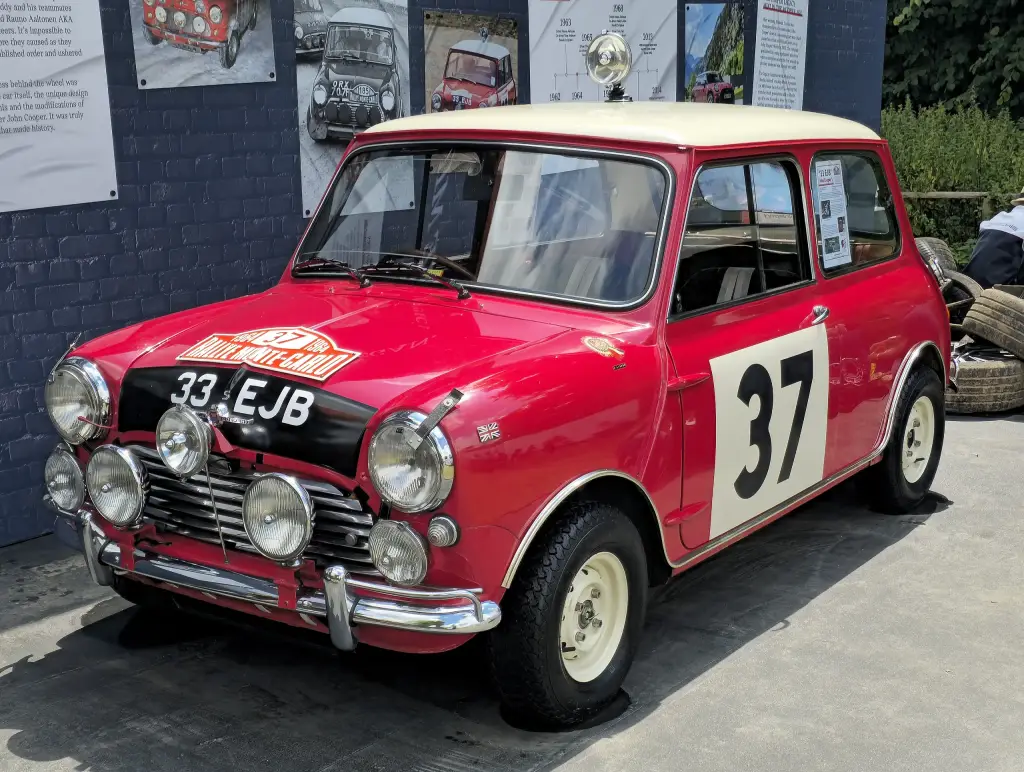
The Mini was the British Motor Corporation’s answer to the bubble cars that flooded Britain after the Suez Crisis. Designed by Alec Issigonis and launched in 1959, it packed four seats into a box only ten feet long and stayed in production, under BMC and its successors, until October 2000.
BMC Mini at a glance
| Maker | British Motor Corporation, later British Leyland and Rover Group |
|---|---|
| Production | 1959–2000 |
| Designer | Sir Alec Issigonis |
| Body | two-door saloon, four seats |
| Layout | transverse engine, front-wheel drive |
| Engine | BMC A-Series four-cylinder, water-cooled |
| Gearbox | four-speed, mounted in the engine sump |
| Names at launch | Austin Seven and Morris Mini-Minor |
| Own marque | from 1969 |
| Built | about 5.38 million of all versions |
Based on the English Wikipedia article on the Mini; one source. The article describes the BMC Mini as a model, not the Turkish assembly of the car.
History of the BMC Mini
The Mini came about because of a fuel shortage. The Suez Crisis of 1956 brought petrol rationing back to Britain, sales of large cars slumped and the market for German bubble cars boomed. Leonard Lord, the head of BMC, reportedly detested them so much that he vowed to design a proper miniature car, and set out the brief: the car had to fit inside a box of 10 by 4 by 4 feet, six feet of its length had to be given to the passengers, and the engine should be an existing unit to keep costs down.
Alec Issigonis, who had been working for Alvis, had been recruited back to BMC in 1955. His smallest project, XC9003, became the priority after Lord’s instructions of October 1956. With a team that included John Sheppard, Jack Daniels, Chris Kingham, Charles Griffin, Vic Everton, Ron Dovey, Dick Gallimore and George Cooper, he had a running prototype by July 1957; it was nicknamed the “Orange Box” for its colour. Lord approved it for production on 19 July and the project became ADO15.
The ADO15 used a conventional BMC A-Series four-cylinder engine, but mounted it sideways, put the four-speed gearbox in the sump under the engine and drove the front wheels. The arrangement let 80 per cent of the floorpan be used for passengers and luggage, and it set the pattern for almost every small front-wheel-drive car since. The radiator went to the left side of the car so that the engine-driven fan could be kept, blowing air into the low-pressure area under the front wing.
The car was first sold as the Austin Seven and the Morris Mini-Minor; the Austin version became the Austin Mini in 1962, and Mini became a marque in its own right in 1969. The Mark I was updated as the Mark II, the Clubman and the Mark III, and the range grew to include an estate, a pickup, a van and the jeep-like Moke. The Mini Cooper and Cooper S won the Monte Carlo Rally in 1964, 1965 and 1967, and in 1999 the Mini was voted the second most influential car of the twentieth century, behind the Ford Model T and ahead of the Citroën DS and the Volkswagen Beetle.
Minis were built at Longbridge in Birmingham and at Cowley, and also assembled or licensed in Australia, Spain by Authi, Belgium, Italy by Innocenti, Chile, Malta, Portugal, South Africa, Uruguay, Venezuela and Yugoslavia by IMV. British Leyland launched the Austin Metro as a follow-up in 1980, but the Mini outlived it and remained in production at Longbridge until October 2000.
Design and features
- Space efficiency: a ten-foot car with room for four people and their luggage, thanks to the wheel-at-each-corner layout.
- Transverse engine and sump gearbox: the packaging idea copied by generations of small cars.
- Huge variety: saloon, estate, van, pickup, Moke and the Cooper performance models.
- Racing record: three Monte Carlo Rally wins for the Cooper and Cooper S.
- Worldwide assembly: built or assembled in more than a dozen countries.
BMC Mini versions
- Mark I (1959): the original car, sold as Austin Seven and Morris Mini-Minor.
- Mark II and Clubman: updates of the Mark I range.
- Mark III: the final major UK update of the original shape.
- Cooper and Cooper S: performance versions with rally success.
- Estate, van, pickup and Moke: commercial and utility bodies.
- Innocenti Mini: the Italian-built version.
The Mini sat alongside BMC’s commercial range, including the J4 van, and its front-wheel-drive thinking shaped later small cars. More BMC models are in the BMC collection.
Video: Building a baby Austin7 MK1 Mini – BMC, Longbridge
Video by the uploader on YouTube.
Sources
- Mini, English Wikipedia: design, history, variants, production