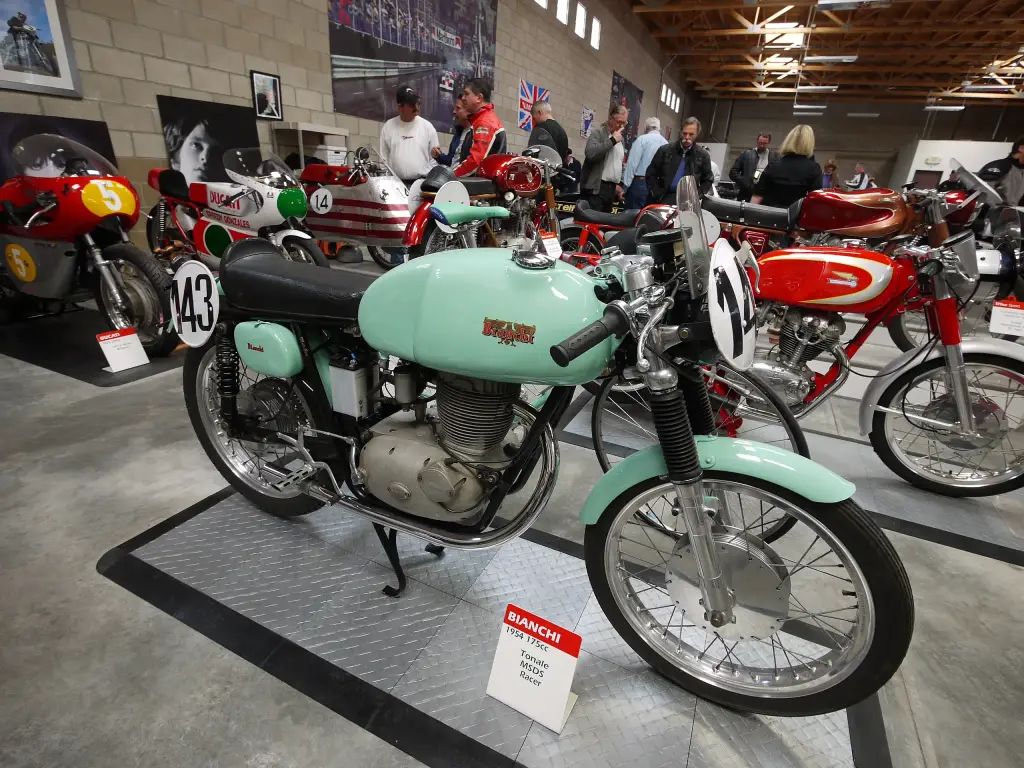
The Bianchi Freccia — the “Golden Arrow” — was the 250 cc model that F.I.V. Edoardo Bianchi launched in 1934 to replace its 220. It was built until 1940 in touring and sport form, and it carried a name that the Milan firm had already used for its smaller singles of the early 1930s.
Bianchi Freccia at a glance
| Maker | F.I.V. Edoardo Bianchi S.p.A., Milan |
|---|---|
| Model | 250 Freccia d’Oro |
| Production | 1934–1940 |
| Replaced | Bianchi 220 of 1933 |
| Earlier namesake | Bianchi 175 of 1930 |
| Touring version | 3,800 lire, “T” suffix |
| Sport version | 3,950 lire, higher power, twin exhausts |
| Engine | 250 cc single |
| Sales support | government subsidies lowered the customer price |
| Successor in 1937 | 250 cc Freccia d’Oro S developed for the military market |
No Wikipedia article exists for this model; the page is based on the English article on the Bianchi marque (one source).
History of the Bianchi Freccia
Bianchi was one of the oldest names in Italian motorcycling. Edoardo Bianchi began building bicycles in a small shop on Milan’s Via Nirone in 1885, built a motorised bicycle in 1897 and a car in 1900, and by 1903 was fitting engines into strengthened bicycle frames. A 498 cc single of 1910 established the Bianchi motorcycle name, and through the 1910s and 1920s the range grew to take in V-twins of 598 cc and 741 cc, a 348 cc side-valve single and, in 1924, a 173 cc overhead-valve single. The Freccia belongs to that expansion of the light and middleweight classes.
The 250 Freccia d’Oro was launched in 1934 to replace the 220 of 1933, which in turn derived from the 175 cc model introduced in 1930. Two versions were offered: a touring model at 3,800 lire and a sport model at 3,950 lire that gave 2.5 horsepower more and carried twin exhausts. Both were designated by a “T” suffix. The model was manufactured from 1934 until 1940, and sales benefited from government subsidies that reduced the price paid by the customer.
The Freccia name stood at the centre of Bianchi’s military work as well. During the Second World War the firm supported Mussolini’s drive for Italian economic self-sufficiency by developing a 250 cc model named Freccia d’Oro S in 1937, offered as a replacement for the 220 cc model; in return the company received contracts to supply the Italian military. Motorcycle production at Bianchi continued after the war and only ceased in 1967, when the rights passed to Innocenti.
Design and features
- Two levels of tune: a touring 250 at 3,800 lire and a sport version at 3,950 lire with 2.5 hp more and twin exhausts.
- Government support: subsidies brought the purchase price down for civilian buyers.
- A name with history: the Golden Arrow title had already been used on the 175 of 1930.
- Military derivative: the Freccia d’Oro S of 1937 was developed with army contracts in view.
Bianchi Freccia versions
- Touring (1934–1940): the standard 250 at 3,800 lire.
- Sport (1934–1940): 3,950 lire, 2.5 hp more, twin exhausts.
- Freccia d’Oro S (1937): the military-oriented development of the 250.
The Freccia was one of the light singles that stood alongside the bigger Bianchi twins; another Milan model of the same years is described in the article on the Bianchi Visconteo. More machines are in the Bianchi collection.
Video: Bianchi Freccia oro 175 – first start
Video on YouTube.
Sources
- Bianchi (motorcycles), English Wikipedia: history, Freccia d’Oro, versions and prices
- F.I.V. Edoardo Bianchi, Italian Wikipedia: company background