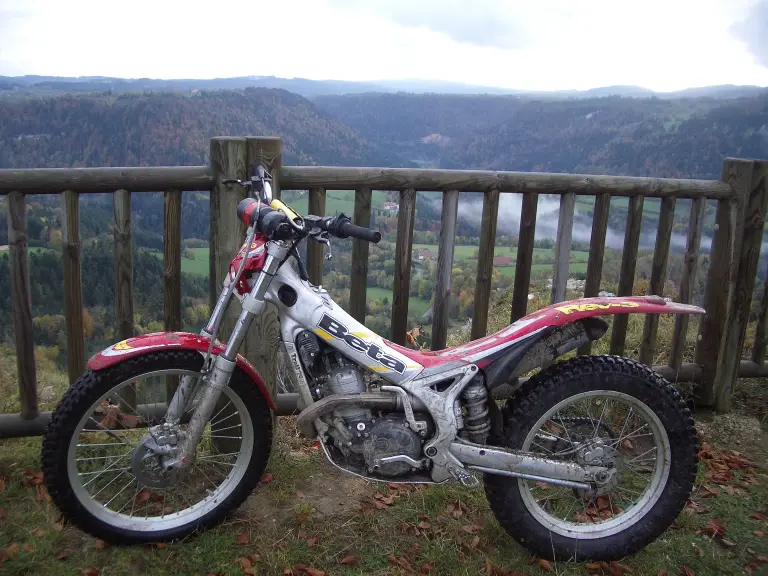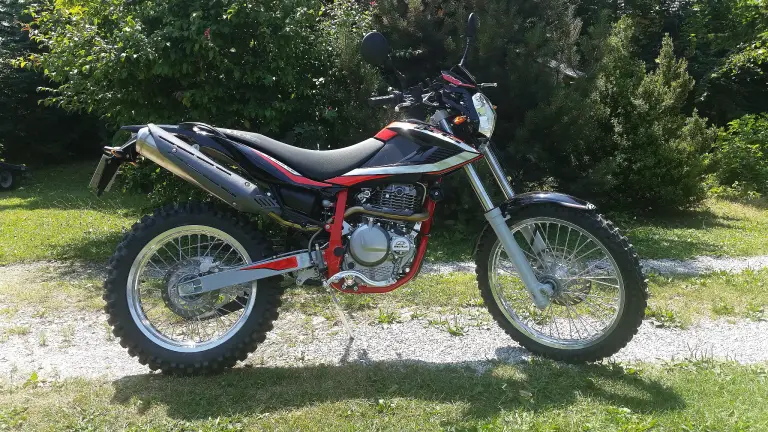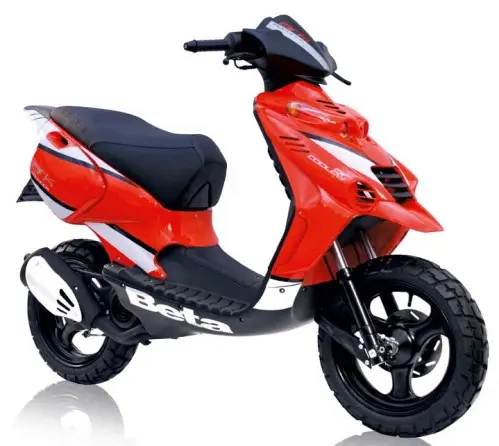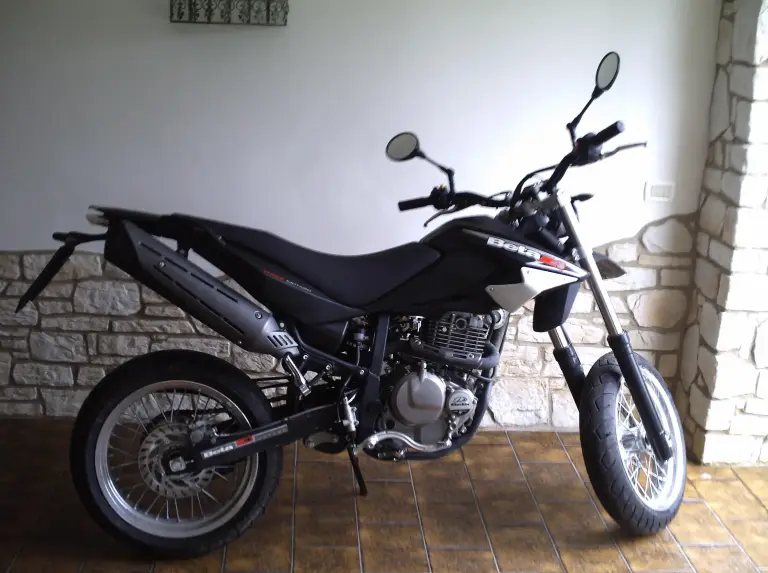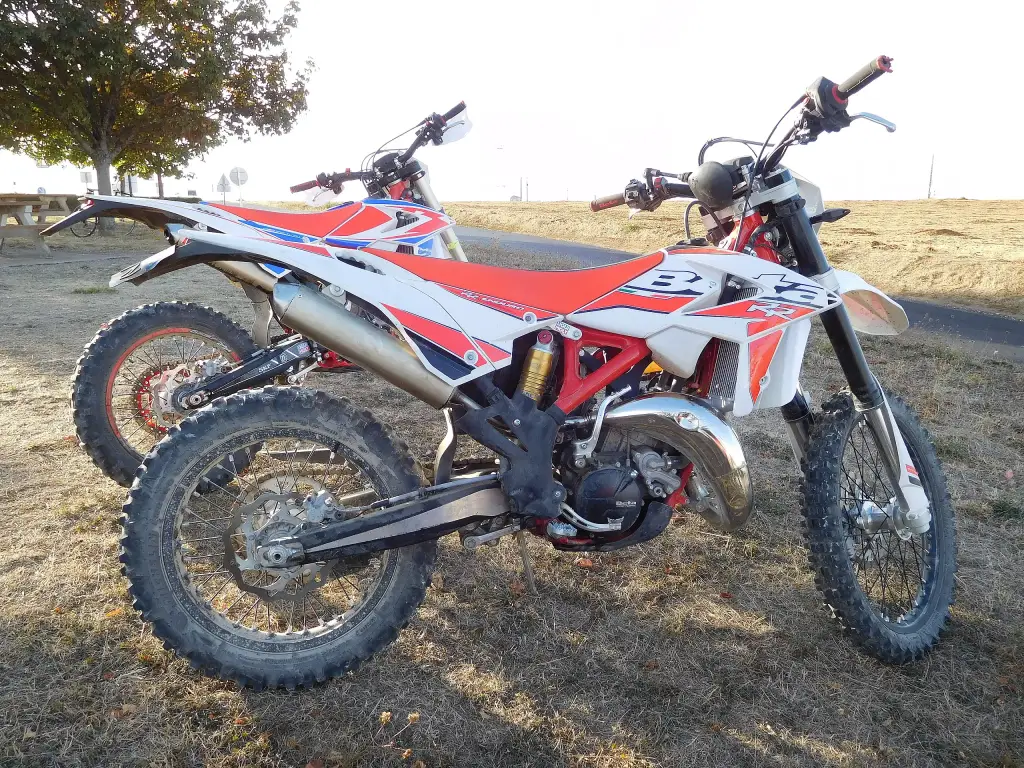
The Beta RR is the name Betamotor has used since 1998 for its road-legal off-road family. The range runs from a 50 cc moped for fourteen-year-olds to 450 and 525 cc enduro bikes, in enduro and supermotard form, with two-stroke and four-stroke engines.
Beta RR at a glance
| Maker | Betamotor, Rignano sull’Arno, Florence |
|---|---|
| First model | RR 50, 1998 |
| Range | 50 to 525 cc |
| Engines | single-cylinder two-stroke and four-stroke |
| Engine suppliers | Minarelli (50, 125), KTM until 2009, Beta from 2010 |
| Body styles | enduro and supermotard |
| Frame | steel; aluminium on the 2003 RR Alu |
| Forks | Paioli and Marzocchi, later 41 mm upside-down RI6V |
| Brakes | single disc front and rear |
| Use | road-legal enduro and supermoto |
The RR has no article of its own on English Wikipedia; this page uses the Italian article on the RR together with the English and Italian articles on Beta.
History of the Beta RR
The 50 cc entry model
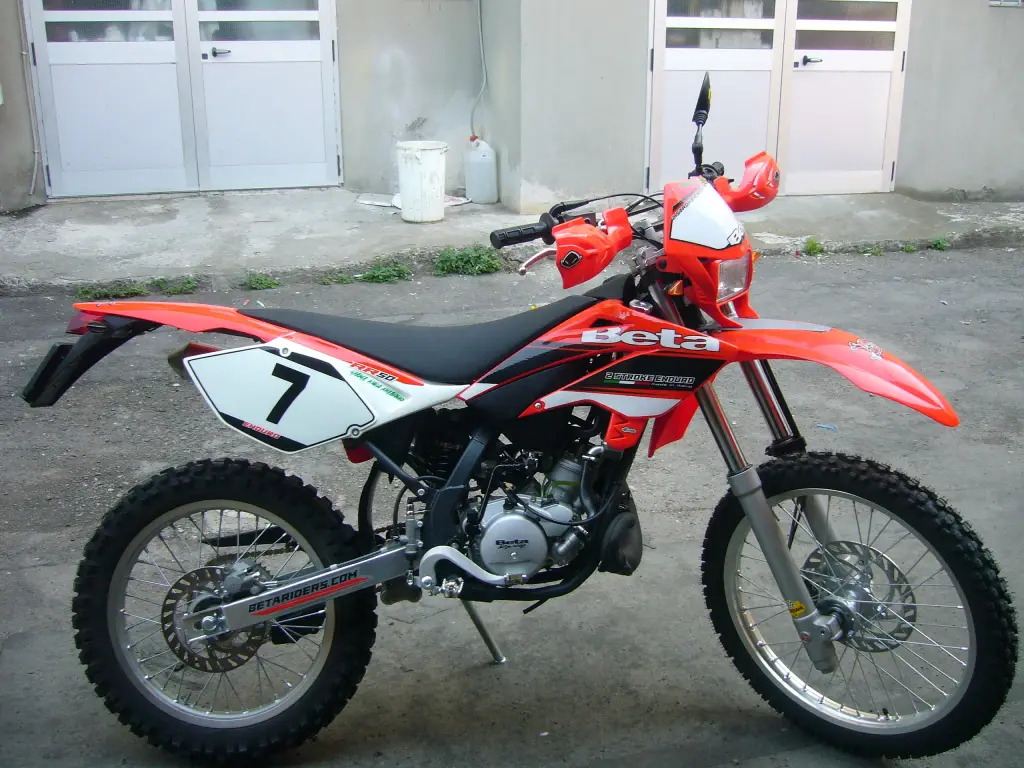
The family began in 1998 with the RR 50, developed from the Beta RK6 built between 1993 and 1997 and sold in base and Racing versions. The Racing model had adjustable forks and twin radiators but gave up the oil mixer. In 2002 the engine became the Minarelli AM6, again in Enduro 50 Base and Enduro 50 Racing form: the Racing bike was lightened of the mixer and the expansion-chamber guard and gained twin radiators, a racing exhaust, a 41 mm Paioli fork adjustable for preload and rebound, an aluminium swingarm and a reinforced clutch with straight-cut gear teeth. The standard machine was a restricted moped for riders from fourteen; the Racing was built for competition but stayed rideable on an AM licence. New plastics and graphics arrived in 2003 together with the RR Alu and its aluminium frame, and a Motard version followed in 2006.
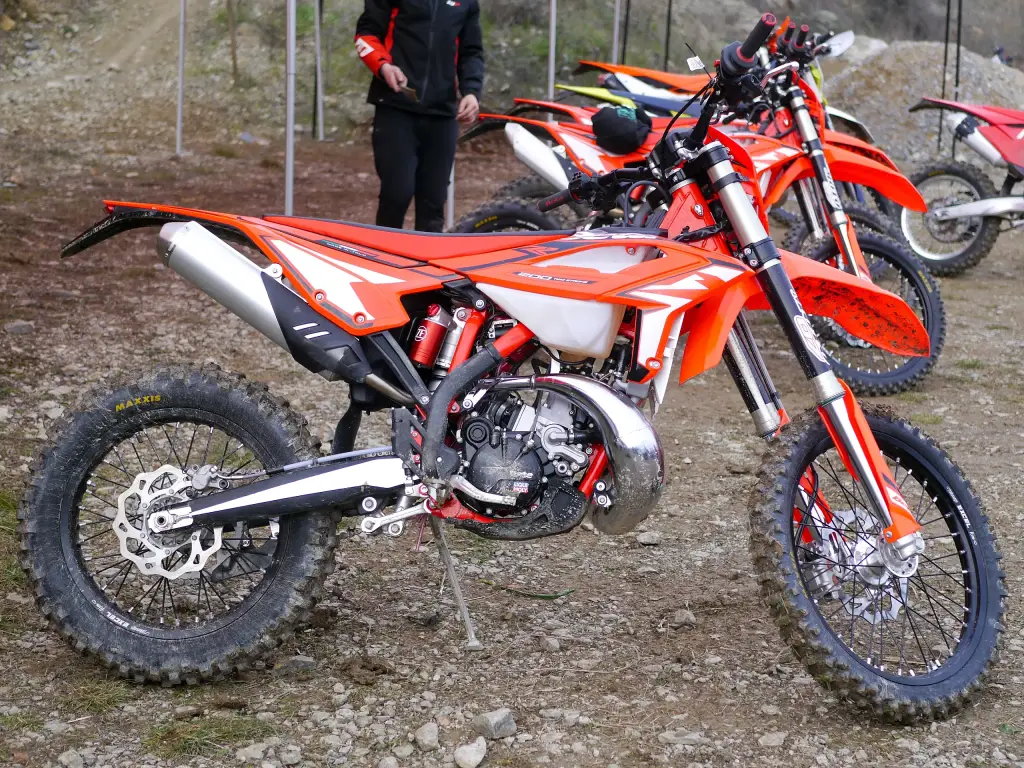
In July 2011 Beta presented the Model Year 2012 bikes with a new frame, a livery taken from the larger models, wave brake discs and, on the Racing, 41 mm upside-down Marzocchi forks. The 2019 Track version used 41 mm RI6V upside-down forks, a red anodised silencer, the Minarelli AM6 engine and 17-inch spoked aluminium wheels in three colour schemes, a blue and red one joining for 2020. The Racing kept its adjustable 41 mm RI6V forks, transparent tank, aluminium swingarm, adjustable monoshock and linkage, twin radiators and no mixer, on 21- and 18-inch wheels against the 17-inch pair of the Track. Both were updated to Euro 5 at the end of 2020, and for Model Year 2021 came a revised rear subframe, an LED tail light, a new tank and plastics inspired by the bigger RRs.
125 cc: four-stroke and two-stroke
The four-stroke 125 appeared in 2006 in enduro and motard form, using practically the chassis of the base 50 with a five-speed single that returned about 30 km per litre and put 10.5 hp on the rear wheel. Its engine derived from a Yamaha design developed in Brazil in the late 1970s. In 2010 Beta introduced the RR 125 LC with a completely revised chassis and the liquid-cooled 15 hp Yamaha-Minarelli engine. A two-stroke 125 followed in June 2017 for Model Year 2018, Euro 4 approved but still carburetted, with an engine designed in-house by Beta’s research and development department.
The larger enduros
Beta entered the four-stroke enduro market in the middle of the 2000s with KTM-sourced RFS motors: the Italian article dates the 249.6 cc 250 four-stroke to 2005 to 2007 and the 398 cc 400 to 2005, alongside 450 and 525 versions, all with Nissin brakes, Marzocchi forks and a Sachs rear shock. A removable clutch sub-cover, revised fork settings and a redesigned swingarm came for 2007, the street-legal RS models appeared in 2008 in 400, 450 and 525 cc, and 2009 brought the first Factory or Race editions with a titanium exhaust, closed-cartridge forks, billet triple clamps and a carbon-fibre skid plate. It was the last year of the KTM-sourced motors.
From 2010 Beta used its own carburetted four-strokes, with double overhead camshafts, separate engine and gearbox lubricants, Brembo hydraulic clutches and six-speed gearboxes; the 350 arrived in the middle of 2010. The 2013 season added the 300 RR two-stroke and 2014 the 250 two-stroke. For 2015 the 400, 450 and 498 became 390, 430 and 480, which Beta called perfect displacements, and in 2019 the carburetted 200 joined the two-stroke line. The Italian article also records the company’s first enduro world title, won in 2016 by Steve Holcombe on the 300 RR in the E3 class.
Design and features
- Road-legal off-road bikes: machines derived from race models but registered for the road, from moped to full enduro.
- Two layouts: enduro and supermotard versions of the same bikes, with the 50 also offered in Motard form from 2006.
- Engine history: Minarelli, KTM and finally Beta’s own motors, introduced for 2010.
- Racing editions: Factory and Race versions with closed-cartridge forks, titanium exhausts and carbon-fibre protection.
- Wide range: 50, 125, 200, 250, 300, 350, 400, 450 and 498 cc, plus the 520 and 525.
Beta RR versions
- RR 50 (1998 onwards): moped in Enduro, Racing and from 2019 Track form, Motard from 2006.
- RR 125 (2006 onwards): four-stroke, from 2010 the liquid-cooled LC and from 2018 a two-stroke.
- RR 250 and 300 2T (2013 onwards): two-strokes with Beta-designed engines.
- RR 350, 400, 450, 498 (2005 onwards): four-strokes, KTM-engined until 2009 and Beta-engined afterwards.
- RS and RR-S: street-legal dual-sport versions sold mainly in the United States.
The RR is Beta’s enduro family; the trial side of the range is covered by the Beta Evo and Beta Rev-3, and the trail models by the Beta Alp. More machines are in the Beta collection.
Video: Beta RR 350
Video on YouTube.
Sources
- Beta RR, Italian Wikipedia: models, dates, equipment
- Beta (motorcycle manufacturer), English Wikipedia: RFS motors, RS models, later development
- Beta Motor, Italian Wikipedia: model list, 2016 enduro title