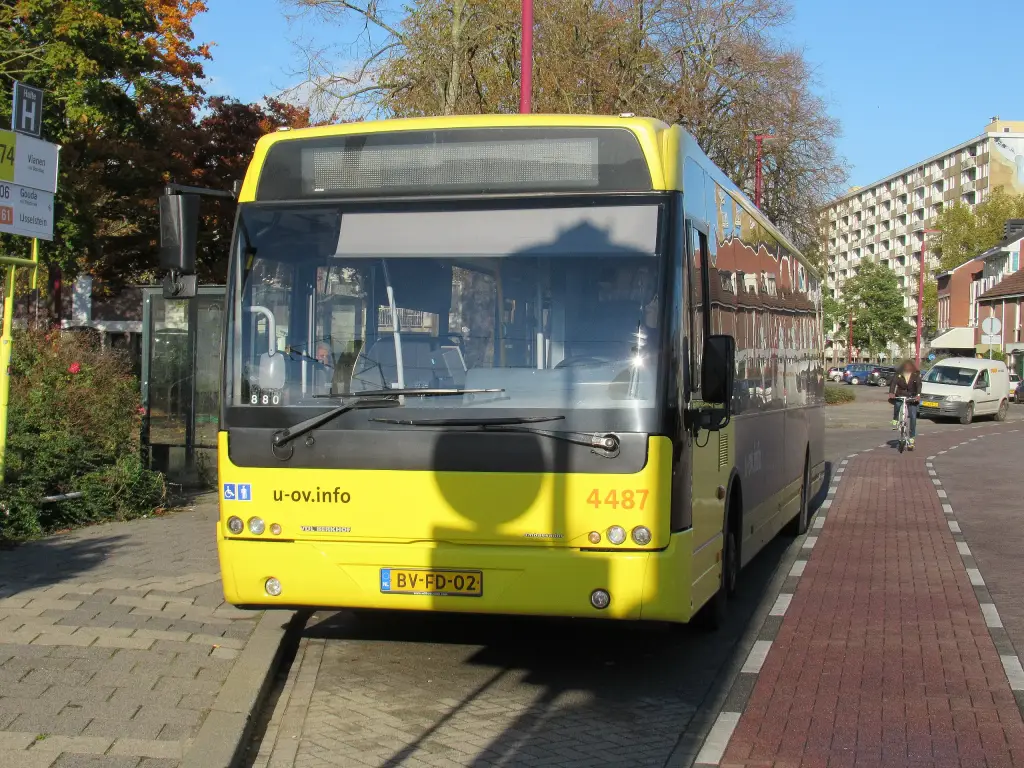

The Berkhof Ambassador was a low-entry city and regional bus built by the Dutch manufacturer VDL Berkhof, part of VDL Bus & Coach, between 2001 and 2011. It was designed as a light, cheap-to-run bus for short-distance work, and it became one of the most common types on Dutch roads before the VDL Citea replaced it.
Berkhof Ambassador at a glance
| Maker | VDL Berkhof, Heerenveen, Netherlands (VDL Bus & Coach) |
|---|---|
| Production | 2001–2011 |
| Replaced by | VDL Citea (12 m in October 2011; 10.6 m in late 2013) |
| Layout | semi-low-floor: 340 mm floor height between the doors |
| Lengths | 10.6 m (ALE 106) and 12 m (ALE 120) |
| Chassis | DAF/VDL SB120 then SB180 (ALE 106); DAF/VDL SB200 (ALE 120) |
| Kerb weight | about 8,700 kg, some 25 per cent below earlier buses |
| Fuel saving | about 15–20 per cent in service |
| Gearbox | Voith automatic |
| Engines | Cummins, later versions tuned for lower emissions |
| Price | about €180,000 when new |
| Main operators | Connexxion, Arriva, Hermes, Syntus, Veolia Transport, Breng (NL); Arriva and Nobina (DK) |
History of the Berkhof Ambassador
The Ambassador grew out of the Euro III emission standard that came into force in 2001. The engine supplier of the existing Berkhof buses was not willing to adapt its unit at short notice, and rather than simply swapping the engine Berkhof used the moment for a wider redesign. Because margins in city and regional bus operation are thin, the company set out to build a bus that was cheaper to buy and cheaper to run.
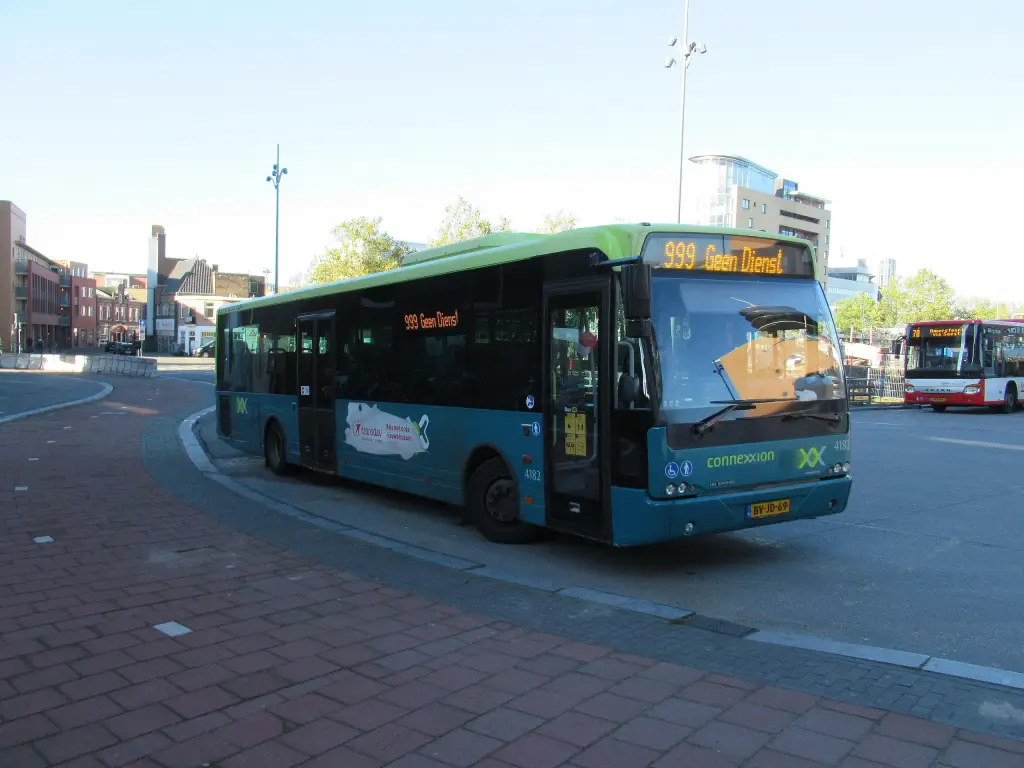

The answer was a lightweight body: plastic panels and a light frame instead of a heavy steel cage, carbon-fibre bodywork and some interior parts, and a chassis frame made of a material between ordinary steel and stainless steel. Components such as the roof, floor and side walls arrived complete and only had to be assembled, which cut production hours roughly in half and reduced the build to thirteen steps. The bus weighed about 8,700 kg against some 11,000 kg for a conventional regional bus, and in service that brought fuel savings of 15 to 20 per cent. Development was supported by a subsidy from Novem, the Dutch energy and environment agency, under its DEMO programme.
Connexxion had enough confidence in the concept to order the bus while it was still on the drawing board, and Berkhof showed the prototype in Connexxion colours at Busworld in Kortrijk in October 2001. Production began the same year at Heerenveen. In 2005 Connexxion ordered 300 buses for €50 million, an order too large for the Heerenveen plant alone, so the Valkenswaard factory was also equipped to build the Ambassador. A further order for 355 buses worth €75 million followed in July 2008.
The Ambassador was exported to Denmark, Germany, Israel, Portugal and Sweden, and operators in Italy also ran the type. The first series, delivered to Connexxion and Hermes, had green LCD route displays that sometimes failed; later buses came with orange LED displays. Early buses, built from 2001 to 2005, had inferior suspension that made them rattle, and the original Voith gearbox was noisy; later versions were sturdier, with better insulation and a quieter, cleaner Cummins engine. In December 2003 a driver was killed after becoming trapped between the front door and the body, and that door design was subsequently replaced. In a storm on 18 January 2007 an Ambassador was blown off a dike, a reminder of how light the bus was.
The 12-metre version was replaced by the VDL Citea LLE in October 2011, and the 10.6-metre bus by the Citea MLE at the end of 2013. Many Ambassadors then found second lives abroad: in late 2017 the Romanian operator STV bought around 500 used buses from Dutch companies, most of them from Connexxion, and about 300 remained in service.
Design and features
- Semi-low floor: the floor between the front and rear doors sits 340 mm above the road, with a step up to the raised rear section over the engine.
- Lightweight build: plastic and carbon-fibre panels on a light frame cut the kerb weight to about 8,700 kg.
- Economy: the low weight and Cummins engines gave 15–20 per cent lower fuel use than conventional regional buses.
- Simple assembly: complete roof, floor and side-wall modules halved the production hours per bus.
- Wheelchair access: a manually or electrically operated ramp was fitted for wheelchair users.
Berkhof Ambassador versions
- Ambassador ALE 106: the 10.6 m midibus on a DAF/VDL SB120 chassis, also used by the Wright Cadet; the chassis changed to the VDL SB180 in 2008.
- Ambassador ALE 120: the 12 m version on a DAF/VDL SB200 chassis, also used by the Wright Commander; the most numerous type.
- Early series (2001–2005): softer suspension, noisy first-generation Voith gearbox and green LCD route displays.
- Later series: sturdier suspension, quieter Voith gearbox, better insulation, cleaner Cummins engine and orange LED displays.
The Ambassador was the main product of Berkhof, the Dutch coachbuilder that became part of VDL Bus & Coach.
Video: Arriva 8414 – VDL Berkhof Ambassador
Video on YouTube.
Sources
- Berkhof Ambassador, English Wikipedia: production years, layout, operators, orders, incidents
- Berkhof Ambassador, Dutch Wikipedia: construction, weight, types, replacement