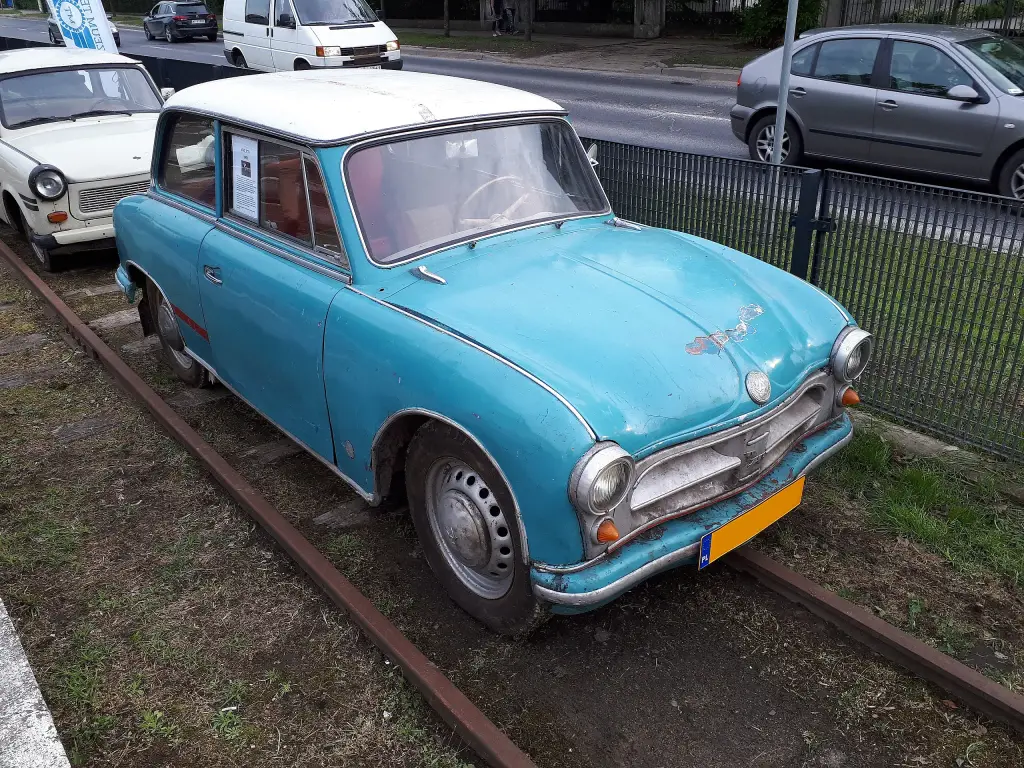

The AWZ P70 Zwickau was a small family car built in East Germany between 1955 and 1959. It replaced the IFA F8 with a new pontoon body of Duroplast panels over a wooden frame, and it was the first car whose plastic body was not made by hand. After 36,151 cars it gave way to the Trabant P 50.
AWZ P70 at a glance
| Maker | VEB Automobilwerke Zwickau (AWZ) |
|---|---|
| Production | 1955–1959 |
| Predecessor | IFA F8 |
| Engine | 684 cc two-cylinder two-stroke |
| Power | 22 PS (16 kW) at 3,500 rpm |
| Torque | 5.4 kpm (53 Nm) at 1,900 rpm |
| Body | Duroplast panels on a wooden frame, plywood floor |
| Gearbox | three-speed, unsynchronised, front-wheel drive |
| Cooling | thermosiphon, without a fan |
| Versions | saloon, estate (Kombi), coupé |
| Latter name | Sachsenring P70 from 1958 |
| Built | 36,151 |
History of the AWZ P70
Origins and the move to plastic
The P70 was developed on the basis of the IFA F8 as an intermediate type intended to test the new body material. Its designation stood for a passenger car with 700 cm³ of displacement. The body was a novelty: a wooden skeleton clad with carefully developed Duroplast shells made of phenol resin reinforced with short cotton fibres (linters). This allowed the factory to do without scarce deep-drawing steel sheet, reduced the weight and promised long life. Because it was expensive to build and still immature in design, the P70 was not considered suitable for mass motorisation; the experience gathered with it went into the parallel development of the Trabant.
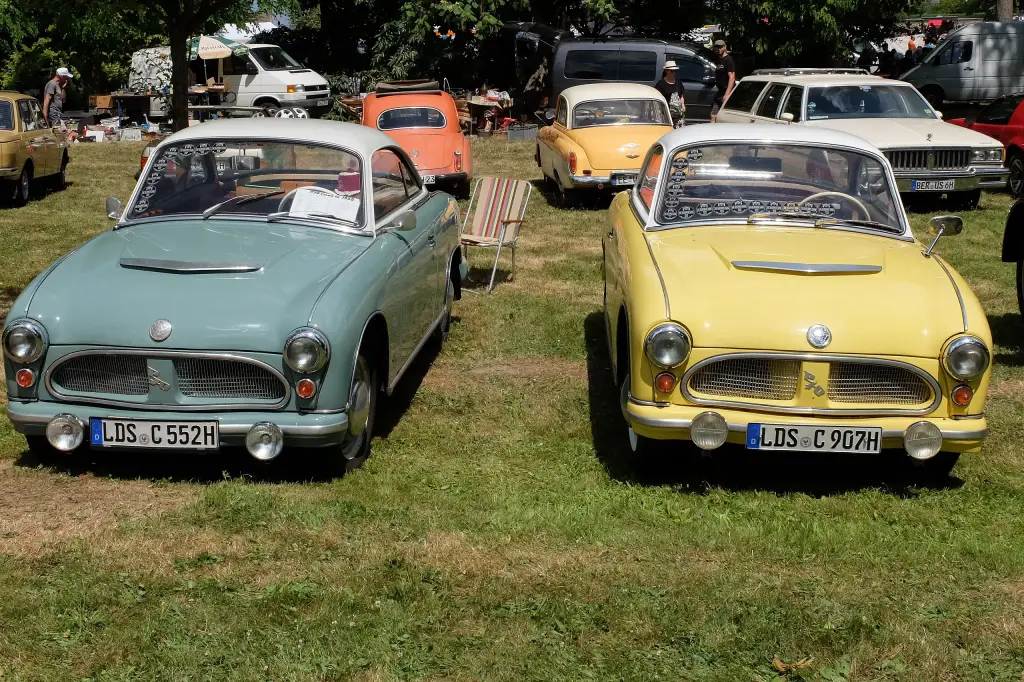

Saloon, estate and coupé
The saloon appeared in 1955, an estate followed in the spring of 1956 and a coupé in the spring of 1957. The estate kept the saloon’s body up to the B-pillar, had a roof covered in imitation leather and a large rear door hinged on the left, and its big boot made it very popular. The coupé was different in character: it had a steel body with a sporting design, an aggressive radiator mouth and a polished aluminium air-scoop dummy on the bonnet, with windows that wound down behind a central pillar. Its sportiness was mostly appearance, as it used the same engine as the other versions. Pick-up bodies that exist today are home-made conversions.
Later years
The car was at first spartanly equipped, which caused discontent and slow sales: it had neither sliding door windows nor a boot lid, and the saloon’s boot could at first be reached only through the passenger compartment. In 1956 the front doors received sliding windows, and a kit was later offered for fitting a boot lid. In 1958 AWZ was united with the former Horch factory to become VEB Sachsenring Automobilwerke Zwickau, and the AWZ P70 became the Sachsenring P70. The P70 was replaced by the Trabant P 50 in 1959. Because of its cotton-based Duroplast body, East Germans nicknamed it the “Papp 70” (cardboard 70).
Design and features
- Duroplast body: the first series-produced plastic car body not made by hand, after the Chevrolet Corvette and the Lloyd 300.
- Wooden skeleton: Duroplast shells fixed to a timber frame with a plywood floor, on a box-section chassis.
- Two-stroke twin: the F8 engine turned through 180 degrees and fitted with aluminium cylinder heads, giving 22 PS.
- Dynastart: a 12-volt generator on the crankshaft that also served as the starter.
- Simple cooling: thermosiphon circulation without a fan, which tended to boil when the car was driven long in first gear.
AWZ P70 versions
- Saloon (1955–1959): the original three-box pontoon body.
- Kombi estate (1956–1959): large boot, left-hinged tailgate, roof in imitation leather.
- Coupé (1957–1959): steel body, about 1,500 built.
- Sachsenring P70 (1958–1959): the same car under the name of the merged works.
The P70 was the direct forerunner of the Trabant, which took over its role in East German motoring. More cars from Zwickau are in the AWZ collection.
Video: AWZ P70
Video on YouTube.
Sources
- AWZ P70 Zwickau, English Wikipedia: production, engine, versions
- AWZ P 70, German Wikipedia: body construction, equipment, technical data