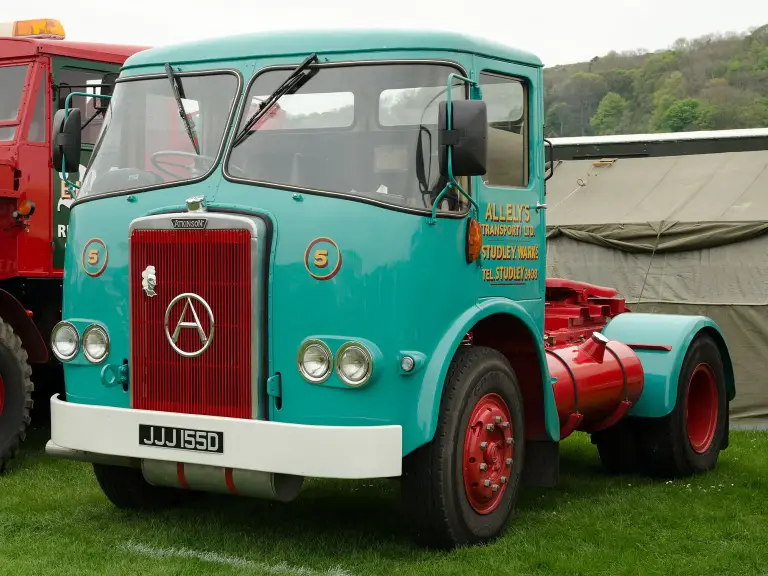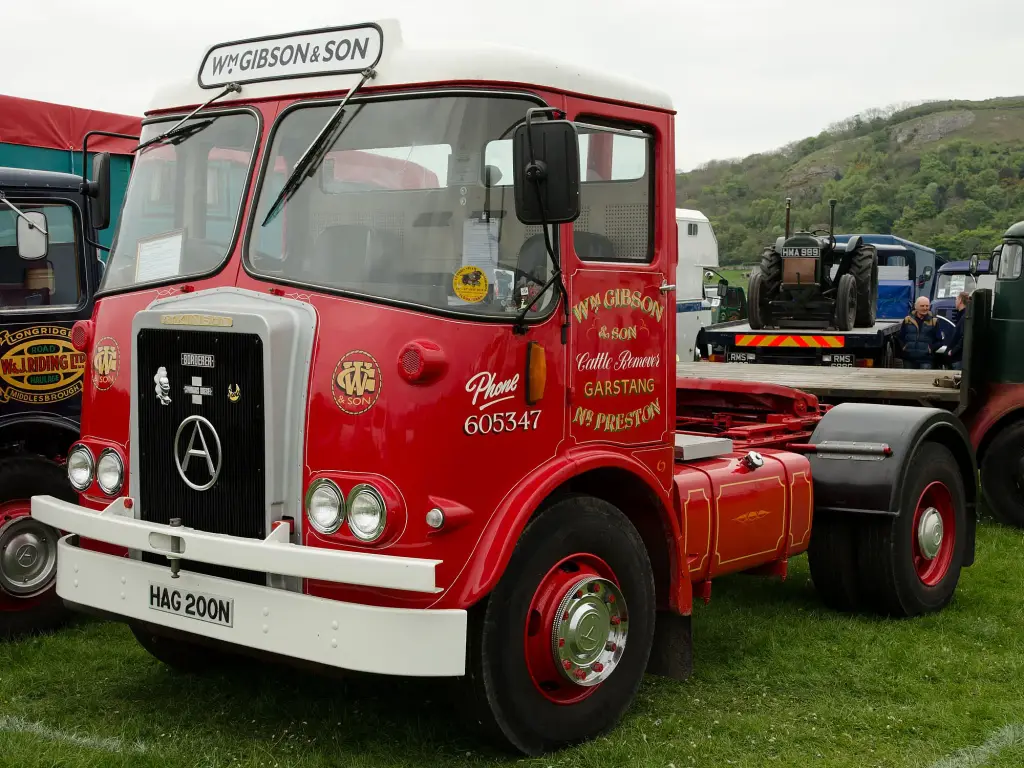
The Atkinson Borderer was the two-axle tractor unit of the range that Atkinson announced at the Commercial Motor Show at Earls Court in October 1970. The most famous of the final Atkinsons, it was built around the revised glass-fibre Mk I cab with its concealed radiator and carried a Gardner, Rolls-Royce or Cummins engine.
Atkinson Borderer at a glance
| Maker | Atkinson Lorries, Walton-le-Dale, Preston |
|---|---|
| Announced | Commercial Motor Show, Earls Court, October 1970 |
| Type | two-axle tractor unit |
| Range | Borderer, Leader, Searcher, Defender, Venturer |
| Cab | revised Mk I glass-fibre cab on ash framing, concealed radiator |
| Engine | Gardner, Rolls-Royce or Cummins, bought in |
| Gearbox | David Brown |
| Rear axle | Kirkstall Forge |
| Badging | no Knight of the Road badge after 1970 |
| Named after | an idea of publicity officer Frank Whalley |
| Company owner | Seddon Diesel Vehicles from 1970 |
| Surviving example | MVD432L, later stretched and named Buccaneer |
The Borderer is described in the Atkinson section of the English Wikipedia article on Seddon Atkinson; this page is based on that one source.
History of the Atkinson Borderer
The lorry Atkinson built
Atkinson had assembled its lorries from tried and tested proprietary components since the 1933 reorganisation: a bought-in chassis frame to Atkinson design, usually a Gardner engine, a David Brown gearbox and Kirkstall Forge rear axles. In 1958, after a change in the Construction & Use Regulations, the company replaced its coachbuilt hardwood and metal cab with a glass-fibre clad cab, known as the Mk I, with twin fixed wrap-around windscreens but the traditional exposed Withnell-tube radiator. The first version had a single headlight; the Deluxe twin-headlight model of 1963 became an Atkinson characteristic and the single-headlight option was dropped.
The revised cab of 1968
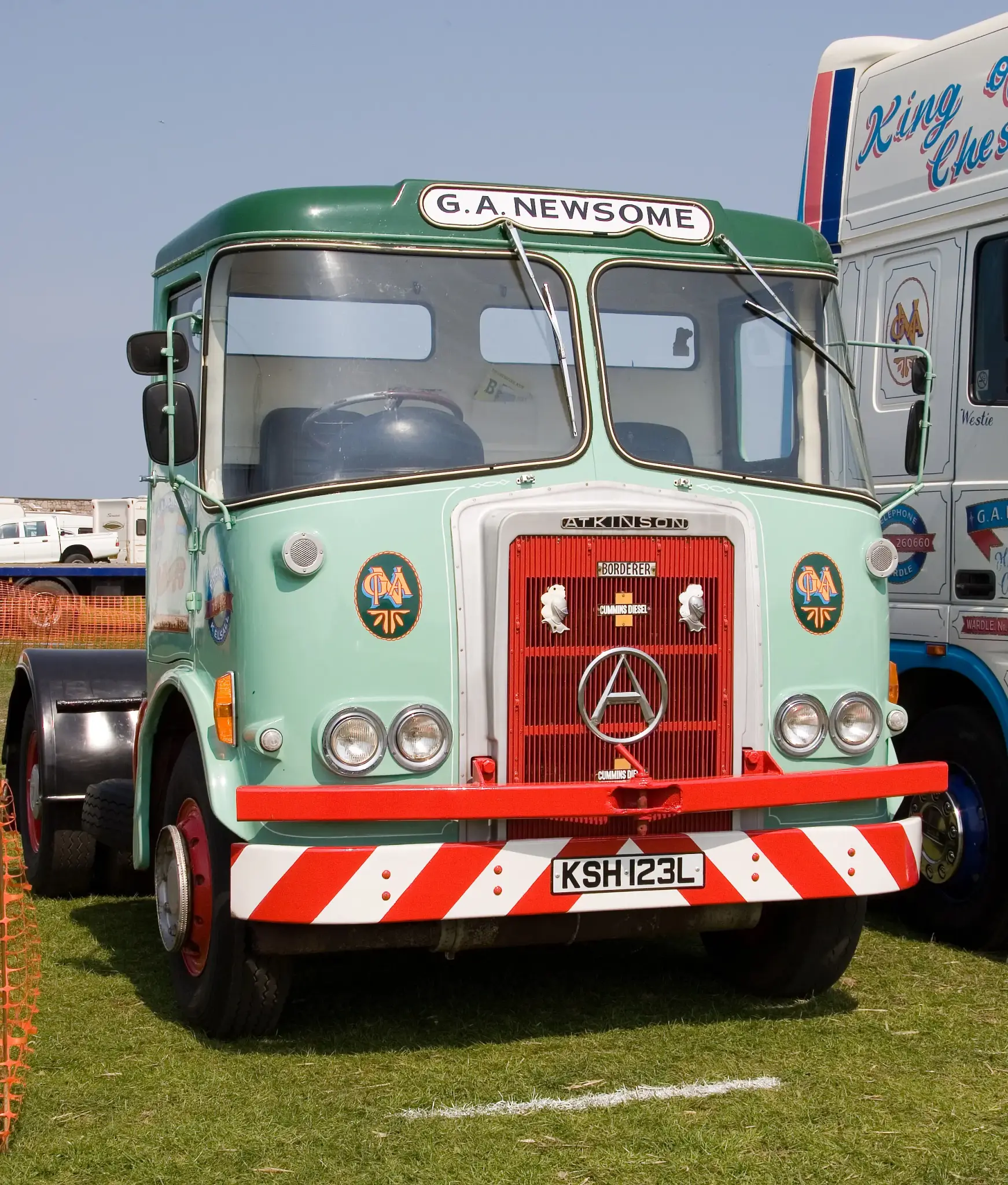
From 1968 the standard Mk I cab was revised with stronger ash framing, larger dimensions and wider, deeper windscreens. The exposed Withnell-tubed radiator gave way to a concealed one behind a glass-fibre shrouded metal grille, which again carried the Knight’s Head, the circular A logo and plates naming the engine manufacturer. Krupp cabs, introduced in 1969, and the View-Line cab were available until 1970 but ceased before the launch of the new range and the merger with Seddon.
Earls Court, October 1970
The revised cab was used for the final Atkinson haulage models, announced at the Commercial Motor Show at Earls Court in October 1970. The naming of the range came from an idea by Frank Whalley, the company publicity officer. The most famous of the models were the two-axle tractor units called Borderer. Three-axle rear-steer tractor units were the Leader, designed for the increases in permitted gross weights that were expected but did not arrive until May 1983; three-axle haulage chassis were the Searcher, four-axle chassis the Defender and three-axle heavy haulage tractor units the Venturer. The two-axle haulage chassis were never given an official name, although the name Raider had been planned for them, and factory grille plates were never produced.
The end of the Knight badge
The 1970 show also marked the end of the Knight of the Road badging. The exhibits were prepared with four separate badges on the radiator grille — the Big A, the Knight’s head, the new model name and the engine manufacturer’s badge. Managing Director Peter M Yates said they looked “like fairground lorries” and told Frank Whalley to stop using the Knight badge, which was consistent with ending the Knight names for the range.
Engines and later life
Gardner had offered no more than 120 bhp for road vehicles in the early 1950s, so Atkinson tried a Daimler 650 cubic inch engine rated at 150 bhp in an eight-wheeled rigid chassis; Rolls-Royce and Cummins units were later offered alongside Gardner, which replied with 150 bhp in 1957 and 180 and 240 bhp in 1966 and 1970. In 1970 Seddon Diesel Vehicles of Oldham acquired Atkinson to form Seddon Atkinson, and in 1974 the firm passed to International Harvester. One Borderer, MVD432L, originally a T3446C, was stretched by its owner John Killingbeck into a 6×2 Chinese Six tractor with an uprated Gardner 6LXB engine to meet the 6 bhp per ton requirement after 1973; the Atkinson archivist Michael Deuchars named it Buccaneer and a replica grille plate was made for it.
Design and features
- Two-axle tractor layout: the classic British artic unit of the period, and the best known model of the 1970 range.
- Revised Mk I cab: glass-fibre panels on a stronger ash frame, with larger, deeper windscreens.
- Concealed radiator: a glass-fibre shrouded metal grille in place of the exposed Withnell tube, still carrying the A logo and the engine maker’s plate.
- Proprietary driveline: Gardner, Rolls-Royce or Cummins power, David Brown gearbox and Kirkstall rear axle.
- New naming: the 1970 range dropped the Knight names and the Knight’s head badge.
Atkinson Borderer versions
- Borderer: two-axle tractor unit, the most famous model of the range.
- Leader: three-axle rear-steer tractor unit, intended for heavier permitted gross weights.
- Searcher: three-axle haulage chassis.
- Defender: four-axle chassis.
- Venturer: three-axle heavy haulage tractor unit.
- Raider: planned name for the two-axle haulage chassis, never used on a production lorry.
The Borderer replaced the lorries sold under the Silver, Gold and Black Knight names in the 1960s. More Atkinsons are in the Atkinson collection.
Video: atkinson borderer cummins 220 (205hp) 10 speed fuller roadranger part two
Video on YouTube.
Sources
- Seddon Atkinson, English Wikipedia: Atkinson company history, 1968 cab, 1970 range, engines, surviving Borderer