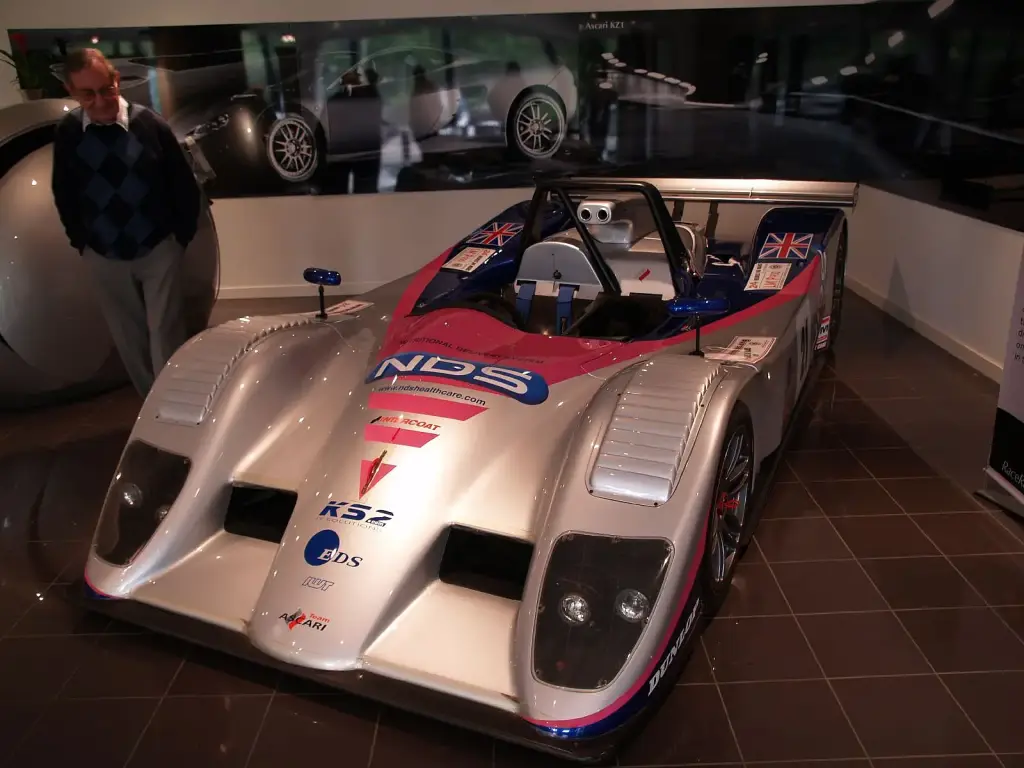
The Ascari A410 was a Le Mans Prototype built by Ascari Cars in 2000 and based on the Lola T92/10 Group C racing car. It used a 4-litre Judd GV4 V10 and competed in European and international sports car racing; in 2002 it was renamed the Ascari KZR-1.
Ascari A410 at a glance
| Maker | Ascari Cars |
|---|---|
| Class | LMP900 |
| Built | two cars and a spare chassis |
| Engine | Judd GV4 4.0-litre V10 |
| Power | about 600 hp (447 kW) at 10,250 rpm |
| Torque | 450 N·m at 8,500 rpm |
| Chassis | carbon fibre monocoque |
| Suspension | double wishbones, push-rod actuated |
| Gearbox | six-speed sequential, rear-wheel drive |
| Debut | 500 km of Silverstone, 2000 |
| Renamed | KZR-1 in 2002 |
| First win | Donington Park, 2001 |
This page is based on English Wikipedia only, so its figures could not be checked against a second source.
History of the Ascari A410
Origins
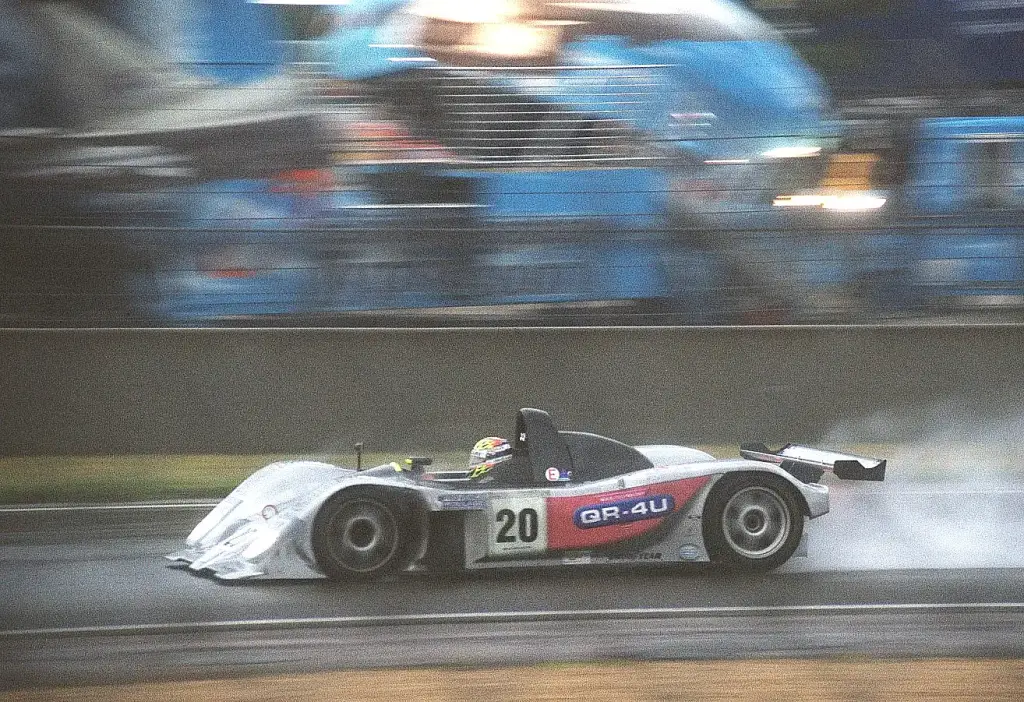
After Klaas Zwart founded Ascari Cars in the late 1990s he began to enter the team in sports car racing, initially with the Ascari Ecosse in 1999, before building the A410 in 2000. The A410 was an LMP900-class car and took its name from the 4-litre Judd GV4 V10 engine it was fitted with. It was based on the Lola T92/10 Group C racing car and featured a similar chassis design and similar suspension. It is clearly distinguishable from the T92/10 by its open bodywork – the Lola had a closed cockpit – but the A410 used several styling cues from it, such as the flat-nosed front end. Even the engine was related: the Judd GV4 was a bigger version of the 3.5-litre GV10 used in the early car, which itself started out life as a Formula One engine.
The car had a carbon fibre monocoque chassis with double wishbone suspension, push-rod actuated coil springs and dampers at both ends. The naturally aspirated Judd GV4 produced around 600 hp at 10,250 rpm and 450 N·m of torque at 8,500 rpm. Power output was similar to that of the Audi R8, the most successful LMP900 car, but the naturally aspirated engine made far less torque than the R8’s 3.6-litre twin-turbocharged V8 – around 250 N·m less. A six-speed sequential gearbox drove the rear wheels, and carbon fibre disc brakes were fitted as standard in the class.
The 2000 season
The A410 made its debut in the 500 km of Silverstone in 2000, but gearbox problems prevented it from racing. Team Ascari then attempted to compete in the 24 Hours of Le Mans, but because it had not attended the Le Mans Test it was not invited. Zwart then entered himself alongside Werner Lupberger and Jeffrey van Hooydonk at the 1000 km of Nürburgring; the car made the start of a race for the first time but retired after 41 laps with another gearbox failure. At the Brno round of the Sports Racing World Cup an A410 finished a race for the first time, with Lupberger and Zwart 19th and last overall, twelve laps behind the next car – the only finish of 2000. The team retired at Donington Park without completing a lap because of electrical issues, suffered similar problems at the Nürburgring after 27 laps, and a spin after 29 laps put it out of the final round at Magny-Cours.
2001: the first win
Mike Phillips attempted to enter an A410 at the 24 Hours of Daytona in 2001 but did not attend the race. In what was now the FIA Sportscar Championship the car, driven by Lupberger and Ben Collins, retired at Barcelona after 74 laps with a blown engine. At Donington Park for the European Le Mans Series both A410s were entered: Patrick Lemarié’s car did not start because of engine problems, while Lupberger and Collins were classified 23rd after retiring with another gearbox problem after 54 minutes. At the 1000 km of Monza came the first success, second place seven seconds behind the Ferrari 333SP-Judd of Giovanni Lavaggi and Christian Vann, followed by fourth at Spa-Francorchamps with the second fastest lap of the race.
At Le Mans in 2001 Lupberger and Collins were partnered by Harri Toivonen in chassis A410-001, while Zwart shared the other car with Xavier Pompidou and Scott Maxwell. Neither finished: A410-001 retired with a fuel pump problem after 11 hours and 134 laps, and the other car crashed out after 15 hours and 66 laps. Back in the FIA Sportscar Championship, Collins and Lupberger took fourth places at Brno and Magny-Cours, then won at Donington Park by almost a minute for the car’s maiden victory. At Mondello Park they finished ninth overall and sixth in the SR1 class, and in the final race at the Nürburgring the car was disqualified from third place because of issues with its dimensions. Team Ascari finished the season fourth with 71 points, and was classified eighth with 11 points in its one European Le Mans Series race.
The KZR-1
In 2002 both cars were renamed KZR-1 – not to be confused with the Ascari KZ1-R GT3 racing car – and shipped to America. They first appeared under the new name at the 24 Hours of Daytona: Lupberger and Toivonen were joined by T. J. Bell in A410-001, while Collins, Zwart and Vann drove A410-002, which was also fitted with a BMW 4-litre V8 engine. Neither car had a successful race: A410-001 was classified 38th overall and ninth in the SRP class after retiring with a blown engine after 15 hours and 429 laps, and the other car was classified 70th and 16th in class after electrical issues ended its run after six hours and 116 laps.
Design and features
- Open bodywork: the A410 was an open prototype where its Lola inspiration, the T92/10, had a closed cockpit.
- Judd GV4 V10: a 4-litre, naturally aspirated engine of about 600 hp at 10,250 rpm, descended from a Formula One unit.
- Carbon fibre monocoque: double wishbone suspension with push-rod actuated springs and dampers, and carbon disc brakes.
- Raced on both sides of the Atlantic: European sports car racing from 2000, then Daytona as the KZR-1 from 2002.
Ascari A410 versions
- A410 (2000–2001): the original Judd-engined LMP900 car, two built plus a spare chassis.
- A410-002 with BMW V8: the second chassis ran at Daytona in 2002 with a BMW 4-litre V8 instead of the Judd.
- KZR-1 (2002–2003): the new name given to both cars for their American campaign.
The A410 came before Ascari’s road-going KZ1 and its racing KZ1-R, which shares part of the name but is a different car. More cars are in the Ascari collection.
Video: 2001 – Le Mans – Scott Maxwell and a Viper goes off at Arnage
Video on YouTube.
Sources
- Ascari A410, English Wikipedia: development, specification, racing history