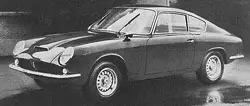
The ASA 411 was a racing coupé built by the Italian manufacturer ASA from 1965 to 1967. It was the competition version of the ASA 1000 GT, clothed by Carrozzeria Marazzi in aluminium and powered by an engine enlarged to 1.1 litres. The name stood for the four cylinders and the 1.1-litre displacement, and the car was built to race in the class for prototypes up to 1100 cm³.
ASA 411 at a glance
| Maker | ASA, Italy |
|---|---|
| Production | 1965–1967 |
| Type | racing coupé, sports prototype |
| Body | coupé by Carrozzeria Marazzi, aluminium alloy |
| Name | 4 cylinders, 1.1 litres |
| Engine | four-cylinder four-stroke petrol, light-alloy head and block |
| Valve gear | chain-driven camshaft in the head, rockers, two valves per cylinder inclined at 60° |
| Clutch and gearbox | single dry-plate clutch; four-speed Humber with overdrive, or five-speed Fiat |
| Chassis | tubular structure with two oval side members |
| Brakes | dual-circuit hydraulic, discs on all four wheels |
| Races | International Championship for Sports Prototypes 1966 and 1967; Targa Florio 1966 |
| Best result | 21st overall and 5th in the 2.0-litre prototype class, Targa Florio 1966 |
The 411 has no English Wikipedia article: this page is based on the Italian Wikipedia article on the car alone (based on one source).
History of the ASA 411
From the 1000 GT to the 411
The 411 grew out of ASA’s attempt to raise sales of the 1000 GT by taking the car racing. Two modified 1000 GTs were entered in the 1965 Targa Florio, and in the autumn of that year the racing version of the 1000 GT, called 411, was presented at the Paris Salon. The body was a coupé designed and supplied by Carrozzeria Marazzi. It was built in aluminium alloy and lightened compared with the production car, with the headlamps faired and flattened. The engine was enlarged to 1.1 litres so that the racing car could compete in the class for prototypes up to 1100 cm³.
Racing career
The car took part in the International Championship for Sports Prototypes in 1966 and 1967 and in the 1966 Targa Florio. Three ASA 411s were entered in the 1966 Targa Florio; the best of them, driven by Silvestre Semilia and Raffaele Pinto, finished 21st overall and fifth in the 2.0-litre prototype class.
Engine and transmission
The engine was a four-cylinder four-stroke petrol unit with its cylinder head and block cast in light alloy. A chain-driven camshaft sat in the head and worked the valves through rockers; each cylinder had two valves set at an angle of 60 degrees to the crown of the piston. The radiator was mounted in front of the engine and the cooling system held five litres, while the oil was to be changed every 4,000 km. Power reached the gearbox through a single dry-plate clutch, and there was a choice between a fully synchronised four-speed Humber gearbox with overdrive on second, third and fourth, or a fully synchronised five-speed Fiat unit without overdrive.
Chassis and body
The chassis was a tubular structure with two oval side members. Braking was by a dual-circuit hydraulic system with disc brakes on all four wheels, the handbrake acting on the rear wheels, and the steering was rack and pinion. Compared with the 1000 GT, the 411 could be told by the air intake on the bonnet, the absence of air vents in the front wings and the fuel filler on the right rear wing. To save weight the body was made in light alloy, the side windows and the rear window were plastic, and the front side windows had to be slid open.
Design and features
- Racing version of the 1000 GT: developed to make ASA’s road car known through competition.
- Marazzi aluminium coupé: lighter than the production body, with faired and flattened headlamps.
- 1.1-litre engine: enlarged so that the car could race in the up-to-1100 cm³ class.
- Two gearbox choices: a four-speed Humber unit with overdrive or a five-speed Fiat unit.
- All-disc brakes: dual hydraulic circuit with discs on all four wheels.
ASA 411 versions
- Paris Salon car (1965): the racing coupé as first shown in the autumn of 1965.
- Humber-gearbox cars: four-speed, fully synchronised, with overdrive on second, third and fourth.
- Fiat-gearbox cars: five-speed, fully synchronised, without overdrive.
The ASA 411 was the racing derivative of ASA’s road car, and it is remembered mainly for its appearances at the Targa Florio. More cars are in the ASA collection.
Sources
- ASA 411, Italian Wikipedia: history, racing career, engine, chassis and body