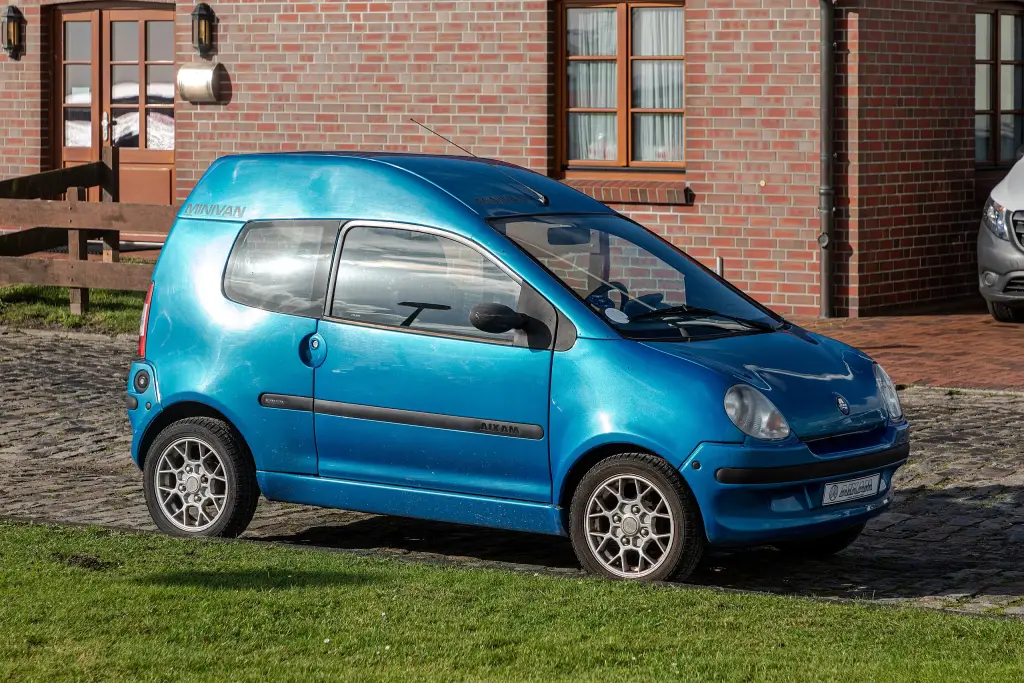

Aixam-Mega is a French maker of light quadricycles based in Aix-les-Bains in Savoie. Since 1983 the firm has built voitures sans permis — cars that in France and several other European countries can be driven without a full driving licence — under the Aixam name, and its former models range from the 400 and 500 of the 1980s to the A.721, A.741, Scouty and Crossline.
Aixam at a glance
| Maker | Aixam-Mega, Aix-les-Bains, Savoie, France |
|---|---|
| Founded | 1983, from Arola (1975) |
| Class | light quadricycle L6e, heavy quadricycle L7e |
| Restricted speed | 45 km/h for the licence-free versions |
| Diesel engine | Kubota Z402, 400 cc two-cylinder, 4–6 kW (5–8 PS) |
| Petrol engine | Lombardini 505 cc twin, about 20 PS (15 kW) |
| Transmission | CVT by CVTech-IBC; 8:1 reversing unit by COMEX |
| Body | ABS panels on an aluminium structure |
| A.721 size | 2,674 mm long, 1,474 mm wide, 1,737 mm wheelbase, 350 kg |
| A.741 size | 2,897 mm long, 1,960 mm wheelbase |
| Range in 2007 | A.721, A.741, A.751, Scouty |
| Production | about 19,000 vehicles in 2023 |
No Wikipedia article covers an individual Aixam model, so this page is built from the brand articles in English, French, Italian and German. The older records for the 400, 500, 500-4, A.721, A.741, MAC, Crossline and Scouty now redirect here.
History of the Aixam
From Arola to Aixam
The company traces its history to Arola, founded in 1975 to build tricycles and quadricycles that could be driven without a licence; the first vehicle was a handlebar-steered tricycle without doors. A group of investors bought Arola out of administration in 1983 and the present firm was founded under the name Aixam, a contraction of Aix-les-Bains and Automobile. According to Philippe Colançon, the long-serving president, the “AM” reading was added afterwards: the name was chosen above all to begin with an “A” and so come first in the alphabetical catalogues of the time. Aixam has remained at Aix-les-Bains ever since.
Arola’s vehicles had been held back by the old rule that limited voiturettes to 50 cc petrol engines, which left them underpowered and unreliable. In the 1980s the founders went to the transport ministry and obtained a derogation allowing diesel engines, and that decision opened the way for the market as a whole. In 1984 Aixam launched the 325 D, followed in 1985 by the 400 D and by its first TQM, capable of 75 km/h. By 1987 the marque led the French market and was building about 4,000 vehicles a year.
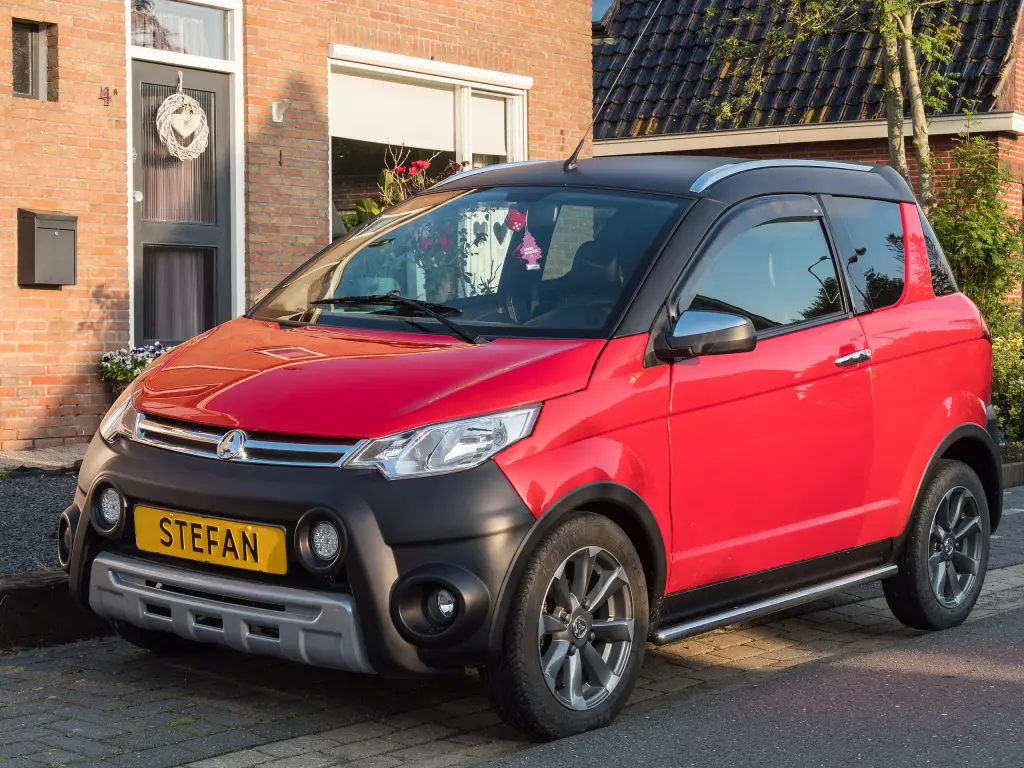
The 400 and 500
The 400 and 500 were very basic machines by later standards, and several engines were offered over the years. The diesel was Kubota’s Z402, a two-cylinder industrial unit of 400 cc rated at 4 to 6 kW (5 to 8 PS); petrol cars used a Lombardini twin of 505 cc and about 20 PS, and later petrol versions were fitted with fuel injection. Steering was by rack and pinion with a comparatively low ratio, the front suspension used MacPherson struts and the rear semi-trailing arms, and the brakes were discs with single-piston calipers in front and drums behind, the latter also working as the handbrake through cables. Drive went through a continuously variable transmission supplied by CVTech-IBC and a combined reversing gearbox and differential of 8:1 from the Italian firm COMEX, built for a town runabout of under 8 PS and limited to about 30 mph.
The A.7xx series
For years the range was built around the A.7xx models, in which the two digits were simply a number. Until 2007 Aixam catalogued four of them: the A.721, the A.741, the A.751 and the Scouty. All used Kubota engines, and the smaller versions had a 400 cc diesel of 5.4 CV (4 kW), the maximum allowed for the class that fourteen-year-olds may drive. The body panels were moulded in ABS and mounted on an aluminium structure.
The A.721 was front-wheel drive with a gear lever having only three positions — forward, neutral and reverse. It measured 2,674 mm long and 1,474 mm wide on a wheelbase of 1,737 mm, weighed 350 kg empty, carried 16 litres of fuel and used 3.5 litres per 100 km, with performance limited by law to 45 km/h. It came in coral red, light grey, ocean blue and dark grey, in Pack, Luxe and Super Luxe trim at roughly €9,000 to €11,000. The A.741 was the longer car at 2,897 mm on a 1,960 mm wheelbase, painted all over rather than with the light grey windscreen pillars of the A.721, and cost a little over €10,000 to more than €12,000. The A.751 could only be driven from sixteen, its engine being equivalent to 125 cc. The Scouty shared the A.721’s dimensions but had a removable roof and became a cabriolet, offered in bright two-tone schemes.
City, Roadline and Crossline
In 2008, for the company’s 25th anniversary, the range was modernised and renamed: the catalogue listed the City, Roadline, Crossline and Scouty R. A second revision in 2010 brought the Crossover, GTO, City Impulsion and City S alongside the Crossline. The “Vision” design of 2013 reorganised the line again into the City, in Pack, S and Premium trim, the Coupé in S, Premium and GTI, the Crossover with a 400 cc diesel, a 599 cc GT diesel or a 505 cc GTR petrol engine, and the Crossline in Pack and Luxe, the one model that did not receive the restyling.
Aixam today
The Mega brand, founded in 1992 for standard-sized cars and later applied to diesel and electric microvans, remains part of the group, and the Mega e-Scouty of 2022 revived a familiar name as an electric vehicle. Polaris Industries of the United States acquired Aixam-Mega in April 2013. Production rose by nearly 70 per cent from 2020 to about 19,000 vehicles in 2023, and in September 2024 a third factory was opened at Andancette in the Drôme, a 17,400 m² plant able to build up to 30,000 vehicles a year. In April 2026 the Easy range replaced the Minauto series, and in Germany Aixam leads the light-car market ahead of Microcar and Ligier.
Design and features
- Licence-free driving: the restricted models are limited to 45 km/h and classed as L6e quadricycles, drivable from fourteen in France and Italy with an AM licence.
- Kubota diesel: a 400 cc two-cylinder industrial engine of 4 to 6 kW, with a 505 cc Lombardini petrol twin as the alternative.
- ABS body on aluminium: plastic panels over an aluminium structure kept the A.721 down to 350 kg.
- Simple transmission: a CVT with a three-position lever — forward, neutral, reverse.
- Small dimensions: 2,674 mm long on the A.721 and 2,897 mm on the A.741.
Aixam versions
- 400 and 500 (1980s): the basic diesel microcars that established the marque.
- A.721: the short front-wheel-drive model with a three-position gear lever.
- A.741: the longer, fully painted version.
- A.751: a more powerful model for drivers from sixteen.
- Scouty: the cabriolet with a removable roof, later renamed Scouty R.
- Crossline (2008–2013): part of the renamed range and the only model left without the Vision restyling.
More microcars are in the Aixam collection.
Video: Aixam Scouty R
Video on YouTube.
Sources
- Aixam, English Wikipedia: history, engines, mechanics
- Aixam, French Wikipedia: founding, diesel derogation, name
- Aixam, Italian Wikipedia: A.721, A.741, A.751 and Scouty details
- Aixam, German Wikipedia: market position, Mega and e-City