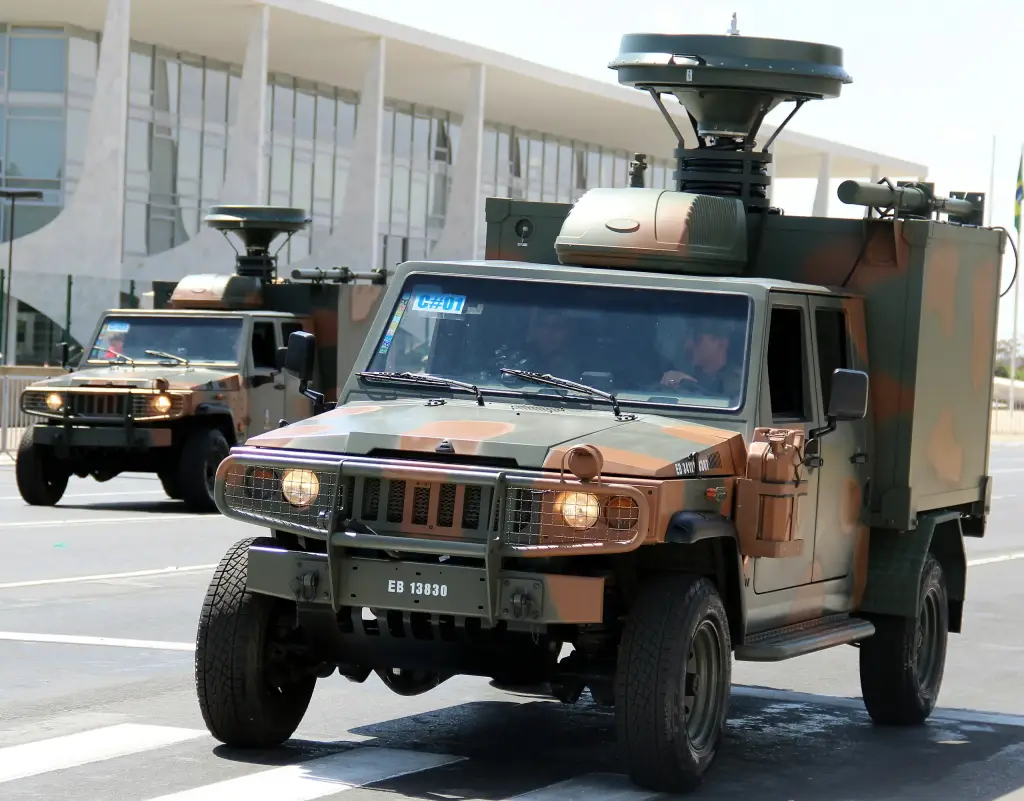

The Agrale Marruá (“Wild Bull”) is a family of four-by-four transport and utility vehicles built by Agrale in Caxias do Sul, Rio Grande do Sul, Brazil. Developed in the early 2000s as a replacement for ageing jeeps in Brazilian service, it has since been adopted by several South American armies and used on United Nations peacekeeping missions in Haiti.
Agrale Marruá at a glance
| Maker | Agrale, Caxias do Sul, Brazil |
|---|---|
| Name | Marruá, Portuguese for “wild bull” |
| In service since | 27 July 2005 |
| Developed from | Engesa EE-4/EE-12 |
| Body styles | two-door and four-door utility, pickup, chassis cab, ambulance |
| Engine (military) | MWM 4.07TCA Sprint-EII 2.8-litre turbodiesel, 132 hp |
| Engine (civil) | Cummins ISF 2.8 turbodiesel, Euro V |
| Transmission | Eaton FS 2305, five speeds |
| Length | 3.8 m |
| Weight in running order | 1,960 kg |
| Payload | 500 kg, plus a 500 kg trailer |
| Maximum speed | 128 km/h |
Based on one source, the English Wikipedia article on the Marruá.
History of the Agrale Marruá
The story of the Marruá begins with another Brazilian company. When Engesa went bankrupt in early 1990, former employees acquired the rights to its EE-4/EE-12 utility vehicle and, working with Agrale, developed an improved version between 2003 and 2005. The aim was to meet a Brazilian armed forces specification for a half-ton 4×4 VTNE — Viatura de Transporte Não Especializada, a non-specialised transport vehicle — to replace the Jeeps then in service. Agrale invested $11 million in the project and built three prototypes for army trials; the Marruá was accepted for Brazilian service on 27 July 2005.
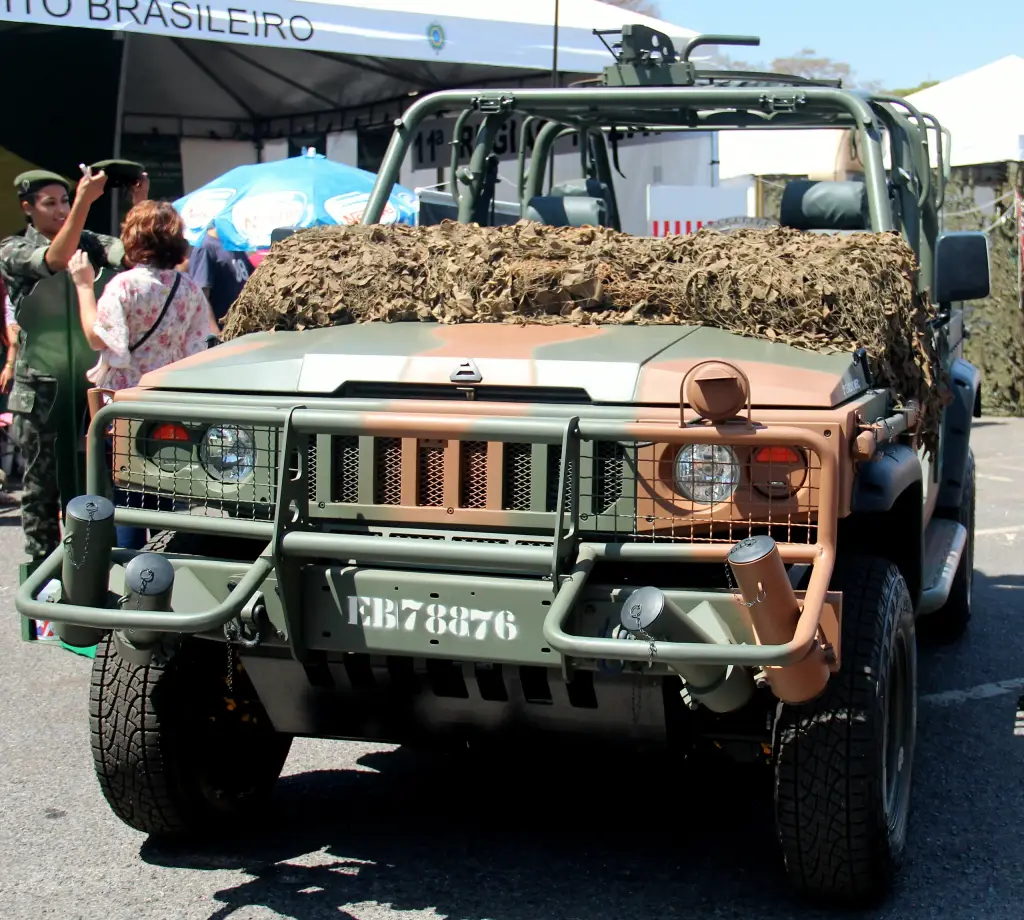

The vehicle was designed to be versatile, robust and easy to maintain. During development it covered more than 60,000 miles (97,000 km) of testing. In its basic form it carries four fully equipped soldiers, and it can also be fitted to take anti-tank missile launchers, recoilless rifles, machine guns or communications equipment.
The Marruá entered service with the Brazilian Army and Marine Corps and was acquired by the armies of Ecuador and Argentina; Argentina used eighteen vehicles with the United Nations peacekeeping mission in Haiti from 2009. Over the years the family has grown into a wide range of military and civil models, and the name is still used for the civil pickups sold in Brazil.
Design and features
- Military and civil families: one platform serves as a troop carrier, ambulance, command vehicle, pickup and chassis cab.
- Simple mechanical layout: a ladder chassis, part-time four-wheel drive and a five-speed Eaton gearbox, chosen for easy field maintenance.
- Go-anywhere geometry: 0.26 m of ground clearance, a 64° approach angle and a 60% maximum incline.
- Long range: a 100-litre tank gives about 1,000 km on the road.

Agrale Marruá versions
- AM2 VTNE ½ ton: the base four-person, two-door vehicle with a removable roof.
- AM11: a five-person, four-door vehicle with a removable roof, also built as the AM11 REC and VTL REC.
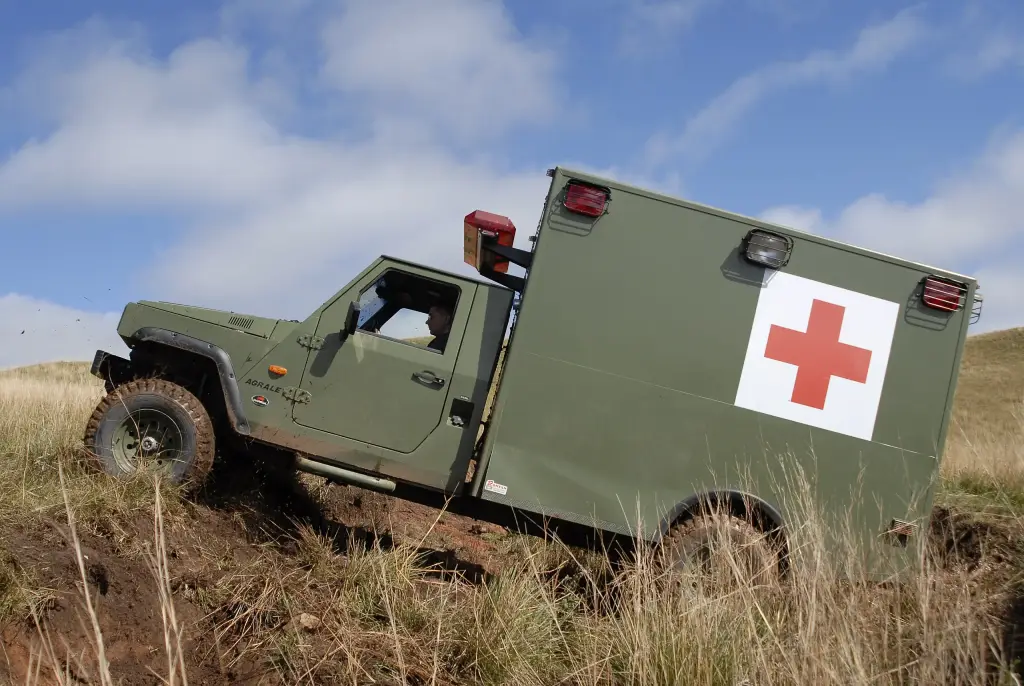
- AM20 and AM21: command and control vehicles and ambulances, single or with intensive-care equipment.
- AM23 and AM31: three-quarter-ton and 1½-ton pickups; the AM41 is a 2½-ton cab-over tactical truck.
- AM200 G2 and AM300 G2: civil single-cab and double-cab pickups and a chassis cab with Cummins engines.
- Bortana EV: an electric version built by the Australian company Safescape for underground mines, with a 160 kW motor and a two-ton payload.
The Marruá is Agrale’s best-known vehicle; more Brazilian and South American machinery is in the Agrale collection.
Sources
- Agrale Marruá, English Wikipedia: history, models, dimensions, performance