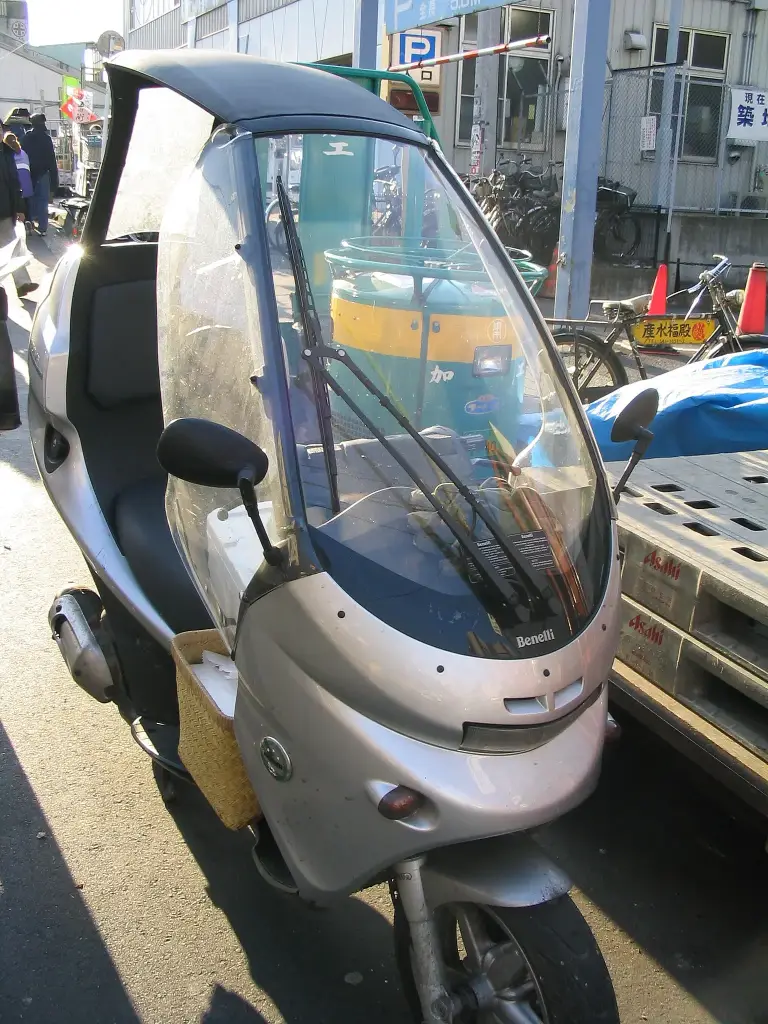

The Adiva was the first scooter built by the joint venture of Benelli and Adiva SRL. Its party piece was a folding metal roof that offered weather protection without turning the scooter into a car: the roof could be folded away in seconds and stowed in the rear box.
Adiva AD at a glance
| Maker | Benelli and Adiva SRL joint venture; Adiva corporation founded 31 July 1996 |
|---|---|
| First shown | 1999 |
| Sold | 2001–2006 |
| Built at | Benelli works, Pesaro, Italy |
| Engine | Piaggio Leader single-cylinder, 125 or 150 cc |
| Power | 8 kW (10.9 hp) or 9 kW (12 hp) at 7,500 rpm |
| Top speed | about 98 km/h (60 mph) |
| Roof | folding metal roof, stowed in an 80-litre rear box |
| Brakes | 220 mm discs front and rear |
| Weight | 135 kg dry |
| Also sold as | Renault Fulltime |
| Successor | Adiva AD250, from 2007, with 200 or 250 cc |
The original records also covered the AD250 and 125 versions, which are described here as part of the same roofed-scooter line.
History of the Adiva AD
Adiva corporation was founded on 31 July 1996 with the aim of developing a new generation of vehicles for city mobility, based on the ideas of entrepreneur Nicola Pozio. Its central idea was the Modular Protection System, a metal roof that folded into the rear storage box and, together with the windscreen and side wind deflectors, protected rider and passenger from the weather. The first Adiva concept scooter was shown to the Italian public in 1999 and engineered by Ugolini Global Design, while the international patent on the folding roof was granted only in 2004.
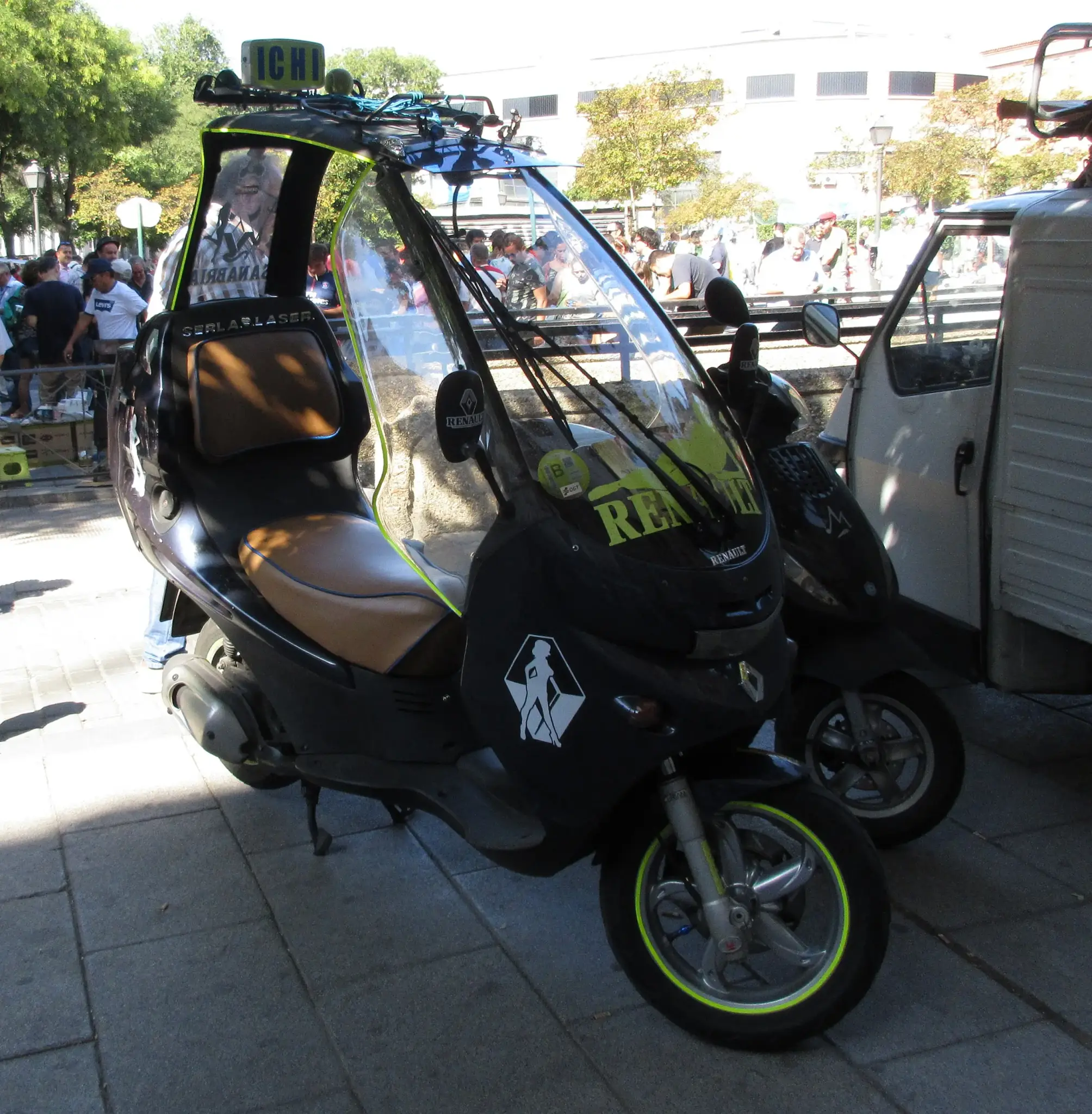

The production Adiva was launched at the Milan motorcycle show in 2000 and built from December of that year at Benelli’s works in Pesaro, sold through Benelli’s dealer network. It went on sale to the public in 2001 and remained available until 2006. The scooter used largely conventional running gear: a Piaggio Leader engine of 125 or 150 cc, telescopic Ceriani forks with 33 mm stanchions, a rear engine-and-auxiliary-arm suspension with twin shock absorbers, and 220 mm disc brakes at both ends. The two engine versions shared identical bodywork.
The roof was the point of difference. It brought real weather protection and, unlike the similar-looking BMW C1, was not a safety cell, so helmets remained compulsory. When not needed it could be folded in about ten seconds and stored in the 80-litre top box. The Adiva was also regarded as having better handling than the C1. Through badge engineering the same vehicle was sold by Renault as the Renault Fulltime.
Production ended in 2006. From 2007 the concept continued under the Adiva brand alone, without Benelli support, as the Adiva AD250 with a 200 or 250 cc engine — the second generation that the company had begun developing in 2002.
Design and features
- Folding metal roof: weather protection that stows in the rear box in about ten seconds.
- Windscreen with wiper: part of the Modular Protection System, with side wind deflectors.
- Piaggio Leader engines: proven 125 and 150 cc units shared with the Vespa.
- Conventional chassis: telescopic forks, twin rear shock absorbers and disc brakes at both ends.
- Badge-engineered twin: sold by Renault as the Fulltime.
Adiva AD versions
- Adiva 125: 8 kW (10.9 hp), the smaller of the two original versions.
- Adiva 150: 9 kW (12 hp), identical bodywork to the 125.
- Renault Fulltime: the same scooter sold through Renault’s network.
- Adiva AD250: the 2007 successor built under the Adiva name with a 200 or 250 cc engine.
More scooters and motorcycles are in the Adiva collection.
Video: Test of the later Adiva AD3 300 roofed scooter
Video on YouTube.
Sources
- Benelli Adiva, English Wikipedia: history, roof, production years, Renault Fulltime
- Benelli Adiva, Italian Wikipedia: company history, Pesaro production, chassis, AD250 successor
- Benelli Adiva, German Wikipedia: technical data, engines, dimensions