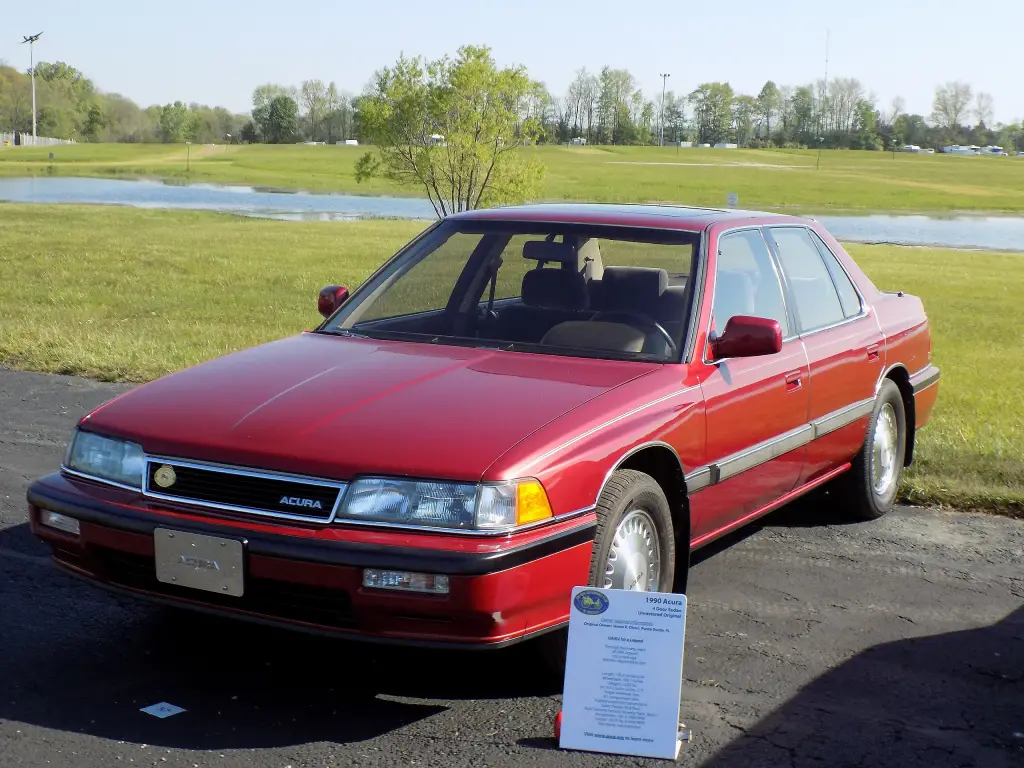
The Acura Legend was a mid-size luxury car sold in the United States and Canada from 1985 to 1995. It was the first flagship of Honda’s Acura brand, and in 1996 it was renamed the Acura 3.5RL, the North American version of the Honda Legend.
Acura Legend at a glance
| Maker | Acura (Honda), Japan |
|---|---|
| Production | 1985–1995 (1986–1995 model years) |
| Class | mid-size luxury car |
| First generation | 1986–1990 |
| Sedan engine | 2.5 L C25A V6, 151 hp |
| Coupe engine | 2.7 L C27A V6, 161 hp |
| Gearbox | four-speed automatic or five-speed manual |
| Developed with | Austin Rover Group, Project XX |
| Related | Rover 800 / Sterling |
| Successor | Acura 3.5RL (1996) |
History of the Acura Legend
The Legend was born of the 1980s voluntary export restraints, which limited how many mainstream cars Japanese makers could sell in the United States and pushed them towards more expensive models. Honda introduced the car in Japan on 22 October 1985 as its premier luxury model, and in North America for the 1986 model year as the top of its new Acura range. Its success against established European and American luxury makers led Toyota and Nissan to create Lexus and Infiniti respectively.
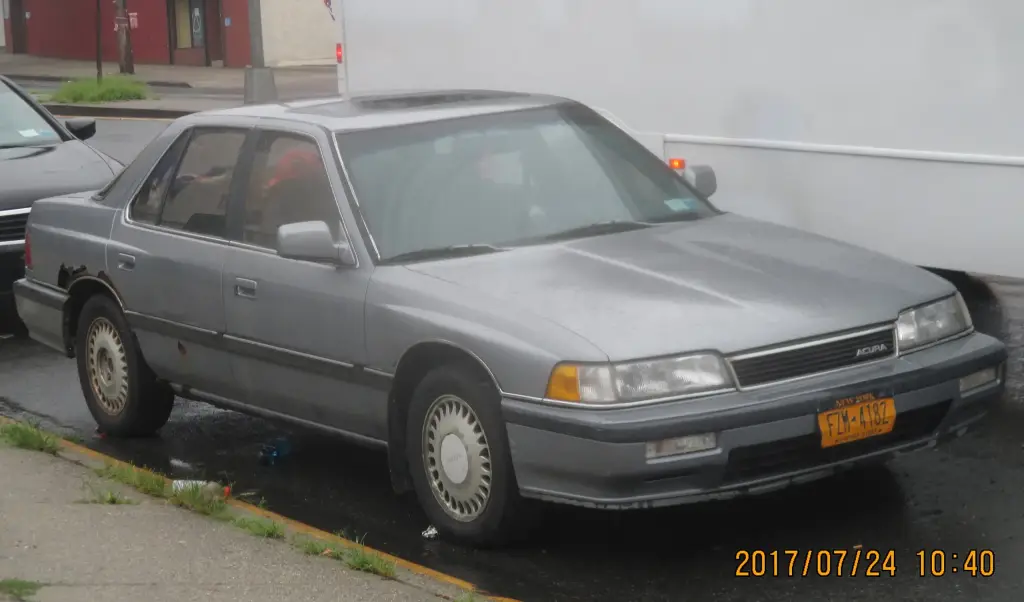
The Legend was developed with Britain’s Austin Rover Group under the name Project XX, which began in November 1981 with a letter of intent to replace the Rover SD1 and give Honda a luxury car. The British counterpart was the Rover 800, sold in the United States as the Sterling. The Legend was the first production Honda to offer a V6 engine. Sedans came first with a 151 hp 2.5-litre C25A V6; coupes arrived in 1987 with a 161 hp 2.7-litre C27A, and sedans received the new engine for 1988.
At launch the Legend was offered with a single trim level and one factory option, the choice of transmission. The 1986 brochure called it the “Legend Touring Sedan”. It had a Technics 80-watt four-speaker cassette stereo with four programmable equaliser settings and a dual-diversity antenna, with a conventional power antenna and one embedded in the rear window, and volume and station controls on the instrument binnacle within reach of the driver’s right hand. North American cars did without some Japanese-market items such as one-touch climate control, and leather was not offered at first.
The Legend won Car and Driver’s Ten Best three years in a row and Motor Trend’s Import Car of the Year for 1987. Manual cars could reach 60 mph in under eight seconds and a top speed of 135 mph, and the body achieved a drag coefficient of 0.32 for the sedan and 0.30 for the coupe. For 1989 the sedan received one-piece headlamps, a revised bumper, boot lid and tail lights, a double-wishbone rear suspension and a new alloy wheel design; anti-lock brakes and a driver’s airbag became standard. The 1987 Legend LS coupe had been the first Japanese car with a driver’s side airbag. For 1990 all Legends had body-coloured mirrors, coupes gained a revised grille and red-and-clear tail lights, and LS models had burlwood trim, a trip computer, a monitoring system and Bose audio. Production of the first generation ended in 1990 ahead of the 1991 second generation.
Design and features
- Honda’s first V6: a 2.5-litre unit in the sedan, 2.7 litres in the coupe.
- Project XX: developed alongside the Rover 800 and Sterling.
- Safety first: the 1987 LS coupe was the first Japanese car with a driver’s airbag.
- Award winner: three Car and Driver Ten Best awards and Motor Trend Import Car of the Year 1987.
Acura Legend versions
- Sedan (1986–1990): 2.5-litre V6, later the 2.7-litre engine.
- Coupe (1987–1990): 2.7-litre V6 and a lower drag coefficient.
- LS (from 1989): trip computer, vehicle monitoring system and Bose stereo.
- 1990 models: body-coloured mirrors, revised coupe grille and tail lights, burlwood trim.
The Legend sat above the Acura Vigor and was replaced by the Acura 3.5RL in 1996. More cars are in the Acura collection.
Video: Acura Legend HD
Video on YouTube.
Sources
- Acura Legend, English Wikipedia: history, Project XX, engines, equipment, updates