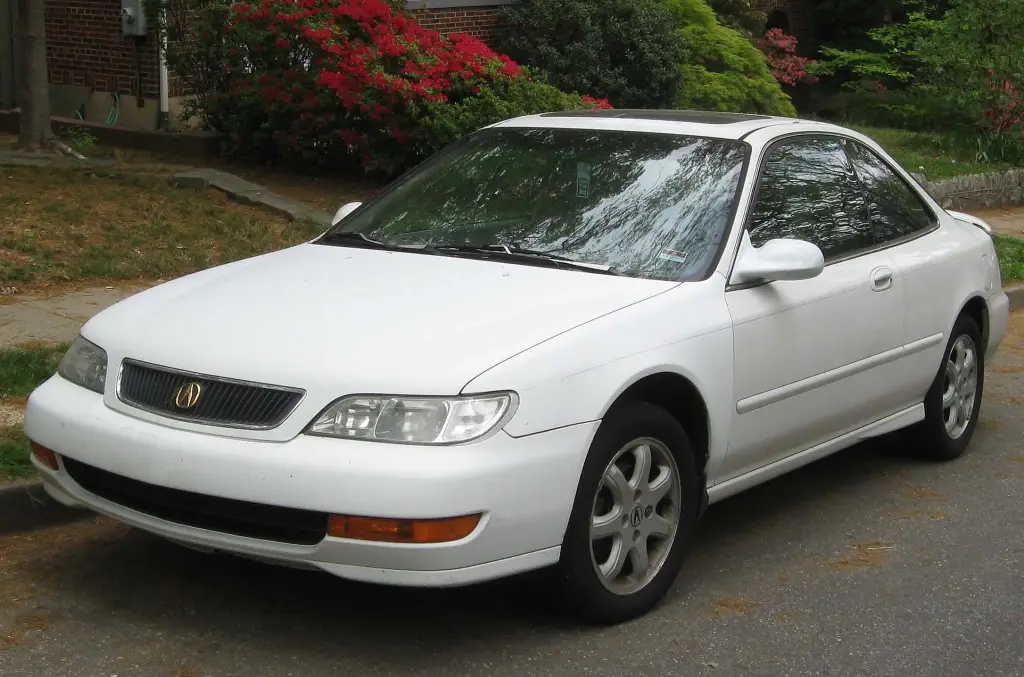
The Acura CL was a mid-size, four-passenger coupe built by Honda’s luxury division in two generations between the 1997 and 2003 model years. It shared its platform with the Acura TL and the Honda Accord, and the first generation was the first Acura assembled in the United States.
Acura CL at a glance
| Maker | Acura (Honda), United States |
|---|---|
| Production | 1996–2003 (1997–2003 model years) |
| Body | two-door, four-seat coupe |
| First generation | 1997–1999, East Liberty, Ohio |
| Second generation | 2001–2003, Marysville, Ohio |
| Engines | 2.2 L I4 145 hp; 2.3 L I4 150 hp; 3.0 L V6 200 hp; 3.2 L V6 225 hp; 3.2 L V6 Type-S 260 hp |
| Gearboxes | five-speed manual (four-cylinder), automatic, six-speed manual (Type-S from 2003) |
| Concept | CL-X, 1995 Detroit auto show |
| Related | Acura TL, Honda Accord |
| Successor | none |
The article is based on one source, the English Wikipedia article on the Acura CL.
History of the Acura CL
The CL was previewed by the CL-X concept car shown at the 1995 North American International Auto Show in Detroit. Designed at Honda’s R&D studio in Los Angeles, the concept was a two-door coupe with a 106.9-inch (272 cm) wheelbase and a 63.2-inch track. It wore carbon-fibre and aluminium composite wheels, 18 inches at the front and 19 at the rear, and Acura quoted a top speed of 140 mph.
Production began in February 1996 for the 1997 model year at Honda’s East Liberty, Ohio plant, alongside the Civic, making the CL the first Acura built in the United States. The 3.0CL used a 3.0-litre J30A1 V6 with 200 hp, while the 2.2CL had a 2.2-litre F22B1 four-cylinder with 145 hp; for 1998 the four-cylinder grew to 2.3 litres and 150 hp. A Premium trim added leather upholstery, heated front seats in the V6 and an Acura/Bose stereo, and from 1999 leather became standard across the range. Four-cylinder cars could be ordered with a five-speed manual gearbox, and all CLs used galvanised body panels.
The second generation arrived in March 2000 as a 2001 model, now built at Marysville, Ohio. It was powered by a 3.2-litre SOHC VTEC J-series V6, with 225 hp in the standard car and 260 hp in the Type-S, which also brought 17-inch wheels, firmer suspension, larger brakes and firmer seats. At the time the Type-S was the most powerful front-wheel-drive car Honda had built. A navigation system was optional, but there was no manual gearbox at launch, a frequent criticism.
In 2002 Acura added a close-ratio six-speed manual with a helical limited-slip differential for the 2003 Type-S. The manual cars lost some minor equipment, including the console light and one of the two heated-seat settings, and went without VSA and TCS, using a three-channel ABS unit instead. Only 3,514 were built for the United States (2,690 without navigation, 824 with) plus 331 for Canada. The 2003 model also received body-coloured grille and door handles, redesigned mirrors, blacked-out headlights and new tail lamps. With the TL due for a 2004 redesign, the CL was dropped without a replacement; sales from 2000 to 2003 totalled fewer than 31,000.
Design and features
- Two generations, two plants: East Liberty built the first-generation car, Marysville the second.
- V6 power: 200 hp from 3.0 litres at launch, 260 hp in the Type-S.
- Six-speed Type-S: close ratios, a helical limited-slip differential and 3,514 cars for the US market.
- Concept origins: the 1995 CL-X previewed the production car’s shape and coupe body.
Acura CL versions
- 2.2CL and 2.3CL (1997–1999): four-cylinder models with 145 or 150 hp and an optional five-speed manual.
- 3.0CL (1997–1999): 200 hp V6, Premium trim with leather and Bose audio.
- 3.2 CL (2001–2003): 225 hp V6, automatic only.
- 3.2 CL Type-S (2001–2003): 260 hp, firmer chassis, six-speed manual available from 2003.
The CL shared its platform with the Acura TL and sat in the range below the RL saloon. More cars are in the Acura collection.
Video: 1998 Acura CL 3.0 Premium Start Up, Exhaust, and In Depth Tour
Video on YouTube.
Sources
- Acura CL, English Wikipedia: history, engines, trims, production numbers